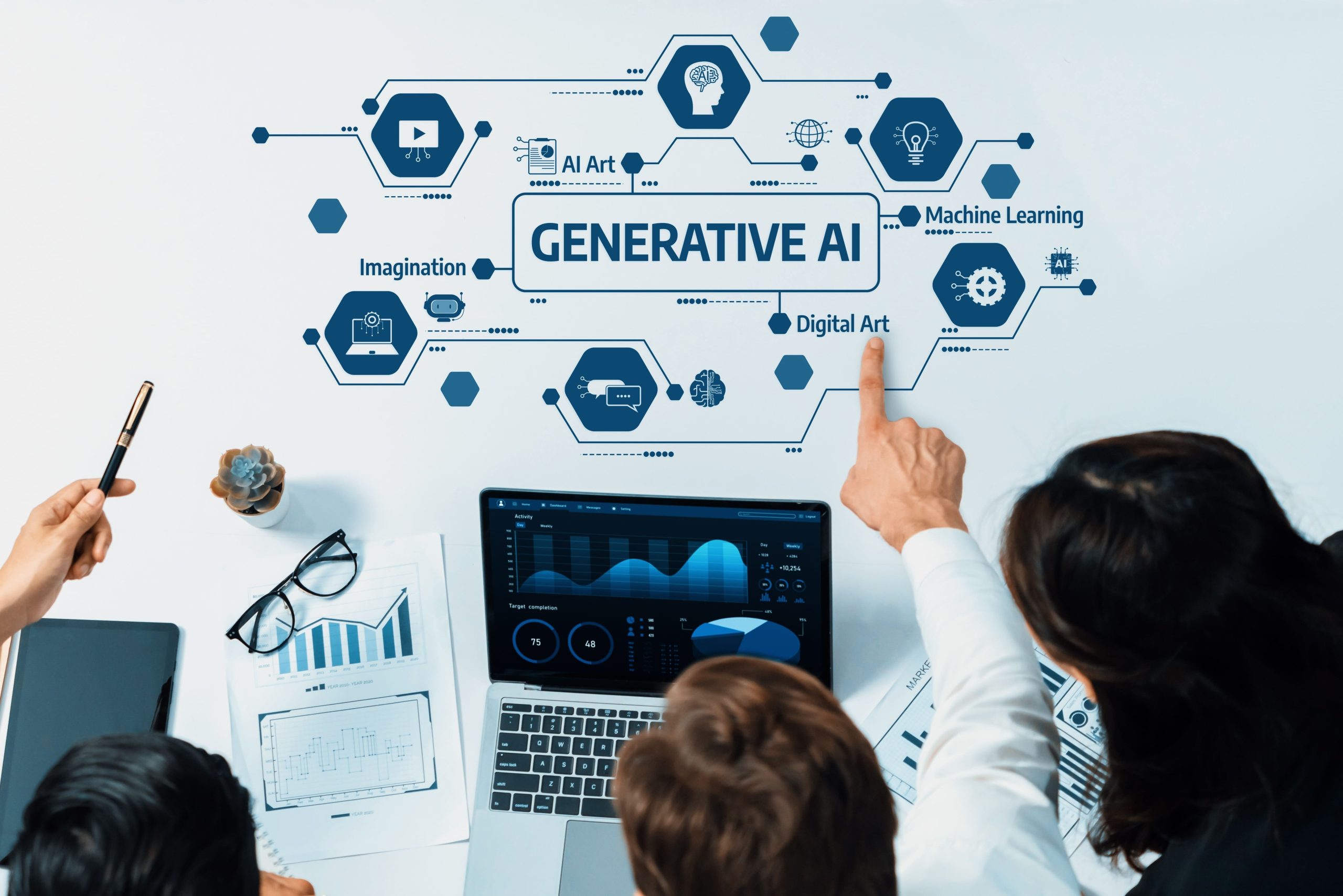

What Generative AI Can Be Used For Across a Business
Summarise this blog




Key Takeaways
- Generative AI is a class of model that creates new outputs (text, images, code, audio, video) based on patterns it has learned from training data, rather than only classifying or predicting against existing data.
- Adoption has crossed the experimentation line. McKinsey’s 2025 survey found 88 percent of organisations now use AI in at least one business function, with 71 percent regularly using generative AI specifically.
- The highest-value business uses sit in marketing and content production, customer operations, software engineering, knowledge management, and product or service development.
- The 2026 shift is toward agentic AI, systems that plan and execute multi-step workflows rather than waiting for a prompt at every turn.
- Real outcomes depend more on workflow redesign and clean data than on the model itself. Most pilots stall when teams bolt AI onto broken processes.
Generative AI has moved out of the demo reel and into the day job. If you sit on a marketing, operations or product team in 2026, whether you should use it isn’t so much the question anymore as it is where it earns its keep, where it doesn’t, and what to give it next.
We’ll walk you through what generative AI is, how generative AI works behind the scenes, and what generative AI can be used for across the kinds of teams Malaysian brands actually run.
Table of Contents
What Generative AI Is (And Where It Came From)
Generative AI is a class of artificial intelligence that produces new content (text, images, audio, video, code, even synthetic data) based on patterns it has learned from a training corpus. The key distinction here is creation versus classification: older AI systems sorted, scored, or predicted based on existing data. But now, with generative models, they build something that wasn’t there a moment ago.
The category went mainstream after the launch of ChatGPT in late 2022, but the underlying research is older. Transformer architecture, the engine behind today’s large language models, was first published by Google researchers in 2017. Image generation, video generation and multimodal models followed in waves.
In 2026, multimodal AI (handling text, image, audio, and video in the same model) is very much the norm rather than the exception.
How Generative AI Works in Practice
At a simplified level, here’s how generative AI works. A model is trained on enormous volumes of data. During training, it learns the statistical relationships between tokens, whether those tokens are words, pixels, audio samples or code symbols. Once trained, the model can generate new outputs by predicting what comes next, token by token, given the prompt and context you supply.
Three things shape how useful that output is for your business:
- The model itself. Bigger and newer isn’t always better. Specialised models often outperform general ones on narrow tasks.
- The context you feed it. Brand guidelines, past campaigns, product data, customer scripts. The richer and cleaner this context, the more aligned the output.
- The workflow around it. A model on its own is a writing partner. A model wired into your CRM, knowledge base and approval flow is an operating asset.
What Generative AI Can Be Used For in a Business

So, what can generative AI be used for day to day? McKinsey’s most recent State of AI survey points to a few clear winners: marketing, customer operations, software engineering, and product or service development. These are the functions where the gap between human-only output and AI-assisted output is widest, and where the feedback loop is short enough to learn quickly.
Here are six business uses worth highlighting:
- Marketing and content production. Drafting campaign copy, generating creative variations for testing, repurposing long-form content into short-form, producing first-cut visuals and video frames, and adapting content into multiple languages for the Malaysian market.
- Customer service. Conversational assistants that handle routine queries, summarise previous tickets for human agents, and draft replies in the agent’s voice. Implementations now achieve accuracy levels well above those of older retrieval-based systems.
- Commercial enablement. Auto-generating call summaries, building proposal drafts from CRM data, prepping account briefs before a meeting and personalising outreach at scale.
- Software engineering. Code generation, pull request reviews, test writing, incident triage and documentation drafting. OpenAI now reports that its own internal teams use coding agents on roughly 80 percent of their work.
- Knowledge management. Turning scattered documentation, recordings and internal wikis into a searchable, conversational layer that the whole company can query without hunting through folders.
- Synthetic data and research. Generating realistic test datasets, simulating customer scenarios, and producing variants for analytics models where real data is scarce or sensitive.
The Shift to Agentic AI in 2026
The headline change this year is not a new model, but a new operating mode. Agentic AI builds on generative capability by adding planning, tool use, and execution, so a system can complete multi-step tasks with a human reviewing the results rather than initiating every step. Think of an agent that plans a campaign, drafts the assets, schedules the posts and hands you a performance summary.
McKinsey’s November 2025 State of AI report found 23 percent of organisations are already scaling agentic AI in at least one business function, and another 39 percent are running active experiments. Google’s own use case directory, refreshed in April 2026, has crossed several hundred named enterprise deployments.
In other words, the direction of travel is clear, even if your own team hasn’t started yet.
Where Most Generative AI Projects Fall Short
The hard truth is that adoption is high, but value capture is low. The same McKinsey report flagged that only a small share of organisations attribute meaningful EBIT impact to AI. The pattern repeats: pilots launch, dashboards light up, then the project plateaus.
What’s important to know is that the teams pulling ahead are running better workflows instead of using better tools. Three habits show up consistently:
- They redesign the process around the model rather than bolting it on.
- They invest in clean, accessible first-party data so the model has something useful to work with.
- They put senior leaders close to the rollout, not five layers away from it.
Bringing Generative AI Into Your Marketing Plan
Generative AI has become a boon to many marketing leaders, making it a tool that every team should get on top of. If you’re in the same space without an in-house AI team, the quickest path to outcomes is to partner with an agency that already runs generative AI within its delivery workflow. Search visibility is one of the clearest places to start, given how much of brand discovery now runs through AI answer engines alongside classic Google results.
Here at Primal, we are an SEO agency in Malaysia that helps brands across the Malaysian market apply generative AI to content production, search visibility and customer experience through our ElevateSEO approach. We combine human editorial judgement with model-driven execution in our approach for AI SEO in Malaysia, so campaigns ship faster and rank stronger in both classic Search and AI Overviews.
Revolutionise the way you handle marketing with our AI SEO services, built around your brand’s data, audience and growth targets. Talk to our team today to make it happen.
References:
- McKinsey & Company – The State of AI in 2025: Agents, Innovation, and Transformation. Retrieved on 27 April 2026 from https://www.mckinsey.com/capabilities/quantumblack/our-insights/the-state-of-ai
- McKinsey & Company – The State of AI: How Organizations Are Rewiring to Capture Value. Retrieved on 27 April 2026 from https://www.mckinsey.com/capabilities/quantumblack/our-insights/the-state-of-ai-how-organizations-are-rewiring-to-capture-value
- Google Cloud Blog – Real-World Generative AI Use Cases From the World’s Leading Organizations. Retrieved on 27 April 2026 from https://cloud.google.com/transform/101-real-world-generative-ai-use-cases-from-industry-leaders
- Google Research – Attention Is All You Need (Transformer Paper, 2017). Retrieved on 27 April 2026 from https://research.google/pubs/attention-is-all-you-need/
Frequently Asked Questions About Generative AI
What is generative AI in simple terms?
Generative AI is a type of artificial intelligence that creates new content (text, images, audio, video, code or synthetic data) based on patterns it has learned from training data. Unlike older AI systems that classify or predict against existing data, generative models produce something new each time you prompt them.
How does generative AI work behind the scenes?
A generative model is trained on a large dataset, where it learns statistical relationships between tokens (words, pixels, audio samples or code). Once trained, it generates new outputs by predicting the next token in a sequence given the prompt and context you supply. The quality of the output depends on the model, the context you feed it and the workflow it sits inside.
Is generative AI worth investing in for a Malaysian brand right now?
Yes, if the rollout is paired with workflow redesign rather than treated as a tool drop-in. Brands seeing real outcomes start with a single high-value workflow, invest in clean first-party data and put senior leaders close to the rollout. Partnering with an experienced agency shortens the time from pilot to production.





Join the discussion - 0 Comment