



By Mark McDowellPosted: 10 min read
SEO Vs AEO Vs GEO And What Google Says About Each
Search engine optimisation (SEO) gets a page ranked in search results, answer engine optimisation (AEO) gets its words used as the direct answer, and generative engine optimisation (GEO) gets a brand mentioned or a page cited in AI answers from tools such as ChatGPT and Google AI Overviews. Google says its AI features rely on its core ranking systems, so SEO is the base for all three.
Key Takeaways
- Most AI answers skip the brand's own site. Across 16,543 AI answers about 12 brands in Elevate, Primal's AI Visibility Tracker, a brand's own website was typically cited in about a quarter of the answers about it, and much of the rest came from marketplaces, comparison sites, Facebook and government registers.
- Google needs no llms.txt or special markup. Google's guide to its generative AI features mentions AEO and GEO and says llms.txt files, chunked content and special schema markup are not needed for Google Search.
- Block GPTBot and still get cited. OpenAI's OAI-SearchBot decides whether a site can appear in ChatGPT search, while GPTBot only collects training data.
- GEO can be measured next to SEO. Search Console and Bing Webmaster Tools both report how often a site's pages appear in AI answers.
- Start with SEO. Then add plain answers, original facts and genuine mentions on other sites, and check a fixed list of buyer questions on each AI platform every month.
What SEO, AEO And GEO Mean
Search engine optimisation (SEO), answer engine optimisation (AEO) and generative engine optimisation (GEO) are three ways to be found when someone searches. SEO aims for a ranked link, AEO for the quoted answer and GEO for a mention or citation inside an AI answer. In the AI answers we see, a brand’s own website is only one source among many. So I run all three as one plan, with SEO as the base.
Over the last month, Elevate, Primal’s AI Visibility Tracker, logged 16,543 AI answers across 172 buyer questions about 12 brands in 12 industries. A brand’s own website was typically cited in about a quarter of the answers about it. A competitor’s site was cited about as often. Most other sources were sites where buyers compare and check. These included marketplaces, review sites, Facebook and government registers.
SEO is the work that gets a page crawled, indexed and ranked on Google or Bing. Success is a link that someone clicks.
AEO aims at the single answer shown above the results, or read out in place of them. On Google that started with featured snippets and the People Also Ask box. It now covers the summaries in AI Overviews too. Google’s systems choose which page to quote.
GEO aims at the answers AI tools write from several pages at once, in ChatGPT, Gemini, Perplexity, Microsoft Copilot and Google’s AI Mode. The name comes from a research paper by Pranjal Aggarwal and colleagues. It tested ways to raise a page’s chance of being cited in those answers. The authors found that what worked changed from one subject to the next.
The pages that rank for this search do not agree on where one term ends and the next begins. Some file AI Overviews under AEO, and some under both.
SEO Vs AEO Vs GEO Side By Side
The difference between SEO, AEO and GEO is where you appear and in what form. Most of the work behind the three is shared.
| SEO | AEO | GEO | |
|---|---|---|---|
| The goal | A ranked link that people click | Your words used as the answer | Your brand mentioned or your page cited in an AI answer |
| Where it appears | Google and Bing results | Featured snippets, People Also Ask, voice answers, AI Overviews | ChatGPT, Gemini, Perplexity, Copilot, AI Overviews, AI Mode |
| Who picks the page | The search engine’s ranking systems | The search engine’s systems | The AI tool, from the pages its own searches return |
| Work on your own pages | Technical health, one page per topic, internal links | A plain answer in the first lines under a question heading | Original facts and first-hand detail a reader can check |
| Work on other sites | Links from relevant sites | The same as SEO | Genuine reviews, directory listings, articles and forum posts |
| How you measure it | Search Console’s Performance report and rankings | Featured snippet and People Also Ask positions | AI citation reports in Search Console and Bing, plus a fixed list of buyer questions |
Every AI tool in the GEO column starts by searching. Google’s guide to its generative AI features says AI Overviews and AI Mode find pages in Google’s own index with its core ranking systems. They also run several related searches at once, which Google calls query fan-out, and write the answer from the pages they find. So a page that cannot rank has little chance of being quoted or cited.
In this video on my YouTube channel, I go through what changes between SEO and GEO when people search with AI tools.
What Primal Sees In The AI Answers
An AI answer about a brand draws on far more than the brand’s own website. It cites the places where buyers compare and check. That means much of GEO happens on other sites.
The chart below shows the share of a typical brand’s AI answers that cite its own website, against the share that rest on other sites. It covers the same 16,543 answers.
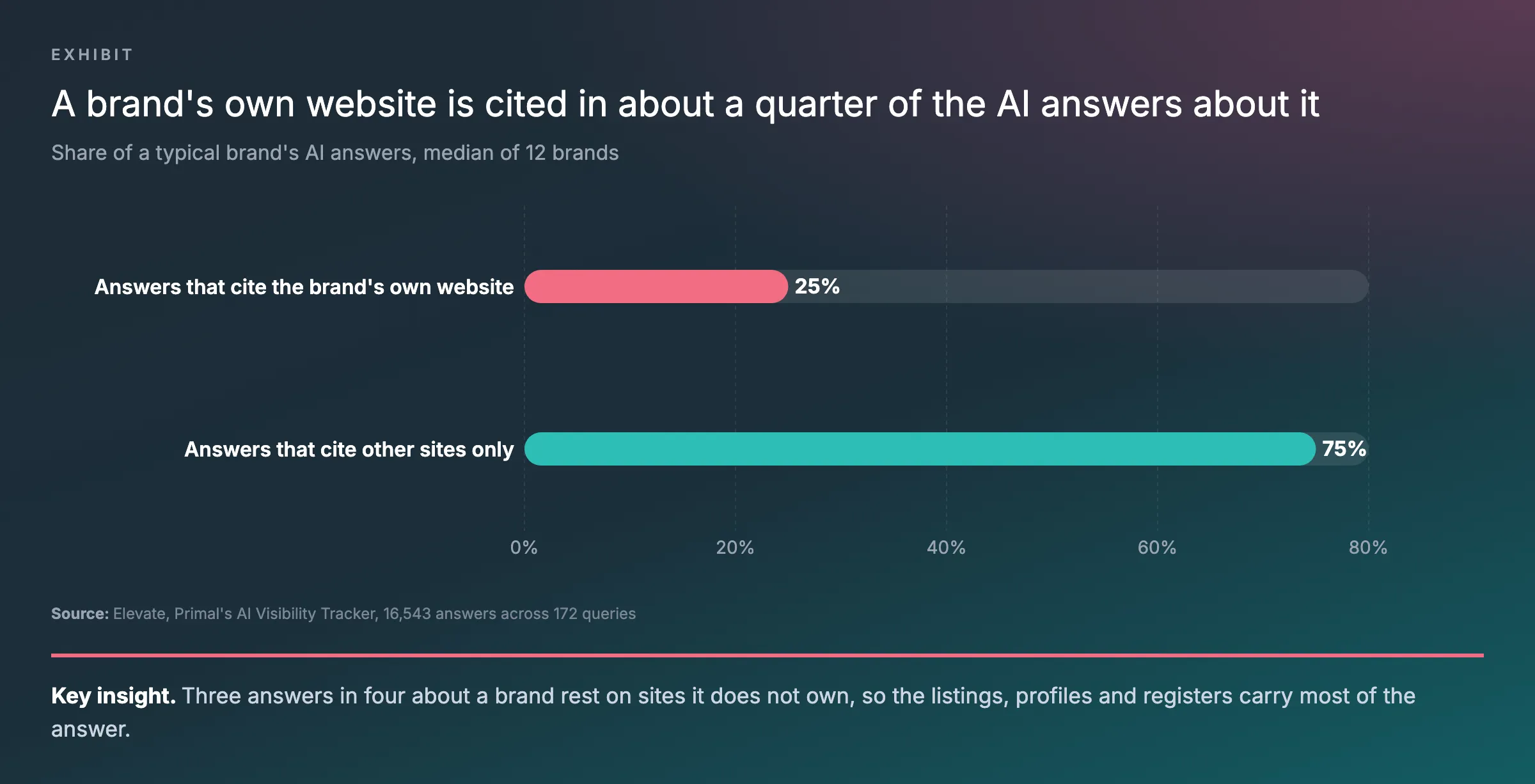
Every brand’s own site was cited, though typically in only about a quarter of the answers about it. Marketplaces and comparison sites appeared for 11 of the 12 brands. Facebook was the most-cited social site for 8. Google’s own Business Profile and Maps results were cited for 7, and government registers or regulators for 6.
General questions work another way. In a second dataset from Elevate, Primal’s AI Visibility Tracker, 3,693 answers across 66 queries, the answers to general SEO questions mentioned no agency and cited publishers and Google’s own pages. A general explainer is cited when it is the clearest page on its topic. It is also cited when it says something an AI tool cannot write.
What Google, Microsoft And OpenAI Say About AEO And GEO
Google says much of the advice that goes under the AEO and GEO labels is not needed for its search. Microsoft uses the GEO label for its own tools. OpenAI’s guidance is mostly about which crawler a site lets in.
Google’s guide mentions both terms. It says terms like AEO and GEO are common online. It also says many suggested “hacks” do not work, or are not supported by how Google Search works.
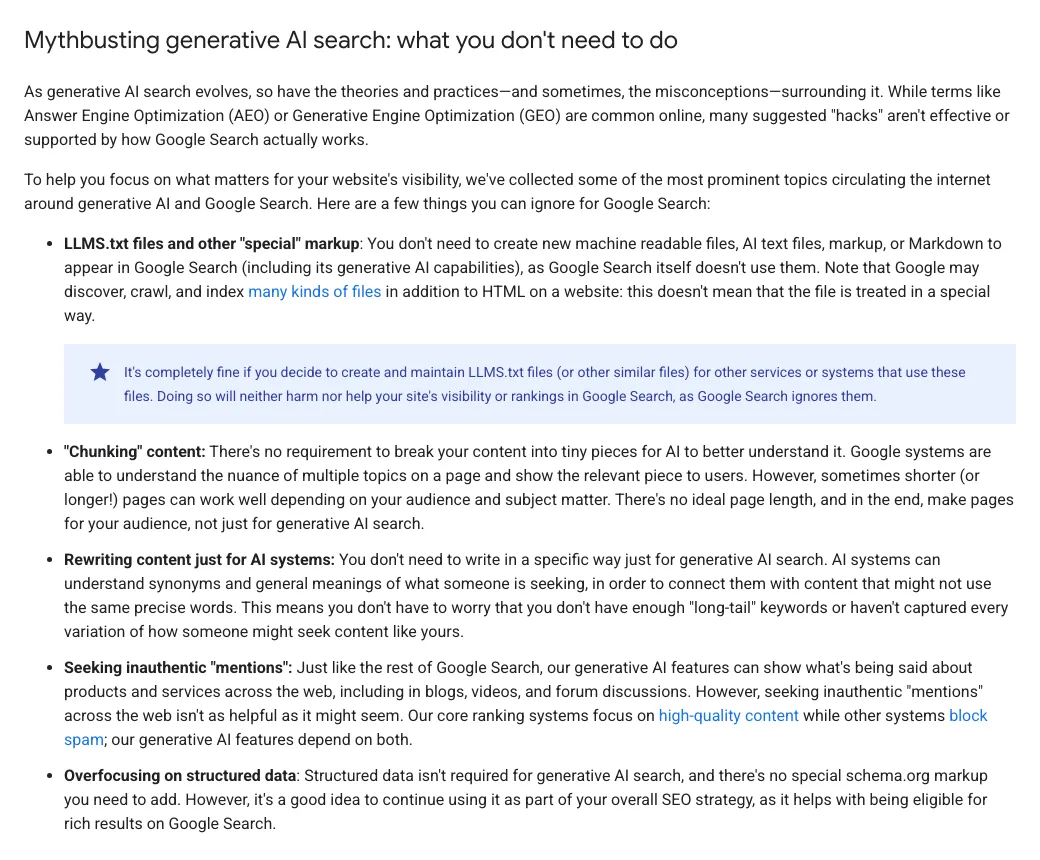
The guide then lists what you can ignore for Google Search. It starts with llms.txt files and other special AI files. Splitting content into small chunks is on it, and so is rewriting pages in a special way for AI. So are chasing inauthentic mentions and adding special structured data. Google adds that structured data still helps a page qualify for rich results. Keeping an llms.txt file for other services is fine too.
Google asks only that a page is indexed and allowed to show a snippet. One more change affects AEO advice directly. Google’s documentation updates log records that FAQ rich results no longer appear in Google Search.
Microsoft
Microsoft has taken up the GEO label. Bing’s announcement of the AI Performance report in Bing Webmaster Tools called it an early step toward GEO tools. The report shows how often a site’s pages are cited in Microsoft Copilot and in AI summaries in Bing. The same post recommends clear headings, tables and FAQ sections, claims backed by evidence and pages kept up to date.
OpenAI
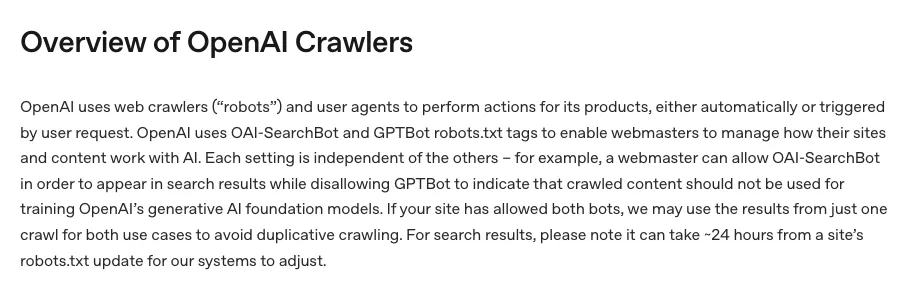
OpenAI’s crawler documentation separates two robots. OAI-SearchBot finds pages for the answers in ChatGPT search, and a site that blocks it will not show in those answers. GPTBot collects content that may be used to train OpenAI’s models. A site can allow the first and block the second.
I follow each platform’s guidance for that platform. I am wary of any advice that does not say which platform it is for.
Which AEO And GEO Advice Holds Up
The advice that holds up on every platform is the advice that was already good SEO. Plain answers under clear headings, facts nobody else has and genuine mentions on other sites all appear in the platforms’ own guidance. Two popular tactics do nothing for Google, and one robots.txt tip points at the wrong crawler.
| Advice you will read | What the platforms publish | What I would do |
|---|---|---|
| Put a direct answer under a heading that matches the question | Google asks for a clear structure and says no special writing for AI is needed. Microsoft recommends clear headings. | Do it, for readers first |
| Add FAQ and HowTo schema markup | Google no longer shows FAQ rich results and needs no special schema for its AI features. Microsoft recommends FAQ sections on the page. | Write the FAQ section and treat the markup as optional |
| Add an llms.txt file | Google Search ignores it | Optional, for other services |
| Split pages into small chunks | Google says there is no need | Skip it |
| Publish original data and first-hand detail | Google asks for content with a point of view of its own. Microsoft asks for claims backed by evidence. | Do it |
| Get mentioned on other sites | Google says its AI features show what people say about you in blogs, videos and forums, and that inauthentic mentions help less than they seem | Earn genuine reviews, listings and coverage |
| Let AI crawlers in through robots.txt | OpenAI uses OAI-SearchBot for ChatGPT search and GPTBot for training | Allow OAI-SearchBot and decide on GPTBot by itself |
| Track appearances in AI answers | Search Console and Bing Webmaster Tools both report them | Check every month |
Some of the articles that rank for this search tell you to unblock GPTBot so you appear in ChatGPT. OpenAI’s crawler page, in the capture below, shows that the two robots do different jobs.
How To Measure SEO, AEO And GEO
You measure all three with the platforms’ own reports and a fixed list of buyer questions. Check the list on each AI tool every month. A click report on its own misses the answers that mention you when nobody clicks.
SEO is still measured in Search Console’s Performance report and a rank tracker. A rank tracker that records featured snippets and People Also Ask positions covers most of AEO. GEO now has reports of its own. Search Console’s Generative AI performance report shows how often links to your site appeared in AI Overviews and AI Mode. Bing’s AI Performance report shows each citation in Copilot and in Bing’s AI summaries.
Neither report tells you what the answers say about your brand. Nor does either one show which other sites the answers cite beside you. That is why we also check a fixed list of buyer questions on each platform. The list shows whether the brand is mentioned, who is mentioned next to it and which sources the answers rely on. Run the same list every month, so each month compares with the one before.
Clicks still come mostly from search. StatCounter’s worldwide figures show search engines sending 91% of the visits it records from search, social networks and AI chatbots. AI chatbots send less than half of one percent.
Where To Start With SEO, AEO And GEO
Start with SEO, because AEO and GEO both depend on pages that search engines can find and rank. Then add the few tasks the other two bring, on the same pages.
- Check in Search Console that your important pages are indexed and can show a snippet.
- Check robots.txt and your hosting or content delivery network settings for AI crawlers. Allow OAI-SearchBot if you want to appear in ChatGPT search, and decide about GPTBot by itself.
- List the questions your buyers ask. Take them from Search Console queries, People Also Ask and the staff who answer customer calls.
- Answer each question in the first one or two sentences of its section, then give the detail.
- Add what only you can say, such as your own process, photos and figures. Give a linked source for anything you did not measure yourself.
- Earn genuine mentions, such as customer reviews and trade coverage. Keep your directory and marketplace listings, Facebook page, Google Business Profile and Bing Places listing up to date.
- Check the same list of buyer questions on each AI platform every month, next to the Search Console and Bing reports.
Primal started in 2015 and has offices in Kuala Lumpur, Bangkok and Singapore. Our AI SEO team runs SEO, AEO and GEO as one plan for each brand, across Google, AI Overviews, ChatGPT and Gemini.
Frequently Asked Questions About SEO Vs AEO Vs GEO
Is AEO The Same As GEO?
They overlap, and people use the terms in different ways. AEO started with the single answers search engines show, such as featured snippets. GEO comes from research on answers that AI tools write from several sources. Google says much of the advice under both terms is not needed for its search.
Do I Still Need SEO If I Do AEO And GEO?
Yes. Google says AI Overviews and AI Mode find pages through its search index and core ranking systems. A page that is not indexed cannot be used. ChatGPT search also has to reach a page through OAI-SearchBot before it can cite it.
How Would You Split The AEO And SEO Deliverables?
Most of the deliverables are the same work. Google says AI Overviews and AI Mode find pages with its core ranking systems. So the SEO work on your pages comes first. The AEO and GEO part adds plain answers under question headings, facts of your own and genuine mentions on other sites.
Should We Focus On Other Platforms As Well As Our Website?
Yes, alongside the website. In data from Elevate, Primal’s AI Visibility Tracker, a brand’s own site was typically cited in about a quarter of the AI answers about it. Marketplaces, review sites, Facebook and government registers supplied much of the rest. Keep the website as the base, and make sure what those sites say about you is complete and correct.
Can One Page Do SEO, AEO And GEO At Once?
Yes, and in most cases it should. A page can rank, answer its question in its first lines and carry facts of its own. That one page can then be listed, quoted and cited. Google’s guide says there is no need to rewrite pages in a special way for AI.
Does An llms.txt File Help With AEO Or GEO?
Not in Google. Google’s guide says Google Search ignores llms.txt files, and that keeping one for other services is fine. Treat it as optional.
Does Blocking GPTBot Keep My Site Out Of ChatGPT?
No. OpenAI says GPTBot collects content that may be used to train its models. OAI-SearchBot is the crawler that decides whether your pages can appear in ChatGPT search. You can block GPTBot and still allow OAI-SearchBot.
Founder and Chief Executive Officer
Mark McDowell is the Founder and Chief Executive Officer of Primal, which he started in Bangkok in 2015. He is on the Forbes 30 Under 30 Asia 2020 list and was Campaign Asia’s Southeast Asia Young Achiever of the Year in 2018. He writes about AI search and search engine optimisation.
About The Author


