By Mark McDowellPosted: 7 min read
8 AI Marketing Statistics And What They Mean For You
Most marketers already use AI, so the AI marketing statistics worth acting on are about AI answers. Over the last month, Elevate, Primal's AI Visibility Tracker, logged 16,543 AI answers about 12 brands in 12 industries, and a brand's own site was cited in about a quarter of the answers about it. Other sources included competitors, marketplaces, review sites, Facebook and government registers.
Key Takeaways
- Most AI answers skip the brand's own site. Over the last month, Elevate, Primal's AI Visibility Tracker, logged 16,543 AI answers about 12 brands in 12 industries, and a brand's own website was cited in only about a quarter of the answers about it.
- Treat listings and Facebook like your website. Marketplaces and comparison sites were cited for 11 of the 12 brands, and Facebook was the most-cited social source for 8.
- Using AI no longer sets a team apart. HubSpot's 2026 State of Marketing Report found 80% of marketers use AI for content creation.
- Start with your own figures. Track a fixed set of buyer questions on each AI platform for a month, then fix the pages and listings the assistants read.
Every figure here names its source. Primal's own figures come from Elevate, the rest from the reports linked in the post.
What AI Marketing Statistics Tell A Marketing Team Now
Most lists of artificial intelligence (AI) marketing statistics tell the same story. Nearly every marketer uses AI, and the market for it keeps growing. Both are true, and neither tells a marketing team where to spend next.
Elevate, Primal’s AI Visibility Tracker, records what AI assistants answer when buyers ask about a brand’s category. A brand’s own website is only one of the sources an answer cites. Competitors, marketplaces, review sites, Facebook pages and government registers are cited beside it. So the figures worth tracking are your own. Check which questions mention you on each platform, and which pages about you get cited.
1. How Often AI Assistants Mention A Brand
How often a brand is mentioned changes with the brand and the question. Its own website, though, is cited in only about one AI answer in four. Over the last month, Elevate, Primal’s AI Visibility Tracker, logged 16,543 AI answers across 172 queries about 12 brands in 12 industries. A competitor’s site was cited about as often as the brand’s own.
The queries are the questions buyers type, such as which option is best, how two options compare, what one costs and where to buy it.
2. Why General SEO Questions Mention No Brand
A general question asks how something works, so the assistant cites the page that explains it best, whoever wrote it. The tracker also logged 3,693 answers across 66 queries about agencies and search over the same month, and on the general search engine optimisation (SEO) questions no agency was mentioned and the answers cited publishers and Google’s own pages. That gives a smaller brand a fair chance of being cited, as long as its page is the clearer one.
The larger set of 16,543 answers points the same way outside search. On technical and health topics, the answers leaned on document and research sites such as Scribd, ResearchGate and PubMed. A published specification or paper can earn citations that a product page does not.
3. Which Sources AI Assistants Cite
AI assistants cite the places buyers compare and check, beside the brand’s own website. In the 16,543 answers, marketplaces and comparison sites appeared for 11 of the 12 brands. In consumer categories such as cars, education, skincare and flowers, they were cited as often as the brand itself.
Facebook was the most-cited social source for 8 of the 12 brands, and government registers and regulators appeared for 6. Google’s own Business Profile and Maps results were cited for most of the brands too.
The chart shows which social platform the assistants cited most for each of the 12 brands. For most of them it was Facebook, not Instagram or LinkedIn.
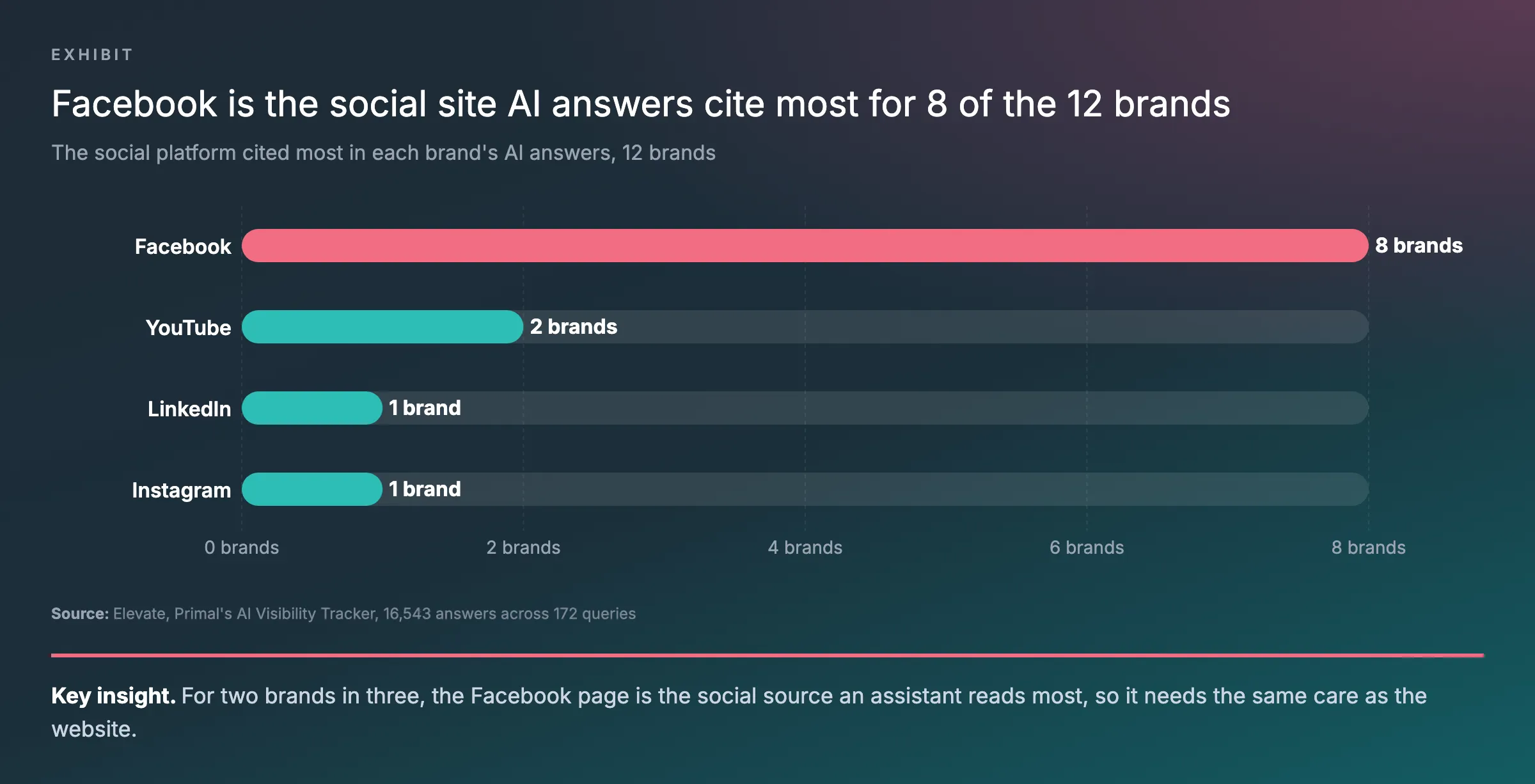
Before you write another blog post, check your listings on the marketplaces, directories and review sites in your category. Correct the services, locations and reviews there so they match your own site. Give your Facebook page the same care as the website. Our guide on how to get cited in AI search covers the page side in more detail.
4. How Many Visits AI Search Sends
AI search sends far fewer visits than Google. Ahrefs’ ChatGPT versus Google panel shows Google sent about 97 times as many visits as ChatGPT in Asia. Across all regions, AI assistants together sent less than half of one per cent of visits.
Visits are only one result of an AI answer. The answer can put your brand on a buyer’s shortlist, and the buyer may search for your name later. That later visit is recorded as a Google search or a direct visit.
That is why mentions and citations belong next to visits and enquiries in your reports. Our guide on how to measure AI search visibility covers the tools for it.
5. What Percentage Of Marketers Use AI
Most marketers use AI, at least for content. HubSpot’s 2026 State of Marketing Report found 80% of marketers use AI for content creation, and 75% use it for media production. McKinsey’s State of AI survey found nearly 9 in 10 firms use AI regularly in some part of the business.
Using generative AI to write and design is now normal, so it no longer sets a team apart. What still varies is whether it pays, and whether buyers find your brand when they ask an AI assistant themselves.
6. How Many Businesses In Malaysia Use AI
Fewer firms in Malaysia use AI than the global surveys of marketers suggest. A study by Strand Partners for Amazon Web Services (AWS) found 38% of businesses in Malaysia consistently use at least one AI tool, up from 27% a year earlier.
Startups and large firms use it more than small ones, the same study found. Most AI adoption is still basic, such as public chatbots and ready-made tools.
7. How Effective Is AI In Marketing
AI saves time more often than it shows up in profit. In McKinsey’s survey, only 37% of respondents could tie any change in earnings before interest and taxes (EBIT) to AI. Where they did see revenue gains, they most often credited AI in marketing and selling.
Most respondents also said AI made them more productive in their own work. For a marketing team, the return on investment (ROI) from AI comes in two parts. One is the time saved making content, which is easy to see. The other is whether buyers find you through AI answers. That part needs the figures in the first three sections.
8. How Big Is The AI Marketing Market
Nobody can give the market size with much precision. The global figure most lists repeat is also older than it looks. Two of the three pages that ranked above this one when we checked quote a global figure from Statista.
The Statista chart behind it names The Insight Partners as its source, with data from 2020 and a release date of April 2021. Statista then filled in each year’s value by assuming the market grew at the same rate each year. So the value for this year on those lists is a calculated point on a forecast made more than five years ago.
For Malaysia, IMARC Group, a market research firm, puts the AI market at a little over 1 billion US dollars in 2025. Its page forecasts about 17 billion by 2034.
I would not put either figure in a business case for a marketing budget. Your own costs, conversion rates and search demand say more about the return.
What To Do With These Numbers
Start with your own figures, then fix what the assistants read.
- Track a fixed set of buyer questions on ChatGPT and Google AI Overviews for at least a month, grouped by type of question. A single day misleads, because the answers change daily.
- Check your listings on the directories, marketplaces and review sites the assistants cite. Fix the services, places and reviews there.
- Publish pages that answer “which” and “how much” questions directly, with facts only you can give.
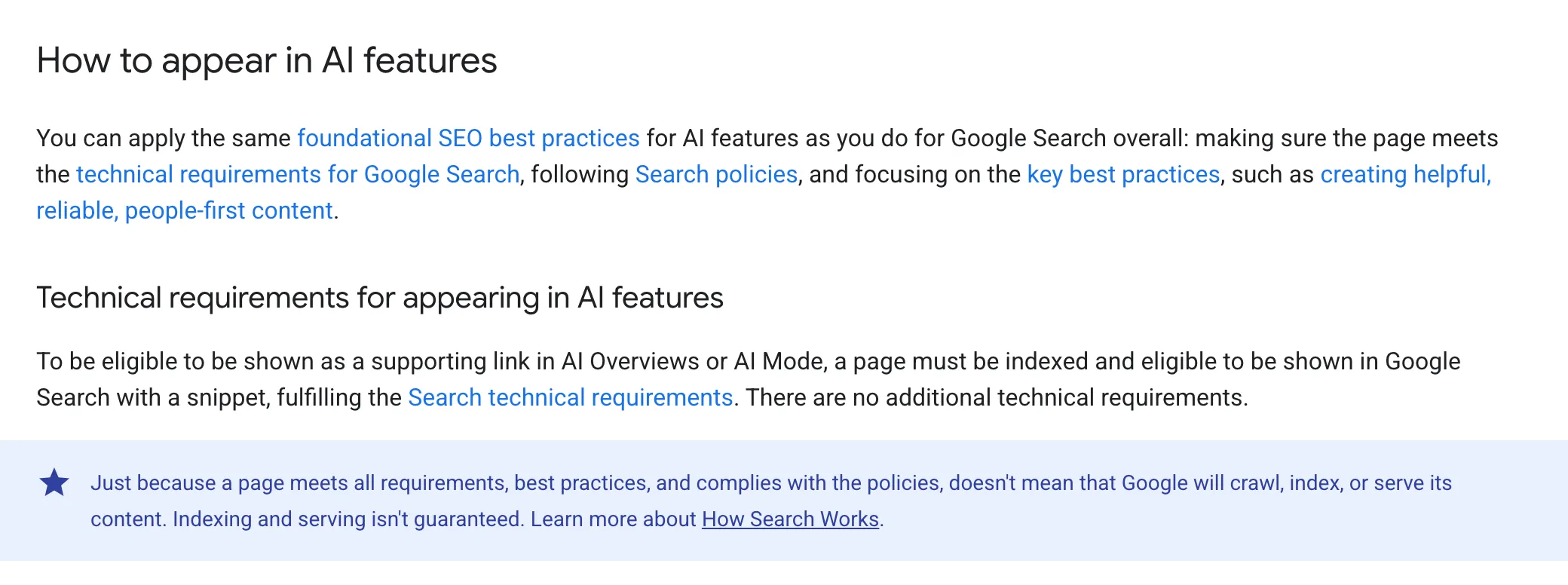
- Keep the search basics in order, because AI Overviews draw on the same index as Google Search.
- Report mentions and citations next to visits and enquiries each month.
Step four needs no special file. Google’s guide to AI features sets one condition for a supporting link in AI Overviews or AI Mode. The page has to be indexed and eligible to show a snippet. It also says no new markup or AI text file is needed. The capture below shows the two parts of the guide that say so.
For step one, the question set matters more than the tool. Mix questions where a buyer picks a supplier with questions where they want a plain answer. The assistants treat the two in very different ways.
My video on how to check whether AI assistants are recommending your brand, from my YouTube channel.
Primal started in 2015 and has offices in Kuala Lumpur, Bangkok and Singapore. Our AI SEO team helps brands get cited in Google AI Overviews, ChatGPT and Gemini, alongside their SEO.
Frequently Asked Questions About AI Marketing Statistics
How Often Should AI Marketing Statistics Be Updated?
Once a year for the outside surveys, and every month for your own figures. AWS, HubSpot and McKinsey each published a 2026 edition of a yearly study. AI answers change from day to day, so a monthly reading of the same questions tells you more than any yearly survey.
Does ChatGPT Or Google AI Overviews Mention Brands More Often?
It differs from brand to brand and from question to question, so there is no general answer worth planning on. Track the same buyer questions on both platforms each month and read them as two separate results. AI Overviews draw on the same index as Google Search, so the search basics help there first.
Can A Smaller Brand Be Cited By AI Assistants?
Yes, most of all on general questions, where the assistant cites the page that explains the topic best. Google’s guide sets a plain test. A page only needs to be indexed and able to show a snippet to be a supporting link in AI Overviews. Listings on marketplaces, review sites and registers are open to a smaller brand too.
Should We Focus Just On The Website, Or More On Other Platforms?
Both, because the website is only part of what an assistant reads. Elevate, Primal’s AI Visibility Tracker, saw a brand’s own website cited in about a quarter of the AI answers about it. Marketplaces, review sites, Facebook and government registers appeared among the other sources for most of the brands.
How Big Is The AI Market In Malaysia?
IMARC Group puts it at a little over 1 billion US dollars in 2025 and forecasts about 17 billion by 2034.
Founder and Chief Executive Officer
Mark McDowell is the Founder and Chief Executive Officer of Primal, which he started in Bangkok in 2015. He is on the Forbes 30 Under 30 Asia 2020 list and was Campaign Asia’s Southeast Asia Young Achiever of the Year in 2018. He writes about AI search and search engine optimisation.
About The Author