



By Mark McDowellPosted: 10 min read
How To Get Cited In AI Search On Every Platform
To get cited in AI search, let each platform's search crawler reach your pages, keep them indexed and allowed to be quoted, and answer each question in the first lines of the page. Then make sure your business appears correctly on the marketplaces, review sites and listings that AI answers cite, because a brand's own site is cited in only about a quarter of the answers about it.
Key Takeaways
- Most AI answers skip the brand's own site. In 16,543 AI answers about 12 brands logged over the last month by Elevate, Primal's AI Visibility Tracker, a brand's own website was cited in only about a quarter of the answers about it.
- Citations need your site and your listings. Your own pages must be open, indexed and quotable on each platform, and your business listed correctly on the marketplaces, review sites, registers and publications the answers already cite.
- Opting out of training still allows citations. OpenAI and Anthropic each run a search crawler separate from their training crawler, and Perplexity says its crawler is not used for training.
- Two tags control what Copilot shows. Bing's guidelines, which also cover Copilot, say a NOARCHIVE tag keeps a page out of Copilot answers and NOCACHE limits Copilot to the address, title and snippet.
- AI Overviews need no special markup or files. Google says a page needs to be indexed and allowed to show a snippet to appear in AI Overviews, and that no special schema markup or llms.txt file is required.
What Gets Cited In AI Search
When an artificial intelligence (AI) assistant answers a buyer’s question, it cites two kinds of page. One is the page that explains the topic most clearly. The other is a site that lists, reviews or writes about the businesses in the answer, such as a marketplace, a review site or a news publisher.
Over the last month Elevate, Primal’s AI Visibility Tracker, logged 16,543 AI answers across 172 queries about 12 brands in 12 industries. Every brand’s own website was cited, but typically in only about a quarter of the answers about it. A competitor’s site was cited about as often.
The chart shows that split for the typical brand of the 12.
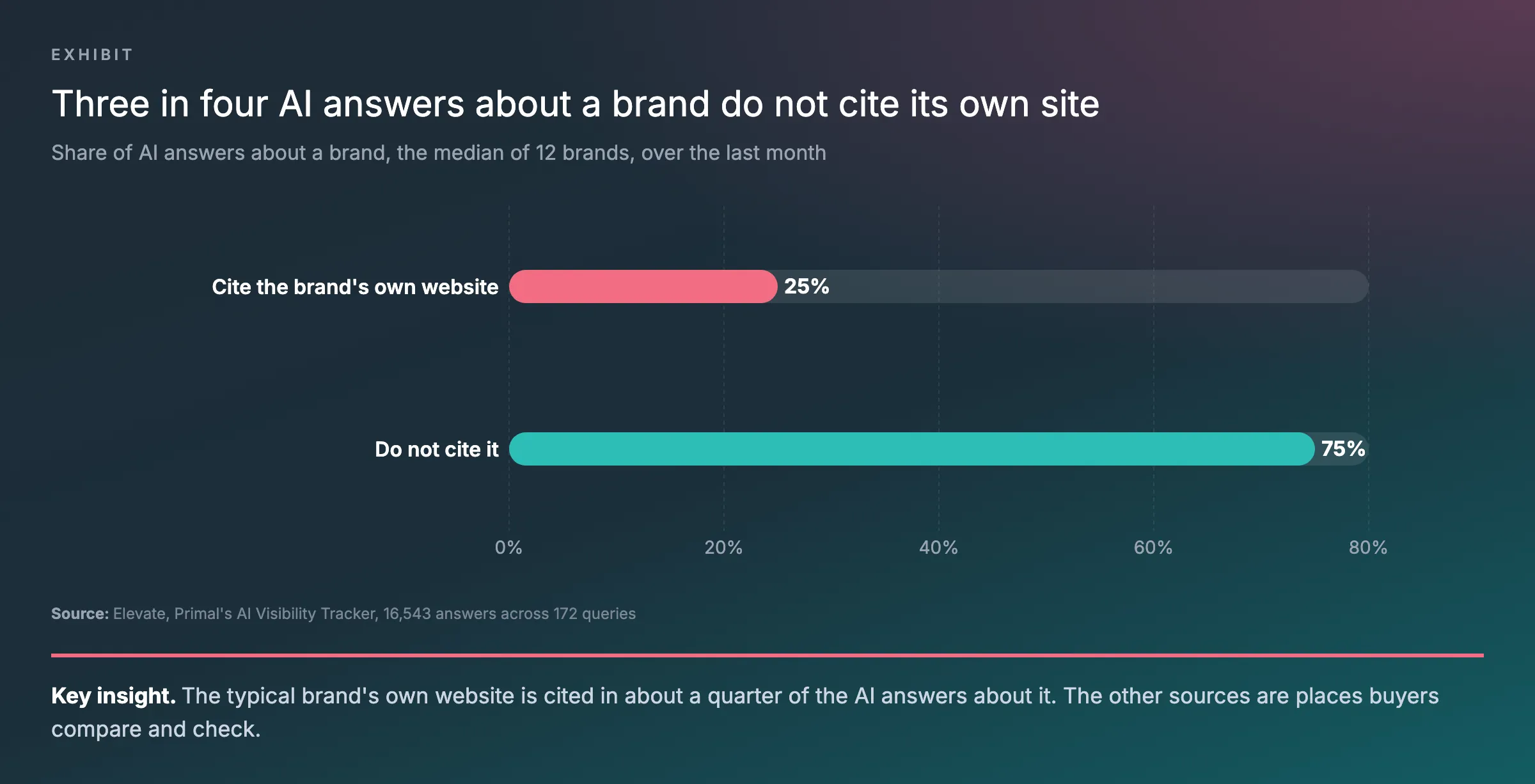
The other sources were the places buyers compare and check. Those include marketplaces, review sites, government registers, publishers, Facebook and YouTube.
General questions work differently. In a separate set of 3,693 answers across 66 queries from the same tracker and month, the general questions about search mentioned no agency at all and cited publishers and Google’s own pages instead.
So getting cited asks two things of a business. First, its own pages have to be open to each platform and allowed to be quoted. The answer has to sit where a machine can lift it. Second, the business has to appear, correctly, on the sites the answers already cite.
How Each Platform Finds The Pages It Cites
Each platform searches before it answers. It reads its own index, or its own crawler’s copy of your page. So a page can be cited on one platform and missing on another. Two indexes do most of the work, Google’s and Bing’s.
How Google’s AI Overviews, AI Mode And Gemini Find Pages
Customers often ask us how to improve their visibility in Google’s AI features, not only in ChatGPT. For those features, the work is plain Google search engine optimisation (SEO). Google’s guide to its generative AI features says AI Overviews and AI Mode pull pages from its Search index. They use the same core ranking systems as Search.
They also run several related searches at once, which Google calls query fan-out. A page must be indexed and allowed to show a snippet. Google says no special schema markup or llms.txt file is needed.
The Gemini app also reads Google’s results before it answers, which Google calls grounding. It has one setting of its own, Google-Extended.
How ChatGPT, Perplexity, Copilot And Claude Find Pages
ChatGPT, Perplexity and Claude each send their own search crawler. Copilot reads Bing’s index. Bing’s Webmaster Guidelines say Bing search and Copilot share one base for crawling, indexing and ranking. ChatGPT search also uses outside search providers, says OpenAI’s help page for publishers. Our guide to ChatGPT SEO covers which ones OpenAI lists.
To check your indexing, inspect your main pages in Search Console’s URL Inspection tool. Do the same in Bing Webmaster Tools. Submit the same sitemap to both, and fix any page either index has left out. It asks for IndexNow too. That is a protocol that tells Bing when a page is added, changed or removed. Bing also says duplicate pages make it less sure which page to cite.
Let Each Search Crawler Reach Your Pages
Let each platform’s search crawler through robots.txt and your firewall. A blocked crawler stops every later step on that platform. Each company publishes its crawler’s name and what happens if you block it.
- Google’s AI features use pages Googlebot can crawl. Bing’s guidelines warn against blocking Bingbot.
- OpenAI’s crawler page says sites that block OAI-SearchBot are not shown in ChatGPT search answers.
- Perplexity’s crawler page says PerplexityBot links websites in its search results. It also shows how to let the bot through Cloudflare and Amazon Web Services (AWS) firewalls.
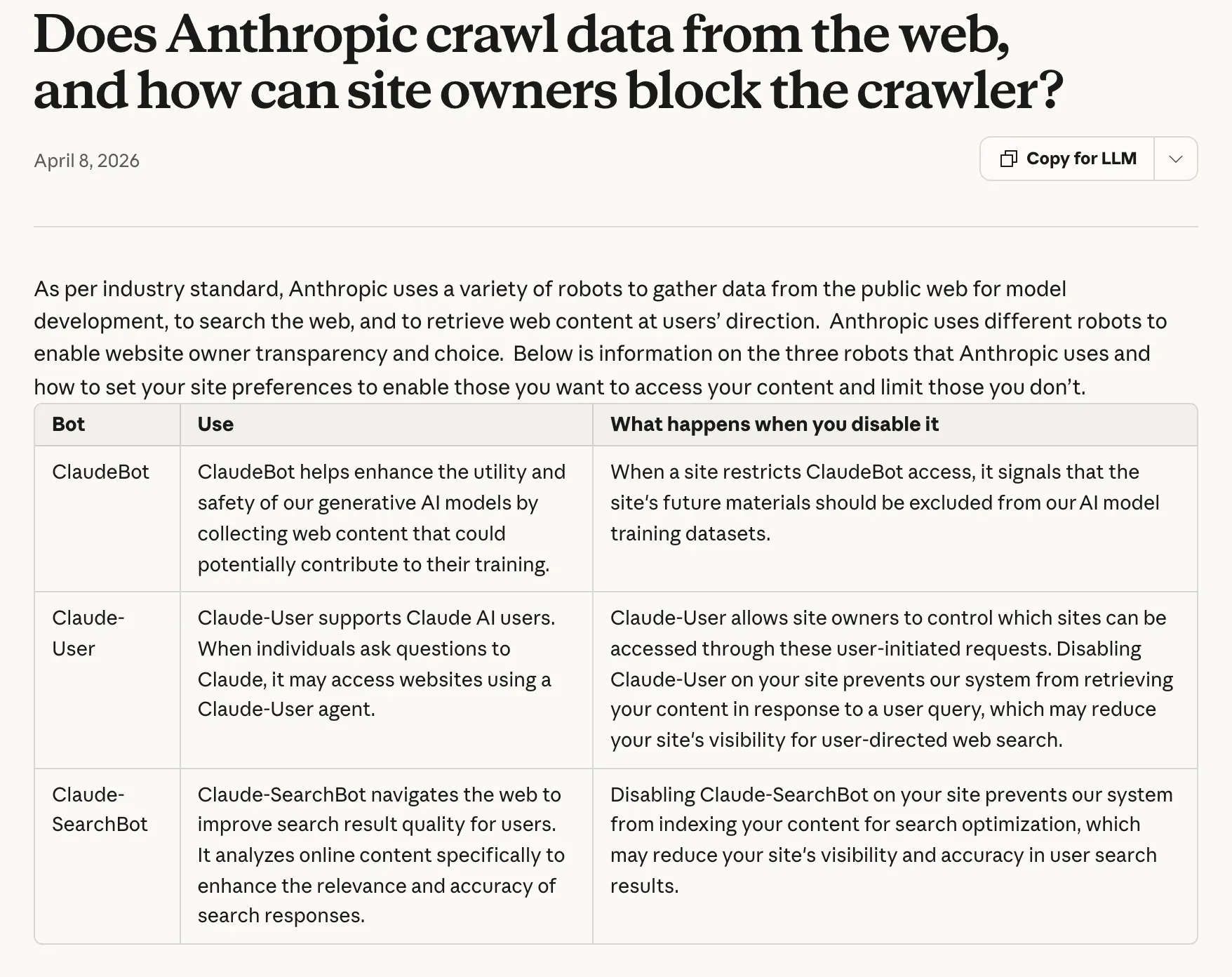
- Anthropic’s help article says blocking Claude-SearchBot stops Claude indexing your pages for search. It may also lower your visibility in Claude’s answers.
Anthropic’s article puts its three crawlers in one table. It is worth a look, because it shows the search crawler and the training crawler as separate lines.
A robots.txt file that lets the search crawlers in by name looks like this:
User-agent: OAI-SearchBot
Allow: /

User-agent: PerplexityBot
Allow: /

User-agent: Claude-SearchBot
Allow: /

User-agent: Bingbot
Allow: /

User-agent: Googlebot
Allow: /
These lines matter when a wider Disallow line would shut the crawlers out. A security plugin can add one. A crawler that finds a group for its own name follows only that group. It ignores the User-agent: * group. So copy any Disallow lines you still need, such as an admin folder, into each group.
My advice is to allow every search crawler and decide about training on its own.
To check this step, open yourdomain.com/robots.txt. Look for each crawler, and for Disallow: / under User-agent: *. Ask whoever runs your hosting, firewall or content delivery network (CDN) about bot protection. It must let the search crawlers through. OpenAI and Perplexity publish the addresses their crawlers use. Those can go on an allow list. Then search your server logs for each name. A crawler that never appears in a month of logs is blocked, or has not found the site.
Can You Block AI Training And Still Be Cited
Yes, on most platforms, because search and training are separate settings. OpenAI’s GPTBot and Anthropic’s ClaudeBot collect training data. Each has its own robots.txt line, apart from OAI-SearchBot and Claude-SearchBot. Perplexity says PerplexityBot is not used to train AI models.
Google works differently. Google’s page on its common crawlers says the Google-Extended token covers two uses. One is training Gemini models, and the other is grounding in the Gemini app. It has no effect on Google Search. So blocking it can keep your pages out of Gemini app answers while AI Overviews still use them.
Remove The Tags That Stop Quoting
A page can be crawled and indexed and still be kept out of answers by a tag. Google needs the page to allow a snippet. A nosnippet tag, or a max-snippet value of 0, keeps it out of AI Overviews. The site also has to be included in the Search generative AI setting in Search Console.
Bing’s guidelines go further for Copilot. A NOINDEX tag keeps a page out of Bing search, Copilot and grounding results. NOSNIPPET and data-nosnippet stop Bing showing captions. They may also weaken Copilot’s citations. NOARCHIVE keeps the content out of Copilot answers. NOCACHE limits Copilot to the page’s address, title and snippet.
Section 10 of Bing’s guidelines sets out these tags in one place. It is the part to send your developer, because the Copilot lines are easy to miss.
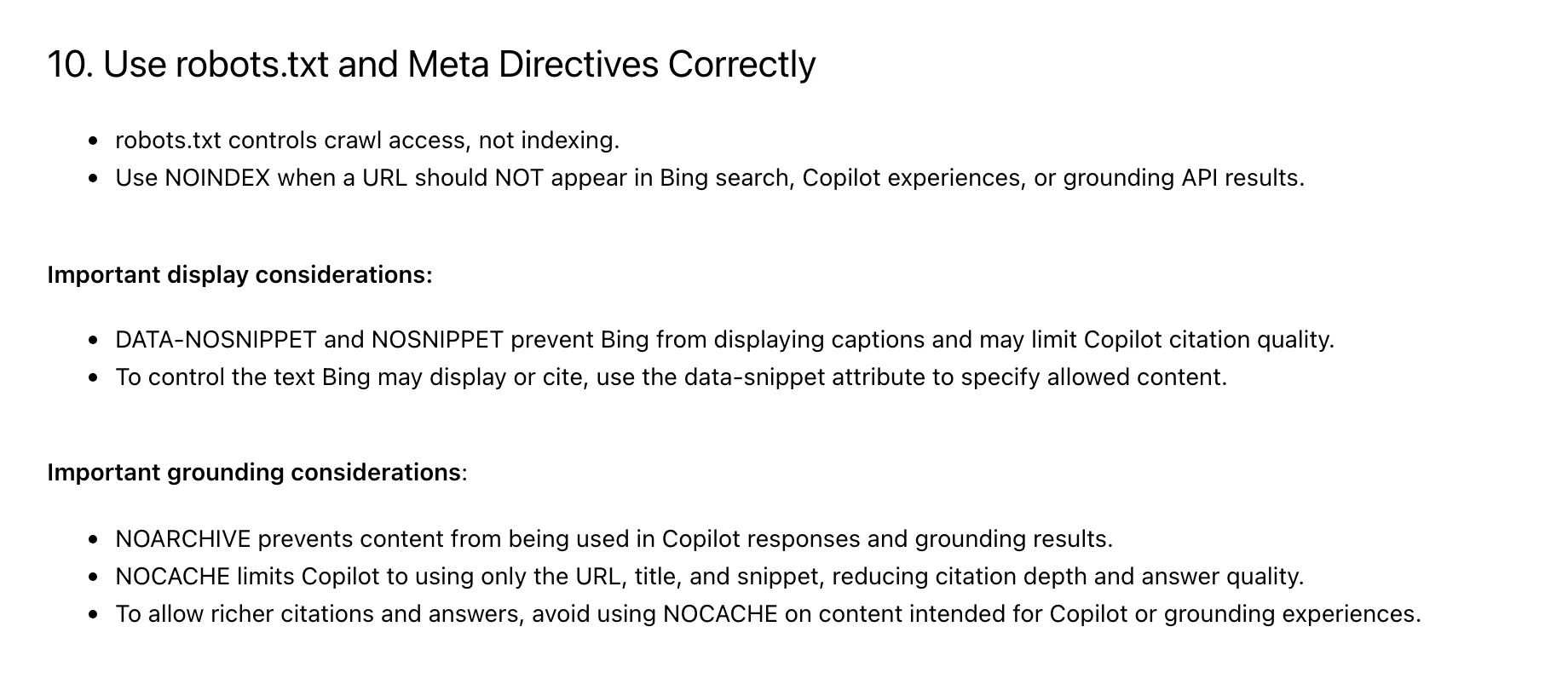
I would remove NOARCHIVE and NOCACHE from any page you want Copilot to cite. The exception is a tag someone set on purpose and can explain.
To check this step, run curl -I on the page address and look for an X-Robots-Tag line. View the page source and search for name="robots". Any noarchive, nocache, nosnippet or max-snippet:0 on a page you want cited needs a reason. In Search Console, open Settings and check the site is included in Search generative AI.
Write Pages An AI Answer Can Quote
Answer each heading in its first one or two sentences. Put that answer in the page’s own text, where it loads without scripts. Keep each page to one main topic.
Customers often ask us how to appear for how-to questions as well as in lists of brands. The same page work covers both, because an assistant can lift any passage that answers on its own.
Google’s guide asks for content a summary of other pages could not give. Its examples are a unique point of view and first-hand experience. It also says you do not need to split pages into chunks or rewrite them for AI. Bing’s guidelines give plainer steps. Put the main information near the top. State facts and definitions outright. Give people, products and places the same names everywhere.
To check this step, fetch the page with curl -s. Search the output for the sentence that answers the page’s main question. If it is missing, a script adds it. Bing’s guidelines advise against that for important content. Then read only the first two sentences under each heading. If they do not answer the heading alone, rewrite them.
How To Appear In ChatGPT Recommendations
Customers often ask us how to appear in ChatGPT’s recommendations when a competitor is already there. ChatGPT and Google’s AI features write a recommendation from the pages they cite, and most of those pages belong to someone else. So the work is to appear, correctly, on the sites those answers already cite.
The same month of AI answers about 12 brands shows which sites those are. Marketplaces, comparison and listing sites appeared in the answers for 11 of the 12 brands. Facebook was the most-cited social source for 8 of them. Google’s own Business Profile and Maps results were cited for 7, and government registers for 6. I would treat a missing or thin listing on one of those sites as a bigger gap than one more blog post.
Google’s guide says its AI features can show what blogs, videos and forums say about products and services. It also warns that chasing fake mentions helps less than it seems. Its spam systems apply to AI features too. Bing’s guidelines say bought links, link networks and artificial social promotion lower visibility.
Genuine mentions are reviews from real customers and correct listings on the marketplaces, directories and registers your buyers use. Press coverage you have earned is another. Keep your Facebook page and Google Business Profile as current as your website, and make your business name, services and locations read the same on each one.
In this video from his YouTube channel, Mark McDowell explains how a brand gets to show up in ChatGPT.
To check this step, write down 20 questions your buyers ask, in their own words. Ask each one in Google, ChatGPT with search on, Gemini, Perplexity, Copilot and Claude. List the sites each answer cites. When the same directory, review site or publication keeps coming up, check that your listing there exists and is correct.
How To Measure Citations On Each Platform
Measure each platform with its own report, because no single report covers them all. Google’s guide points to the Generative AI performance report in Search Console for AI Overviews and AI Mode.
Bing added AI Performance to Bing Webmaster Tools as a public preview. It shows how often Copilot and Bing’s AI summaries cite your pages, and which pages. It also lists the grounding queries, the phrases the AI used to find your content.
OpenAI’s help page says ChatGPT adds utm_source=chatgpt.com to the links people click. Your analytics can use that tag to separate those visits. For Perplexity and Claude, the monthly prompt check from the section above is the measure.
I would start with the grounding queries in Bing’s report. They show the searches an AI actually ran. You can set them beside the headings on the pages you want cited. Our post on measuring AI search visibility sets out a monthly report that brings these sources together.
The Order To Work In
Customers often ask us how to get noticed on AI search engines specifically. Start with the settings, then the pages, then the sites that cite you, and measure every month. Crawler access, indexing and quoting tags apply to every page at once, and a fault in any of them stops the rest working on that platform.
I would fix those before rewriting a single page. Then pick which platforms to check first by where your buyers come from. Your analytics shows which assistants send visits today. That is a better guide than any market average.
Primal was founded in 2015 and has offices in Kuala Lumpur, Bangkok and Singapore. Our ElevateSEO™ programme covers this work for Google AI Overviews, ChatGPT, Gemini and Perplexity. It also reports which sources each platform cites in your category.
Frequently Asked Questions About AI Search Citations
How long does it take to get cited in AI search?
No platform publishes a timeline. OpenAI says a robots.txt change reaches ChatGPT search in about 24 hours, and Bing says IndexNow helps keep Copilot current. After that, a citation depends on whether your page answers the searches the platform runs, so check the same questions each month.
Does schema markup help you get cited in AI search?
Not on its own. Google says its AI features need no structured data or special markup, though markup still helps with rich results. Bing says structured data may help grounding but guarantees nothing, and it must match what the page shows. Add accurate markup where it fits, and expect the citation to come from the steps above.
Why does one AI platform cite my page and another does not?
Each platform reads its own index or its own crawler’s copy. So a page can be open to one platform and blocked on another. For the platform that does not cite you, check its crawler in robots.txt and your firewall. Then check the index it reads, and any tag that limits quoting, such as NOARCHIVE for Copilot.
Should we focus on other platforms, not just the website?
Customers often ask us this, and the answer is both, in order. In the AI answers about 12 brands logged by Elevate, Primal’s AI Visibility Tracker, every brand’s own website was cited, but in only about a quarter of the answers about it. Fix the settings on your own site first, because they apply to every page, then keep your listings on those other sites correct.
Founder and Chief Executive Officer
Mark McDowell is the Founder and Chief Executive Officer of Primal, which he started in Bangkok in 2015. He is on the Forbes 30 Under 30 Asia 2020 list and was Campaign Asia’s Southeast Asia Young Achiever of the Year in 2018. He writes about AI search and search engine optimisation.
About The Author


