



By Mark McDowellPosted: 9 min read
ChatGPT SEO And How To Get Cited By ChatGPT
ChatGPT SEO is the work of getting your pages cited when ChatGPT searches to answer a question. ChatGPT rewrites the question into short searches, reads what comes back and cites the pages it used. To be among them, a site has to let OpenAI's OAI-SearchBot crawler in, show up in those searches and be listed on the other sites AI answers cite, such as marketplaces, review sites and Facebook.
Key Takeaways
- Most AI answers skip the brand's own site. Over the last month, Elevate, Primal's AI Visibility Tracker, logged 16,543 AI answers across 172 queries about 12 brands, and a brand's own website was cited in only about a quarter of the answers about it.
- Listings and Business Profiles get cited often. Marketplaces, comparison and listing sites appeared in the AI answers for 11 of the 12 brands, and Google's own Business Profile and Maps results for 7.
- Treat your Facebook page like your website. Facebook was the most-cited social source for 8 of the 12 brands.
- Check robots.txt and the firewall first. OpenAI says a site can appear in ChatGPT search when its crawler, OAI-SearchBot, can reach the pages.
- Google Analytics can show ChatGPT visits by page. ChatGPT adds utm_source=chatgpt.com to the links people click, so you can see which of your pages it sends visitors to.
What ChatGPT SEO Means
ChatGPT SEO is search engine optimisation (SEO) for ChatGPT. It is the work of getting your pages cited, and your brand mentioned, when ChatGPT answers a question. When a buyer asks an AI assistant about a brand, the answer usually cites other people’s sites.
Over the last month, Elevate, Primal’s AI Visibility Tracker, logged 16,543 AI answers across 172 queries about 12 brands in 12 industries. A brand’s own website was cited in only about a quarter of the answers about it. So the first job is to let ChatGPT read your site. The next is to be listed, complete and reviewed on the other sites the answers cite for your category. Those are often marketplaces, review sites, Facebook and Google’s own business listings.
Many pages that rank for this phrase are about a different job, using ChatGPT to write title tags or plan keywords. This post is about being cited. It is one part of answer engine optimisation (AEO). That covers every assistant that gives an answer in place of a list of links.
In Malaysia, ChatGPT also sends websites more visits than any other AI chatbot. StatCounter’s figures put its share at about four in five of the visits that AI chatbots refer.
How ChatGPT Picks The Sources It Cites
ChatGPT picks its sources by running a search. When a question needs current information, it rewrites the question into short search queries. Then it reads the results and cites the pages it used. OpenAI sets this out on its help page about ChatGPT search.
ChatGPT decides on its own when to search, and a user can also switch Search on from the tools menu. Answers that use search can carry citations. A Sources button lists the pages behind the answer, along with other links. Search works on every ChatGPT plan, and for people who are not signed in.
The search query ChatGPT writes decides which pages it reads. OpenAI says ChatGPT search sometimes works with outside search providers. When it does, it usually turns the question into shorter, targeted searches. After it reads the first results, it may send more specific ones. It can also add the user’s general location, worked out from their connection. So a question about restaurants near me can become a search with the city in it. If memory is switched on, saved details can be added as well.
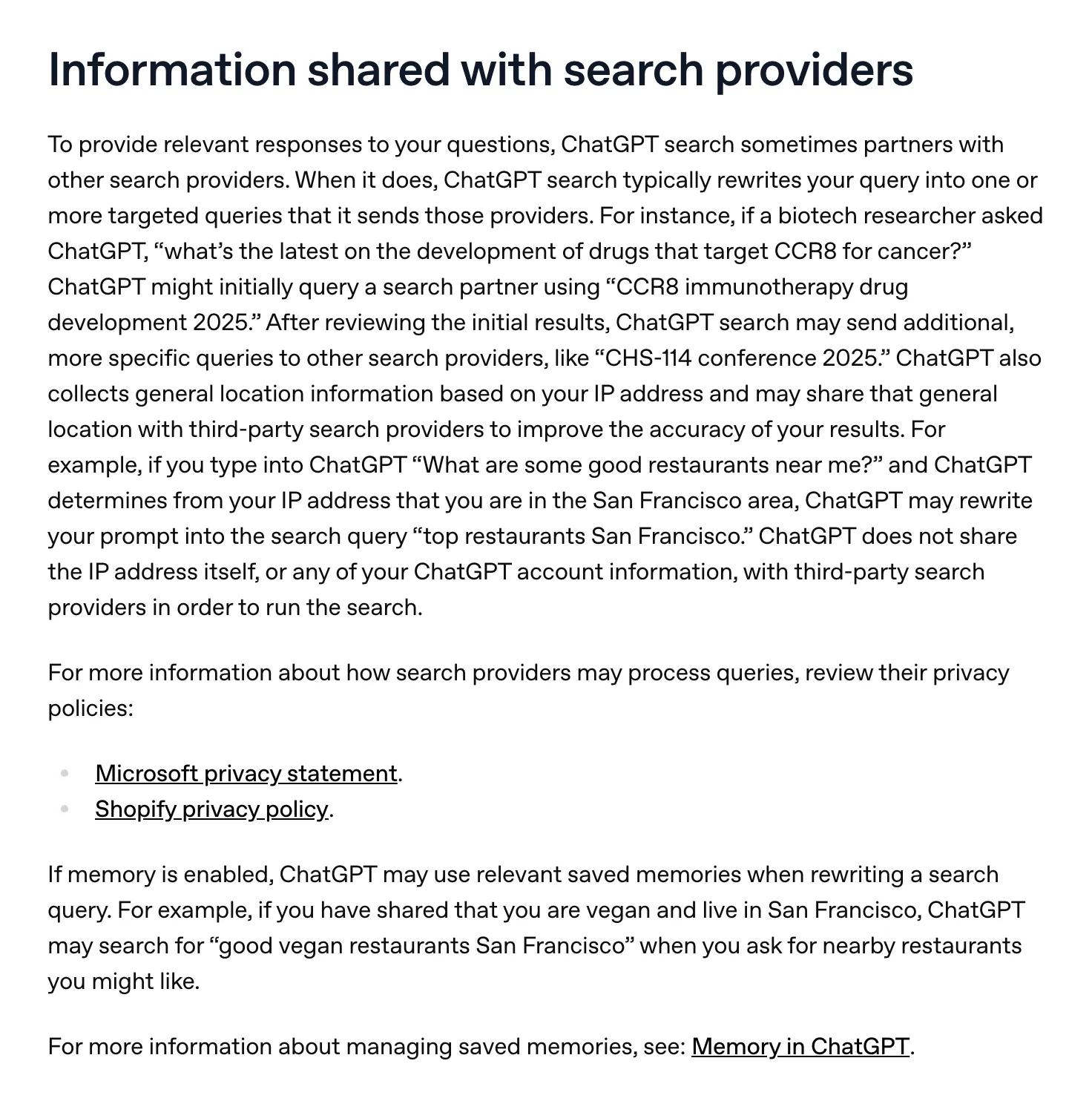
The same page lists the privacy policies of two search providers, Microsoft and Shopify. Microsoft runs Bing, so I read that as a reason to check that your pages are in Bing’s index as well as Google’s. On ranking, OpenAI says ChatGPT weighs several factors to help people find relevant, reliable information. It also says a place in the results is not guaranteed.
OAI-SearchBot, OpenAI’s crawler, has to be able to read the page. OpenAI’s publishers FAQ says any public site can appear in ChatGPT search, as long as it does not block that crawler. The page also has to show up for the short searches ChatGPT writes, and those can carry a city or a detail the user never typed. And in my view, it has to say something specific enough for ChatGPT to quote.
Product searches are handled separately. OpenAI’s shopping help page says product results come from structured data, such as price and description. Merchants and other providers supply that data, and other third-party content is used too. The same page says product results are not ads and that OpenAI’s partnerships do not influence them. Shopify stores are connected already. Other merchants can apply to send OpenAI a direct product feed.
Which Pages ChatGPT Cites For Buyer Questions
For a buyer question about a brand, AI answers cite the places buyers compare and check, as well as the brand’s own site. In the tracker’s data above, the brand’s own website was cited in about a quarter of the answers about it, and a competitor’s site about as often. The queries were the kind a buyer types, such as which is best, how two compare, what something costs and where to buy it.
Marketplaces, comparison and listing sites appeared in the answers for 11 of the 12 brands. Google’s own Business Profile and Maps results were cited for 7. A government register or regulator was cited for 6, such as the agency that accredits university courses.
Social pages were among the sources too. Facebook was the most-cited social source for 8 of the 12 brands. YouTube led for 2, LinkedIn for 1 and Instagram for 1. The chart shows that split across the 12 brands.
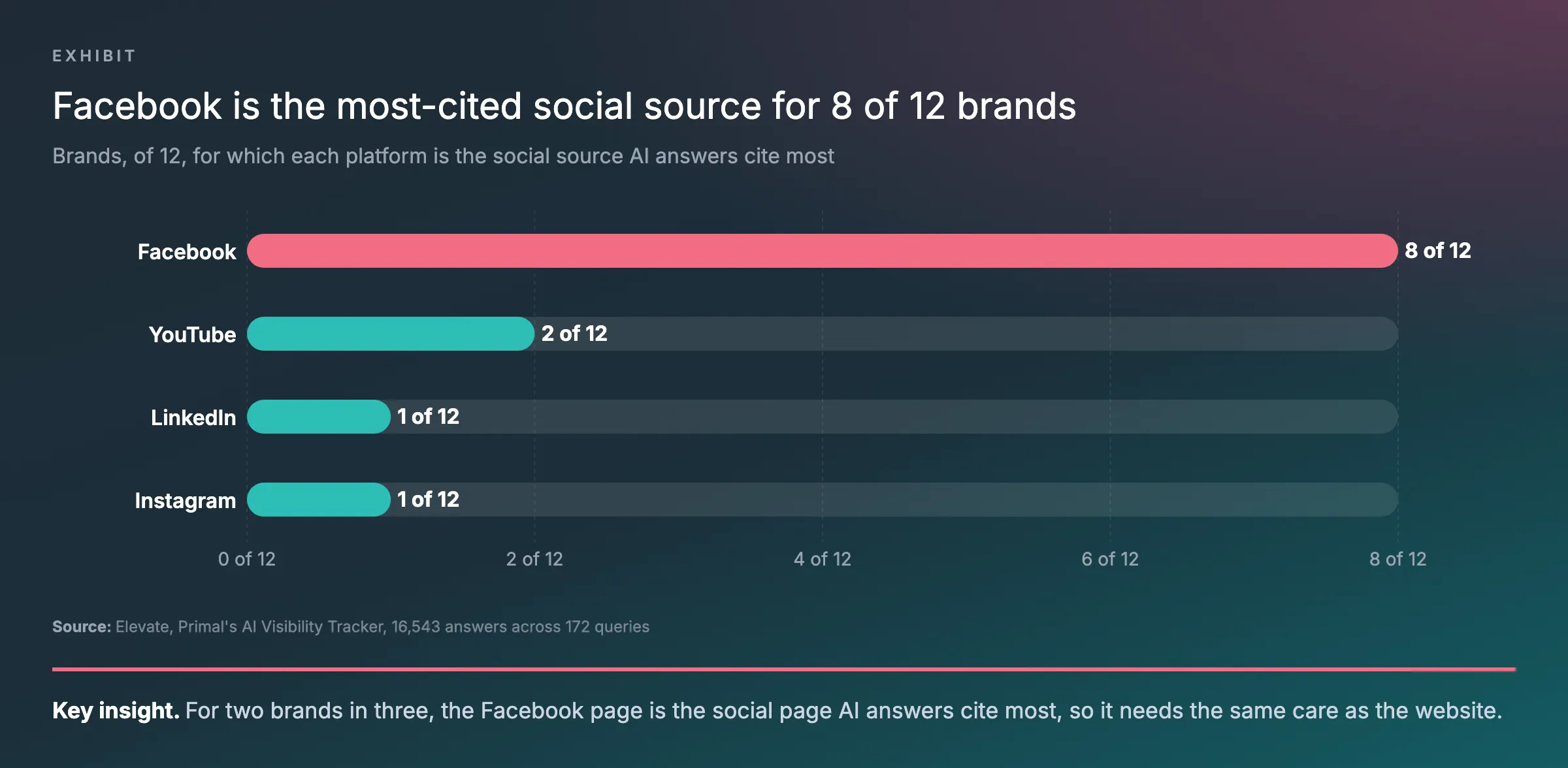
So for most brands, the Facebook page is part of what an assistant reads. It needs the same care as the website, with the same name, services, locations and contact details.
In a second set from the same tracker, 3,693 answers across 66 queries, the general SEO answers mentioned no agency at all and cited publishers and Google’s own pages. On buyer questions, fix your listings and profiles on the sites the answers cite before you write another blog post. On general questions, the aim is to be the cited page, so write the clearest answer to the question.
How ChatGPT Differs From Gemini, Formerly Bard
ChatGPT and Gemini find pages in different places. Gemini, Google’s assistant, searches with Google, so a page in Google’s index is already within its reach. ChatGPT relies on OpenAI’s own crawler and its search partners. A site that Google can read may still be closed to ChatGPT.
Gemini is the assistant Google first released as Bard. Google renamed Bard to Gemini in February 2024.
| For a site owner | ChatGPT | Gemini |
|---|---|---|
| Made by | OpenAI | |
| Where it finds pages | OAI-SearchBot and partner search providers | Google Search |
| The robots.txt line that covers your site | OAI-SearchBot | Google-Extended |
| What to check first | Your firewall lets OpenAI’s crawler through, and Bing has your pages | Google has indexed your pages |
A firewall that lets Googlebot through can still block OpenAI’s crawler. And a page missing from Bing may be missing from ChatGPT’s searches. Our Gemini SEO guide covers Gemini’s side in full, including the Google-Extended setting.
How To Get Cited By ChatGPT
To get cited by ChatGPT, start by letting OpenAI’s crawler read your site, then work on the pages ChatGPT reads for your category. For most businesses, your listings on marketplaces, review sites, Facebook and Google come first. Your own comparison and service pages come next.
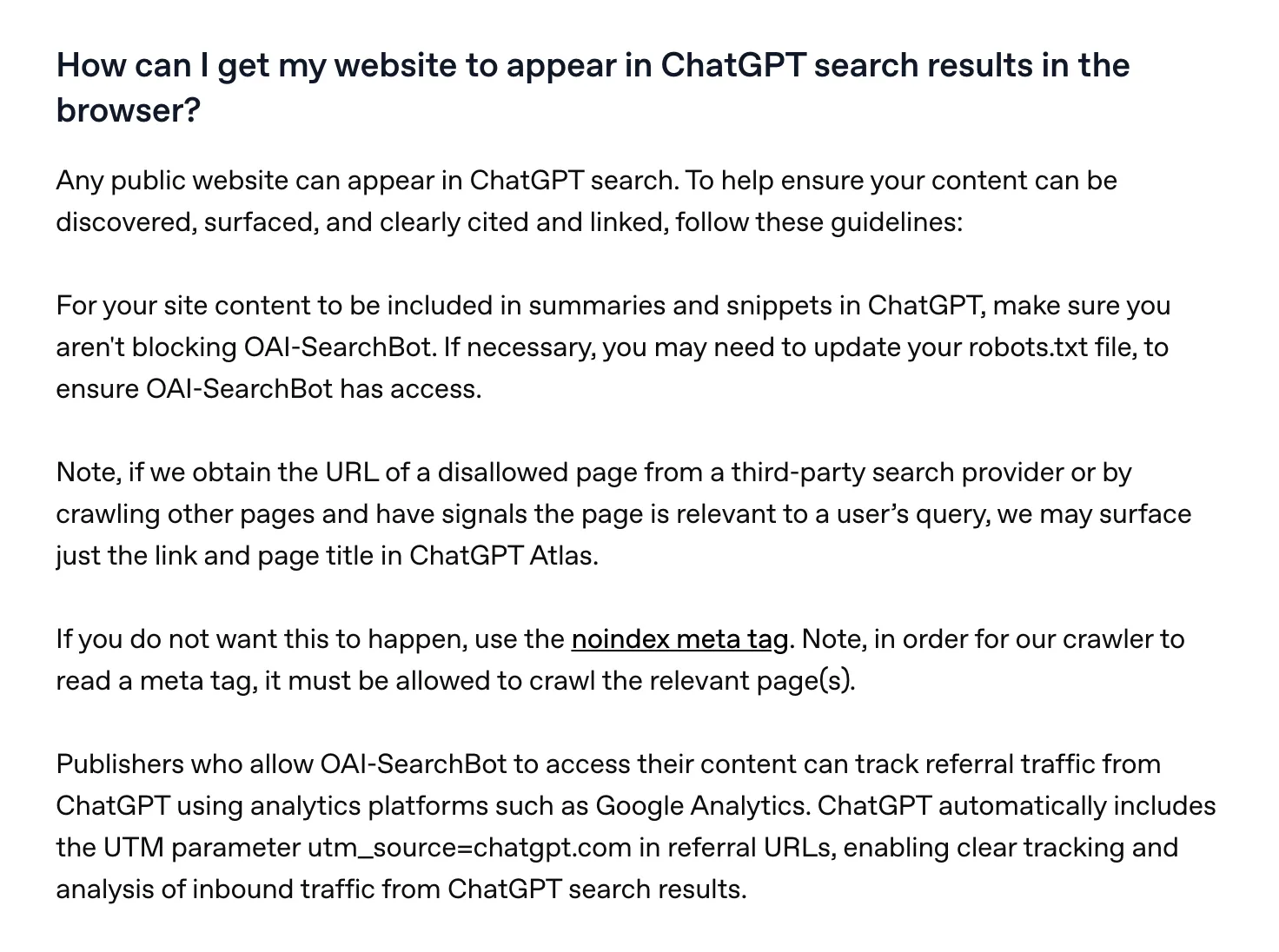
- Let OAI-SearchBot in. Open robots.txt and look for any line that blocks it. Then check that your host, firewall or content delivery network lets through the crawler addresses OpenAI publishes. OpenAI’s crawler page says a robots.txt change takes about 24 hours to reach its search results. GPTBot, its training crawler, is a separate setting.
- Check Bing as well as Google. Verify the site in Bing Webmaster Tools, submit your sitemap and check that your main pages are indexed. Microsoft is one of the two search providers OpenAI lists.
- Write down 20 questions your buyers would ask ChatGPT, in their own words. Run each one with search on, open Sources and note the sites that appear. Repeat it each month, because each run is one sample of an answer that can change.
- Fix your profile on every site that appears. That includes marketplaces, review sites, any directory that lists your trade, your Facebook page and your Google Business Profile. Fill in every field, including your services and locations, and ask real clients for reviews.
- Write pages that answer which provider to choose. A comparison page, or a service page that says who it is for and where you work, gives ChatGPT something specific to quote. Put the answer in the first lines.
- If you sell products, keep your product data complete and current. Shopify stores reach ChatGPT already, and other merchants can apply to OpenAI for a direct product feed.
A video from my YouTube channel on how a brand gets into ChatGPT’s answers.
I would do step 1 before anything else, because none of the other steps help while the crawler is blocked. ChatGPT-User is the agent ChatGPT uses to open a page during a conversation. The same crawler page says it does not decide whether a site appears in ChatGPT search.
How To Measure ChatGPT Visibility
Measure ChatGPT in two ways, by the visits it sends you and by the answers it gives about you. OpenAI’s publishers FAQ says ChatGPT adds utm_source=chatgpt.com to the links people click. That lets Google Analytics show those visits by source. The answers need a tracker, or the monthly question check from step 3.
In Google Analytics, filter sessions by that source and look at the landing pages as well as the total. A page that ChatGPT visitors reach often is a page ChatGPT already cites, which shows you the topics where it uses your site.
A citation that nobody clicks does not show up in analytics, so the answers need tracking of their own. A tracker asks the same questions every day and records which brands each answer mentions and which pages it cites. Our guide to measuring AI search visibility covers the reports and trackers that do this.
The FAQ also covers the opposite case. Blocking OAI-SearchBot keeps a page’s content out of ChatGPT search. OpenAI may still show the page’s link and title in ChatGPT Atlas, its browser, if it finds the address elsewhere. A noindex tag stops that, as long as the crawler can still fetch the page and read the tag.
What To Do First
Start with access. Let OAI-SearchBot in and check that Bing has your main pages, because OpenAI’s crawler has to reach a page before ChatGPT search can use it. Then run your buyers’ questions in ChatGPT and see which marketplaces, review sites and social pages it cites for your category. Get your profile complete and reviewed on each of them before you write anything new. When you do write, write the pages that help a buyer choose, and check the answers again each month.
Primal started in 2015 and has offices in Kuala Lumpur, Bangkok and Singapore. Our AI SEO team helps brands get mentioned and cited in ChatGPT, Gemini and Google’s AI Overviews. That work sits in the same plan as their SEO.
Frequently Asked Questions About ChatGPT SEO
Should we focus just on the website, or more on other platforms?
Customers often ask us whether they should focus just on the website or more on other platforms. Work on both, starting with the website, because ChatGPT search can only use pages OpenAI’s crawler can reach. In the data from Elevate, Primal’s AI Visibility Tracker, a brand’s own site was cited in about a quarter of the answers about it. The answers also cited marketplaces, review sites, Facebook and Google’s own business listings, so keep your profiles there complete and current.
Should we add content for the AI engines, work on keywords or fix the website first?
Customers often ask us whether to add content for the AI engines, work on the keywords or fix what is on the website first. Fix the website first, starting with access, because OpenAI’s crawler has to reach a page before ChatGPT search can use it. Then fix your listings on the sites the answers cite. Write new content after that, starting with the pages that help a buyer choose.
Does ChatGPT use Google or Bing to search?
OpenAI’s help page says ChatGPT search works with partner search providers. It lists the privacy policies of Microsoft, which runs Bing, and of Shopify. Google is not on that list. ChatGPT also has its own crawler, OAI-SearchBot, so check that it can reach your site and that your pages are in Bing’s index.
Are ChatGPT product results paid placements?
No. OpenAI’s shopping help page says product results are not ads and that OpenAI’s partnerships do not influence them. They come from structured product data that merchants and other providers supply, such as price and description.
How do I keep a page out of ChatGPT search?
Block OAI-SearchBot in robots.txt to keep the page’s content out of ChatGPT search answers. OpenAI’s publishers FAQ says the link and title can still appear in ChatGPT Atlas if OpenAI finds the address elsewhere. To stop that, add a noindex tag and leave the page open to the crawler. It has to fetch the page to read the tag.
Is Gemini the same as Google Bard?
Yes. Bard was the first name of Google’s assistant, and Google renamed it Gemini in February 2024. Gemini finds pages through Google Search. ChatGPT uses OpenAI’s crawler and its search partners, so a page can be open to one and closed to the other.
Founder and Chief Executive Officer
Mark McDowell is the Founder and Chief Executive Officer of Primal, which he started in Bangkok in 2015. He is on the Forbes 30 Under 30 Asia 2020 list and was Campaign Asia’s Southeast Asia Young Achiever of the Year in 2018. He writes about AI search and search engine optimisation.
About The Author


