



By Mark McDowellPosted: 9 min read
Gemini SEO And How Gemini Picks The Sources It Cites
Gemini SEO is the work of getting your pages cited when Google's Gemini answers a question. Gemini searches Google when it decides a prompt needs it and cites pages from Google's index, so a page has to be indexed, rank for those searches and leave Google-Extended unblocked in robots.txt. Gemini writes its own searches, so check what it cites on its own.
Key Takeaways
- Most AI answers skip the brand's own site. Over the last month, Elevate, Primal's AI Visibility Tracker, logged 16,543 AI answers about 12 brands, and a brand's own website was cited in about a quarter of the answers about it.
- Keep your listings complete where buyers compare. Marketplaces and comparison sites were cited in the AI answers for 11 of the 12 brands.
- Gemini cites pages that rank for its searches. Google's developer documentation says Gemini decides whether a search would help, writes its own search queries and cites the pages it used.
- Check the Gemini app separately. Gemini writes its own searches, so a page cited in AI Overviews still needs a check there with the questions your buyers ask.
- Blocking Google-Extended leaves Search rankings alone. Blocking it in robots.txt stops the Gemini app grounding its answers in your pages, and Google says it has no effect on whether a site appears or ranks in Google Search.
Why Gemini SEO Needs Its Own Check
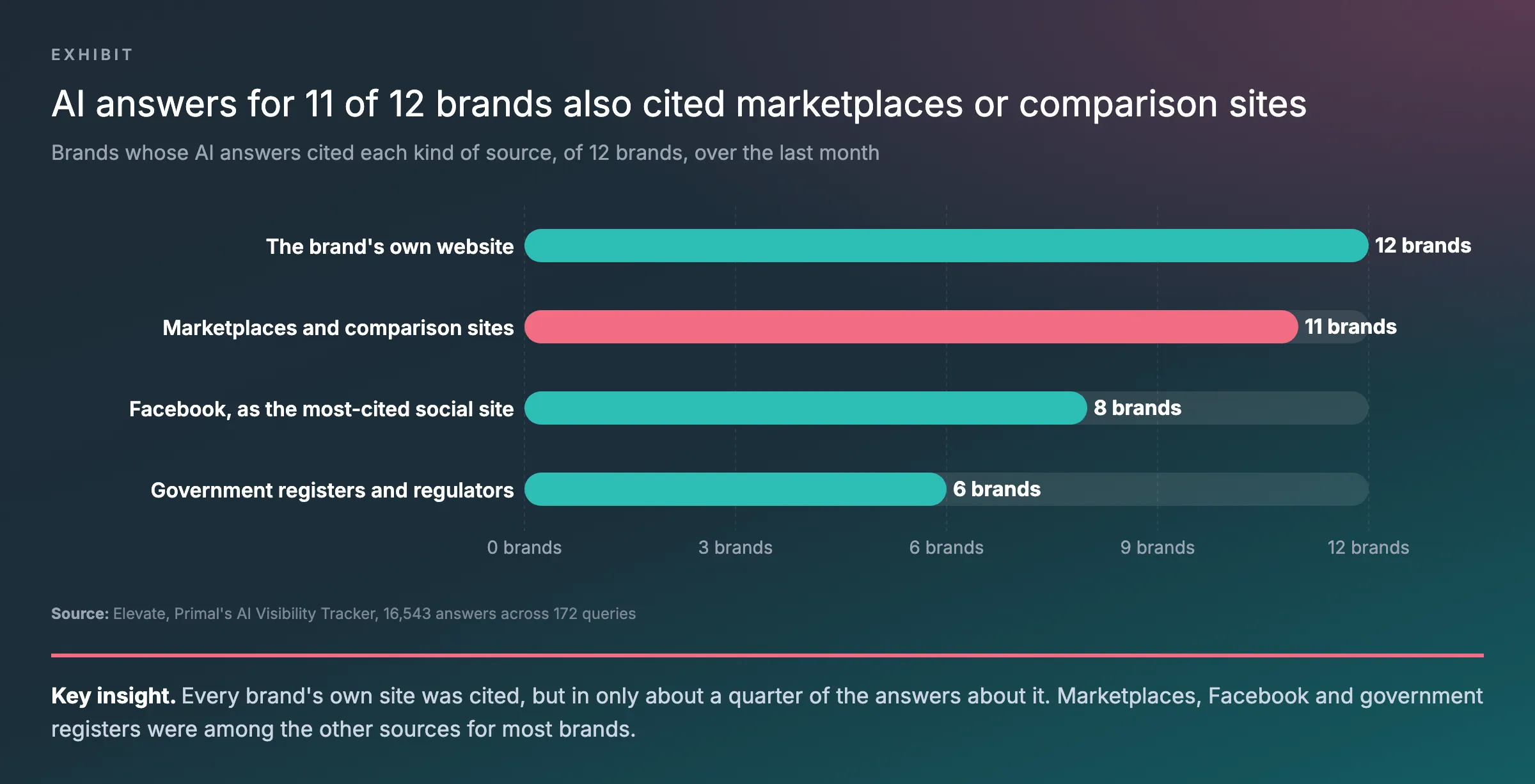
When an artificial intelligence (AI) assistant answers a question about a business, the business’s own website is only one of its sources. Over the last month, Elevate, Primal’s AI Visibility Tracker, logged 16,543 AI answers about 12 brands in 12 industries. A brand’s own website was cited in about a quarter of the answers about it. A competitor’s website was cited about as often. Marketplaces and comparison sites were cited for 11 of the 12 brands. Facebook was the most-cited social site for 8 of them, and government registers appeared for 6.
The chart below puts those numbers side by side, with the brand’s own site, cited for all 12, at the top.
Gemini, Google’s own chat assistant, finds its sources through Google searches it writes itself. So the pages it cites depend on what those searches return. That can be a marketplace or a directory as easily as your own site. A citation in another assistant does not tell you what Gemini cites.
For a business, that means search engine optimisation (SEO) for Gemini, often called Gemini SEO, needs a check of its own. Most of the work is SEO you may already do. A page Gemini cites has to be in Google’s index and rank for the searches Gemini runs. The site also has to leave Google-Extended open. That is the robots.txt setting that covers the Gemini app. After that, ask Gemini your buyers’ questions each month and see which sites it cites.
What Gemini SEO Covers
Gemini SEO means getting your pages cited when one of Google’s Gemini products answers a question. The name covers two products, and each one has its own setting and its own report.
The first is the Gemini app, at gemini.google.com and on phones. The second is Google Search itself. Google has said it uses a custom version of Gemini in AI Mode and AI Overviews. So a business asking for Gemini SEO usually wants both.
| Where the answer appears | Where its sources come from | The setting for your site | Where you see the result |
|---|---|---|---|
| The Gemini app | Google searches the model runs when it decides to search | Google-Extended in robots.txt | Visits in the AI Assistant channel of Google Analytics 4 (GA4) |
| AI Overviews and AI Mode in Google Search | Google’s Search index and ranking systems | The Search generative AI control in Search Console | Search Console’s Generative AI performance report |
AI Overviews have their own guide on this site.
Does Gemini Cite The Same Pages As AI Overviews
Do not assume it does. The Gemini app and AI Overviews both draw on Google’s index, but each runs its own searches and writes its own answer. Different searches can return different pages, so the two can cite different sites for one question.
So a page that appears in AI Overviews still needs testing in the Gemini app, and the other way round.
How Gemini Picks Its Sources
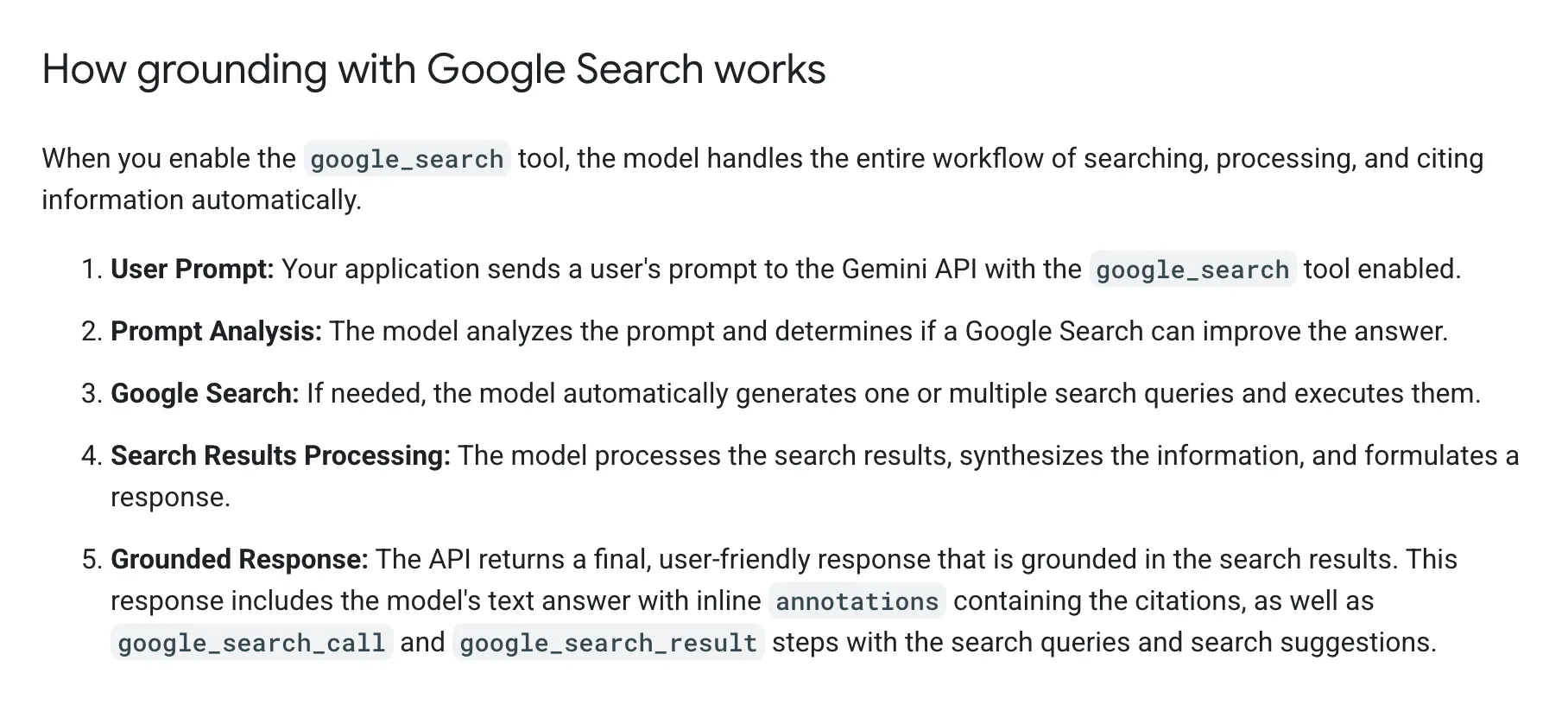
Gemini picks its sources by searching Google when it decides a search would improve its answer. It then cites the pages it used. Google’s developer documentation on grounding with Google Search sets out the steps.
The model reads the prompt and decides whether to search. If it does, it writes one or more search queries and runs them. It reads the results, writes the answer and ties each part to the page it came from. A prompt the model can answer from what it already knows may get no search at all, and so no sources.
The Gemini app works on the same idea. Google’s list of its common crawlers explains grounding in the app. The model is given content from the Google Search index when a prompt arrives. In the app, the pages it used sit behind a Sources button under the answer. Google’s Gemini Apps Help says some answers show no sources at all.
Google’s guide to generative AI features in Search calls these extra searches query fan-out. The model sends several related searches at once to collect more for one question. A buyer who asks which accounting software suits a small company might set off one search on price and another on tax features. Your page has to appear for one of those shorter searches. Their words can differ from the words in the buyer’s prompt.
The Settings That Decide Whether Gemini Can Use Your Site
Two settings decide it, and each covers different products. Google-Extended, a line in robots.txt, covers the Gemini app. The Search generative AI control in Search Console covers AI Overviews and AI Mode.
Google-Extended is a token you can add to robots.txt. Google’s crawler documentation says it lets publishers decide two things. One is whether Google may use their pages to train future Gemini models. The other is whether Gemini may use them for grounding, in the app and in Vertex AI, Google Cloud’s platform for developers. The page also says Google-Extended does not affect whether a site appears in Google Search, and it is not a ranking signal.
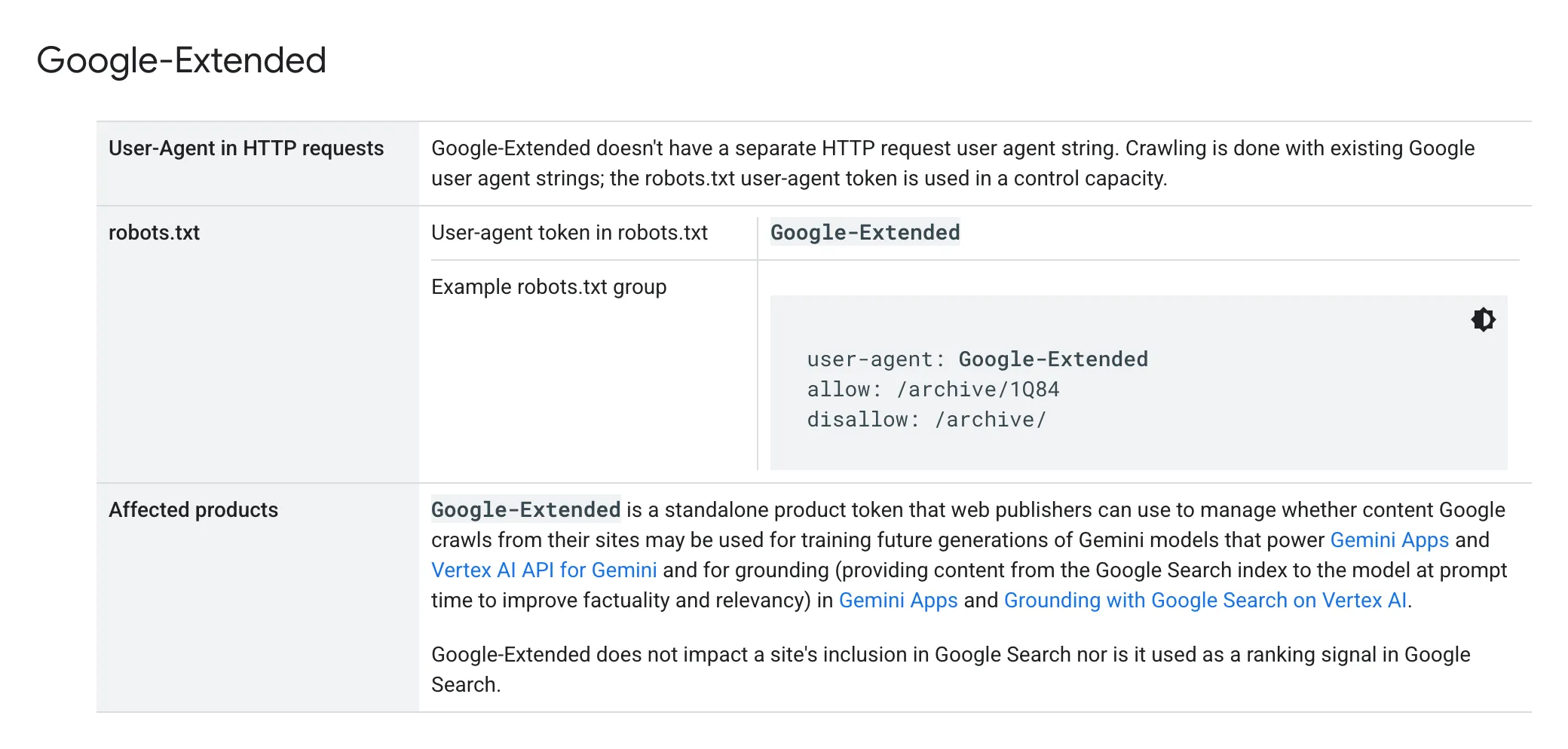
So a robots.txt group of User-agent: Google-Extended and Disallow: / keeps your pages out of Gemini’s training. It also keeps them out of the answers the app grounds in Google Search. Blocking Googlebot goes further. It takes your pages out of Google Search, and so out of the index every Gemini product uses.
The other setting is the Search generative AI control in Search Console, under Settings. Its help page lists AI Overviews, AI Mode and the AI features in Discover. Excluding a site takes its links and content out of those features, usually within a day or two. The Gemini app is not on the list.
I would leave both open for almost every business that sells a product or a service.
How To Get Cited By Gemini
A page gets cited by Gemini when Google has indexed it, it ranks for one of the searches Gemini runs, and Google-Extended is open.
- Open your robots.txt file and look for Google-Extended. If a Disallow line sits under it that nobody chose on purpose, remove it. Check that Googlebot can crawl the pages you want cited.
- In Search Console, confirm that the site is included in the Search generative AI control and that your main pages are indexed. Remove any nosnippet tag you did not mean to set.
- Write down 20 questions your buyers would ask Gemini, in their own words. Ask each one in the Gemini app, open Sources and note the sites it cites. Do it again each month and compare.
- Rank for the shorter searches behind those questions. That is ordinary SEO on content and links, on a site Google can crawl without errors.
- Get listed on the sites AI answers already use for your category. In the data above, those were marketplaces, comparison sites and government registers for most brands. Google’s own Business Profile and Maps results were cited for more than half of the brands too. So keep your Google Business Profile complete. In our separate data on agency questions, 3,693 answers across 66 queries, Clutch, a directory of agencies, was cited in about 4 of every 10, more than any agency’s own site. A full profile with real customer reviews gives an assistant a page about you on a site it already reads. Your own check in step 3 shows which of these sites Gemini uses for your category.
- Put the answer near the top of each page, then add what other pages lack, such as your own data, timelines or photos. Google’s guide calls this non-commodity content. In our data on the 12 brands, answers on technical and health topics also cited document and research sites such as Scribd, ResearchGate and PubMed. A published specification or study gives an assistant something a product page does not.
Seeking inauthentic mentions is less helpful than it may seem, Google’s guide warns. Its spam systems apply to AI features too. I would put fake reviews in that group. A paid listing on a directory is not spam, it is a normal placement, as long as the listing is accurate.
What You Can Skip
Google’s guide lists several things that Google Search and its AI features do not need. Search does not use llms.txt files or other markup made only for AI. Content does not need splitting into small chunks. No special schema markup is needed for AI answers either.
Several of the pages ranking for Gemini SEO still recommend frequently asked questions (FAQ) and HowTo schema as a way to get cited. Structured data does help a page qualify for rich results, which our guide to schema markup covers. Google’s guide does not list it as a way to get cited in AI answers. The Gemini app grounds its answers in the same Search index, so I would follow the same guide for the app.
How To Measure Gemini Visibility
Measure the Gemini app in Google Analytics, and Gemini inside Google Search in Search Console. Neither report shows a Gemini app citation that nobody clicked.
Google Analytics 4 has an AI Assistant channel in its default channel group. It holds visits from assistants such as ChatGPT and Gemini. Visits from AI Overviews and AI Mode go to Organic Search instead. Filter the AI Assistant channel to sessions with Gemini as the source. Then look at which pages those visitors reach.
For AI Overviews and AI Mode, Search Console’s Generative AI performance report shows how often each page appears. You can split it by page, country, device and date. It shows impressions, not clicks.
Gemini already sends some of these visits. StatCounter’s figures for Malaysia show which AI chatbots send people to websites. Gemini comes second to ChatGPT, with about one visit in seven.
For citations nobody clicked, use the monthly check from step 3. A tracker that asks Gemini the same questions every day also works. Our guide to measuring AI search visibility compares the options.
What Gemini SEO Means For Your Business
In our own data, a brand’s own website was one source among many in the AI answers about it. Gemini picks its sources from Google’s index through searches it writes itself. So most of the work is ordinary SEO. On top of it, leave Google-Extended open, keep your listings complete and look at what Gemini says each month. Check the app and Google Search in their own reports. Neither one covers the other.
Primal was founded in 2015 and has offices in Kuala Lumpur, Bangkok and Singapore. Our AI SEO team works on getting brands cited in Gemini, Google AI Overviews and ChatGPT, as part of their SEO.
Frequently Asked Questions About Gemini SEO
Is Gemini SEO different from Google SEO?
Only in a few places. Gemini draws its sources from the Google Search index, so a page that is indexed and ranks for the right searches is already a candidate. The differences are Google-Extended, which affects only Gemini, and the need to check Gemini’s answers on their own.
When somebody searches, what is being used to show results related to our brand?
Gemini uses the pages that come back from the Google searches it runs for the question. In our data on 12 brands, a brand’s own website was cited in about a quarter of the AI answers about it. Marketplaces, comparison sites, government registers and Facebook were among the other sources. So list the sites Gemini cites for your buyers’ questions, then fix what those pages and your own say about you.
Does blocking Google-Extended remove my site from Google Search?
No. Google’s crawler documentation says Google-Extended does not affect whether a site appears in Google Search and is not a ranking signal. It does stop Google using your pages to ground answers in the Gemini app and to train future Gemini models.
Can I see Gemini app citations in Search Console?
No. Search Console’s Generative AI performance report covers AI Overviews and AI Mode. Visits from the Gemini app appear in Google Analytics 4, in the AI Assistant channel. A Gemini app citation that nobody clicks appears in neither report.
Does schema markup help a page appear in Gemini?
Google’s guide to generative AI features says no special schema is needed for AI answers in Search. It still recommends structured data for rich results. For the Gemini app, which grounds its answers in the same index, I would follow the same advice.
Founder and Chief Executive Officer
Mark McDowell is the Founder and Chief Executive Officer of Primal, which he started in Bangkok in 2015. He is on the Forbes 30 Under 30 Asia 2020 list and was Campaign Asia’s Southeast Asia Young Achiever of the Year in 2018. He writes about AI search and search engine optimisation.
About The Author


