By Mark McDowellPosted: 14 min read
What Is Answer Engine Optimisation (AEO)?
Answer engine optimisation (AEO) is the work of making your page the one an answer engine quotes when it answers a question, in a Google featured snippet, an AI Overview, ChatGPT or Gemini. Each engine searches an index, reads the pages it finds and cites the ones that support its answer. So your page must be reachable, indexed, allowed to be quoted, and answer the question in its first sentences.
Key Takeaways
- AEO starts with a page that can rank. Google's documentation says no markup can claim a featured snippet or a place in an AI Overview, and its systems choose the page.
- Competitors are cited as often as you. In 16,543 AI answers logged over the last month by Elevate, Primal's AI Visibility Tracker, a brand's own website was cited in only about a quarter of the answers about it, and a competitor's site about as often.
- Narrow answers can be cited for broad questions. Google AI Overviews and AI Mode run several related searches behind one question.
- Blocking OAI-SearchBot removes you from ChatGPT search. OpenAI says a blocked site is left out of ChatGPT search answers, and a robots.txt change takes about a day to apply.
- Questions trigger AI summaries far more often. In Pew Research's study of Google searches, 60% of searches that began with a question word produced an AI summary, against 18% of all searches.
What Is Answer Engine Optimisation
Answer engine optimisation (AEO) is the work of making your page the one an answer engine quotes. An answer engine gives the answer first and the links second. Google’s featured snippets and People Also Ask box work this way. So do AI Overviews, Google’s AI Mode, ChatGPT, Gemini and the voice assistant on a phone.
The data in Elevate, Primal’s AI Visibility Tracker, changed how I think about the job. Over the last month, a brand’s own website was cited in only about a quarter of the AI answers about it. So AEO is two jobs. The first is a page that is easy to quote. The second is presence on the sites the assistants already trust.
The articles that rank for this search define AEO in two ways. Coursera defines it by featured snippets and answer boxes on the results page. HubSpot, which sells a tracking tool, defines it by how often a business appears in answers from ChatGPT, Gemini and Perplexity. I use one definition that covers both, because both formats need the same thing from a page. That is a passage that answers the question on its own, on a page the engine can reach and is allowed to quote.
Google treats AEO as part of search engine optimisation (SEO). Its guide to AI features in Search says AEO and generative engine optimisation (GEO) are names for work on how a brand shows up in AI search. From Google’s side, that work is still SEO. It also says many suggested AEO hacks do nothing in Google Search. For how the three terms compare, see SEO vs AEO vs GEO.
Where Answers Appear And Who Picks Them
Each answer engine chooses its own source, and each gives you one setting that can take your page out. None gives you a setting that puts it in.
| Answer format | Where it appears | Who picks the page | What you control |
|---|---|---|---|
| Featured snippet | The top of Google’s results, inside People Also Ask, or beside the knowledge panel | Google’s systems, judging how well a passage answers the search | nosnippet or data-nosnippet removes text, and a low max-snippet value makes a snippet less likely |
| People Also Ask | The expandable questions in Google’s results | Google’s systems choose the questions and the pages | The same snippet settings |
| AI Overviews and AI Mode | Google Search | Google’s core ranking systems, often through several related searches at once | The snippet settings, plus the Search generative AI setting in Search Console for the whole site |
| ChatGPT search | ChatGPT | OpenAI’s search, which reaches pages through its OAI-SearchBot crawler | Allow or block OAI-SearchBot in robots.txt |
| Gemini | The Gemini app | Google Search, when Gemini decides a search will help | Google-Extended in robots.txt, which covers Gemini app answers but not Google Search |
| Spoken answers | Phones and other devices people talk to | Google’s systems, often from a featured snippet | max-snippet also applies to Google Assistant |
Google’s featured snippets documentation says there is no way to mark a page as a featured snippet. Google’s systems decide which page would make a good one. The same page says a low max-snippet value makes a snippet less likely without a guarantee, and points to nosnippet when a site needs certainty.
The settings reach AI answers too. Google’s robots meta tag documentation says nosnippet applies to every form of Google result, AI Overviews and AI Mode included. It stops the page being used as a direct input for those two features.
Featured snippets also have their own policies. Google removes snippets that break its content policies for Search. On civic, historical, medical and scientific topics, a snippet should not contradict expert consensus. A site with many snippets that break the policies stops getting featured snippets at all.
Which AI Assistants People In Malaysia Use
Of the AI chatbots, ChatGPT sends the most visits to websites in Malaysia, and Gemini comes second. StatCounter tracks the visits that chatbots send to the sites that use its code. It puts ChatGPT at about four visits in five and Gemini at most of the rest. Perplexity, Copilot and Claude share the remainder.
Google AI Overviews are not in those figures, because they sit inside Google Search. Google shows one only when its systems judge that it adds to the results. So a business should plan for Google AI Overviews, ChatGPT and Gemini first, and let the rest wait until those three are in order.
How AI Assistants Choose The Pages They Cite
Each assistant turns the question into one or more searches. It reads the pages that come back and cites the ones that support its answer. Google’s name for that step is retrieval-augmented generation, or grounding.
Your page can only be picked if the assistant’s crawler can reach it, if it sits in the index the assistant searches, and if a passage on it answers one of those searches.
What Query Fan-Out Means
Query fan-out is the set of related searches an assistant runs behind one question. Google’s guide gives an example. For “how to fix a lawn that’s full of weeds”, the extra searches might include “best herbicides for lawns” and “how to prevent weeds in lawn”.
So one buyer question can pull in pages written for narrower questions. Take a buyer who asks which accounting software suits a small business. The searches behind it could cover price, features, local support and user reviews. A page that answers one of those well can be cited, even if it never answers the whole question.
How Google AI Overviews And AI Mode Choose
Google AI Overviews and AI Mode pick their links from Google’s own Search index. Google’s guide says both use its core ranking systems to find fresh pages, then link the pages that support the answer.
Google’s page on AI features and your website states what a page needs to get in. A page must be indexed and able to show a snippet in Google Search. There are no extra technical requirements, and no special markup.
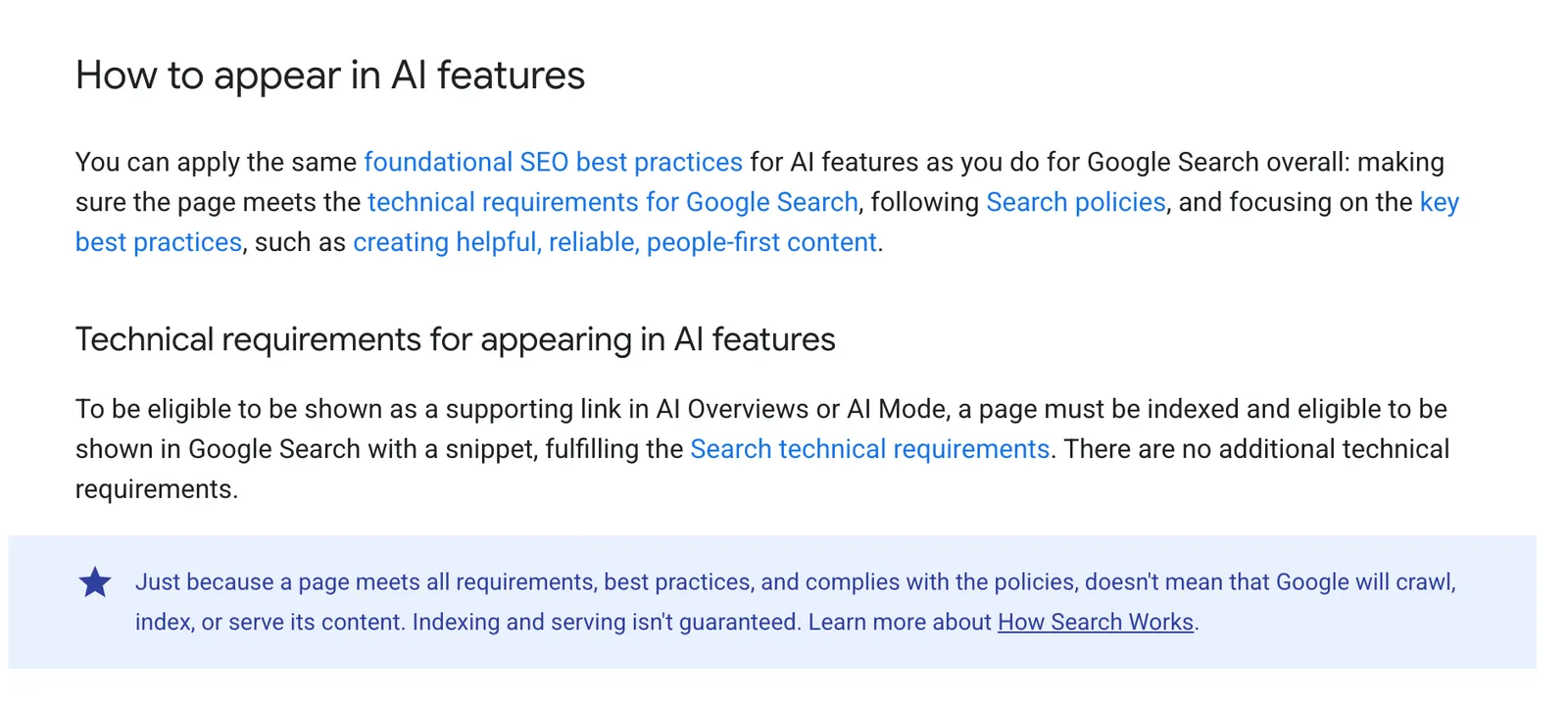
Meeting that requirement does not promise a link. Google says indexing and serving are not guaranteed. The two features may also use different models, so the links they show will differ.
How ChatGPT Chooses
ChatGPT searches the web when a question needs current facts, then cites the pages that support its answer. OpenAI’s help page on searching with ChatGPT says it often rewrites the question into one or more shorter searches for its search partners. After it reads the first results, it may send more specific searches. It can also add the user’s rough location, so a question typed in Kuala Lumpur can bring local pages into the answer.
OpenAI’s crawler page states the condition. Sites that block OAI-SearchBot are not shown in ChatGPT search answers. A robots.txt change takes about a day to apply. GPTBot is a separate crawler for training, so blocking it does not remove a site from ChatGPT search. The site’s host or content delivery network must also let OpenAI’s published IP addresses through.
How Gemini Chooses
Gemini first decides whether a Google search will help its answer. If it will, Gemini writes one or more searches, reads the results and cites the pages it used. Google’s developer guide on grounding Gemini with Google Search sets out these steps.
One setting is Gemini’s own. It is called Google-Extended, and you set it in robots.txt. Google’s crawler documentation says it decides whether your pages can train Gemini models and back up answers in the Gemini app. It does not change whether a site appears in Google Search. Block it, and your pages leave Gemini app answers while Google Search can still show them.
Why Questions Get Answers
Answer formats show up most on questions. A Pew Research study of Google searches found that 18% produced an AI summary.
The share rose to 60% for searches that began with a question word such as who, what, when or why. Long searches and full sentences got a summary far more often than one or two words did. The chart shows the share for each kind of search.
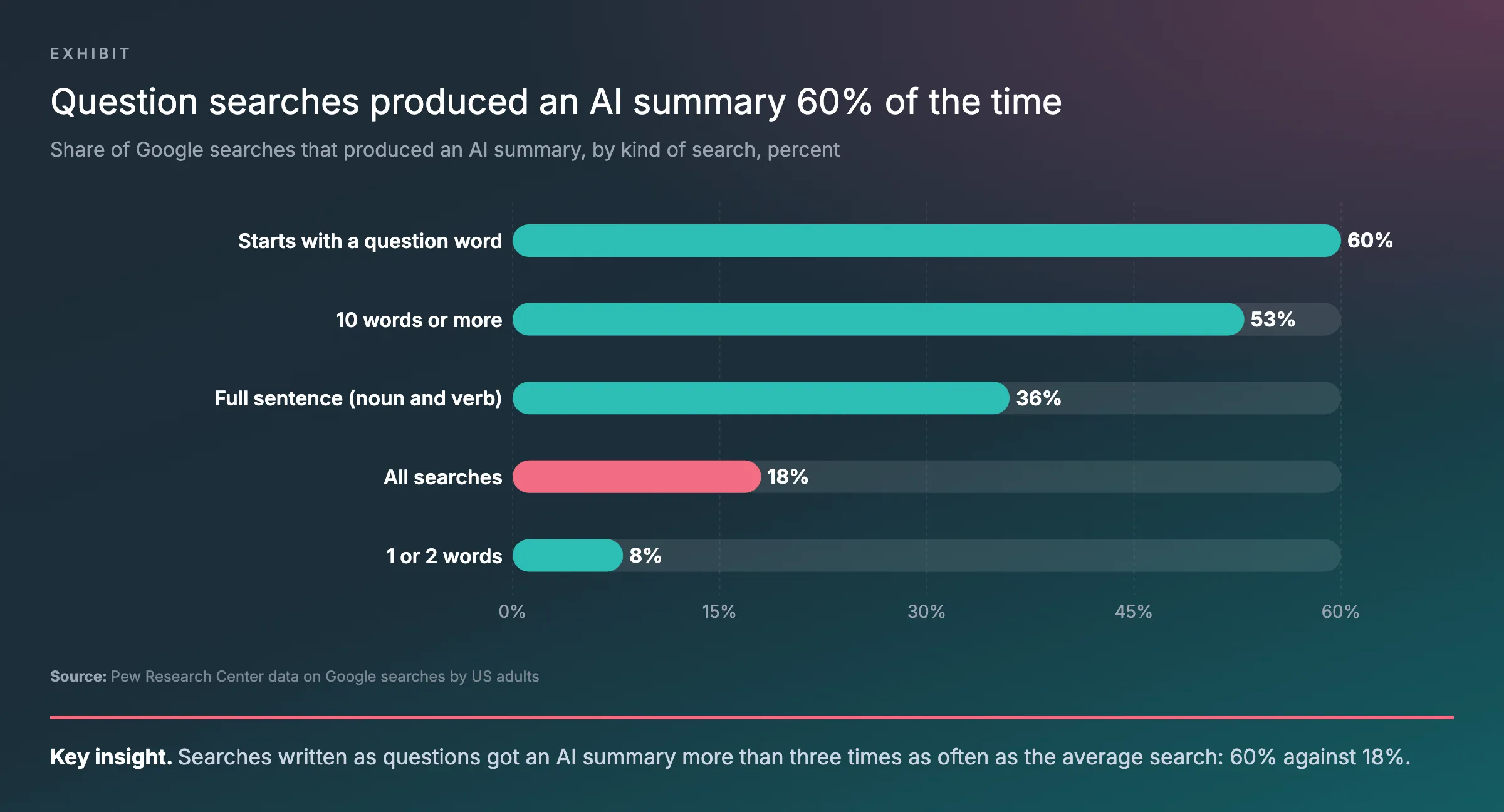
So AEO work begins with the questions buyers type, especially the long and specific ones.
What AI Answers Cite For Buyer Questions
Most AI answers about a brand do not cite the brand’s own website. Over the last month, Elevate, Primal’s AI Visibility Tracker, logged 16,543 AI answers across 172 buyer questions about 12 brands in 12 industries. A brand’s own site was cited in about a quarter of the answers about it, and a competitor’s site about as often.
The brands run from a university and a used-car marketplace to a skincare brand and an industrial equipment supplier. Most of the questions take the forms buyers type, such as “best X”, “X vs Y”, “how much does X cost” and “where to buy X”.
The other sources were much alike across these very different industries. Marketplaces, comparison and listing sites appeared in the answers for 11 of the 12 brands. In consumer categories such as cars, education, skincare and flowers, they were cited as often as the brand itself. Google’s own Business Profile and Maps results appeared for 7 of the 12 brands. A government register or regulator appeared for 6, such as the qualifications agency for a university or the construction board for concrete.
Social pages were among the sources too. Facebook was the most-cited social source for 8 of the 12 brands, YouTube for 3 and Instagram for 1. The chart shows that split by brand.
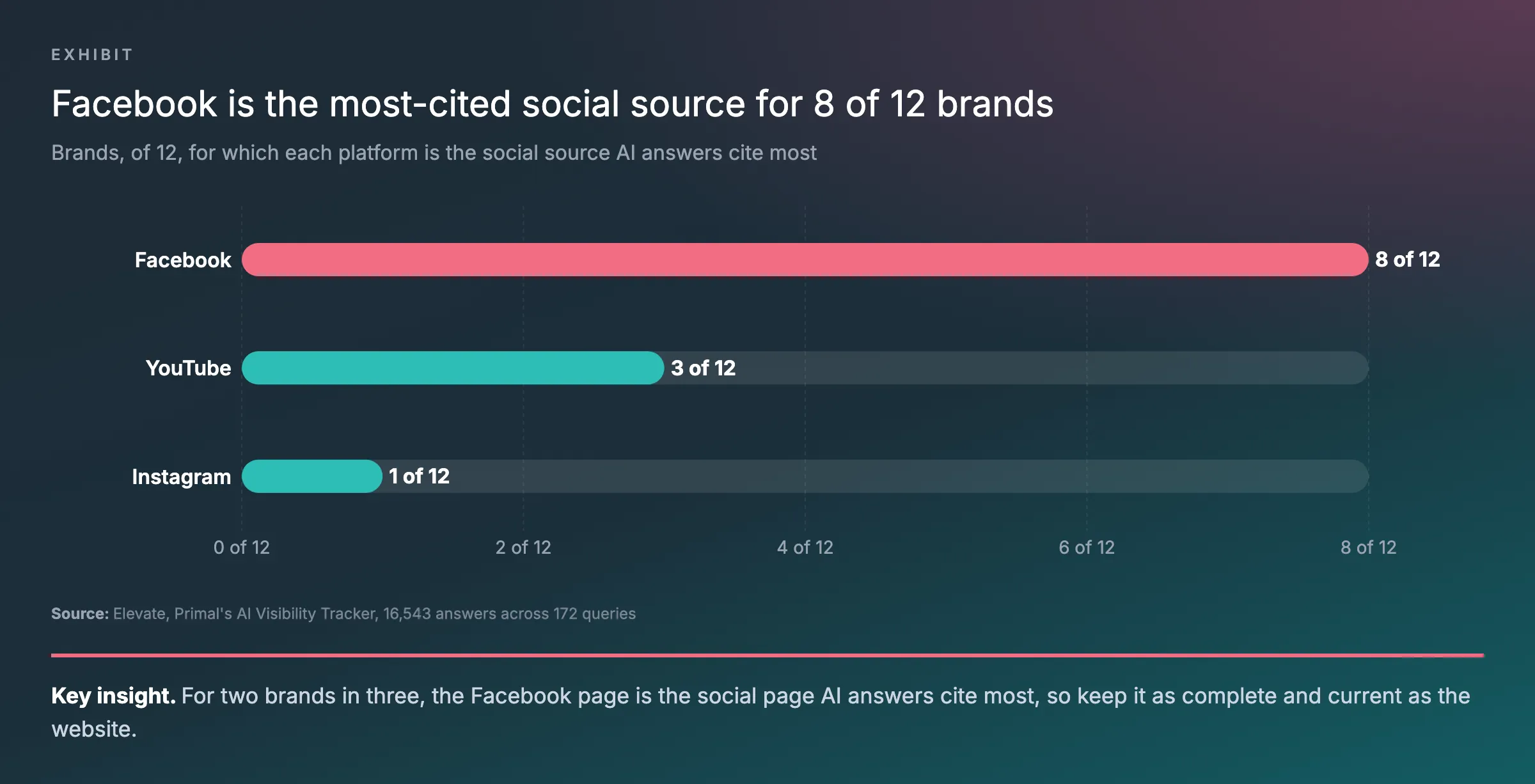
So for most brands, the Facebook page is part of what an assistant reads. Give it the same name, services, locations and contact details as your website.
Your own pages are only part of AEO. The rest is being listed, accurately, on the sites the assistants already cite for your category. Google’s guide warns that fake mentions are not as helpful as they seem, so this means real listings, reviews and coverage.
How To Write An Answer That Can Be Quoted
An answer engine lifts a passage out of your page and shows it without the text around it. The passage has to answer the question by itself, so every answer should pass four tests.
- The first sentence answers the question in the heading.
- The answer still makes sense when read alone, with no “this” or “it” that points back to an earlier paragraph.
- Any figure carries its source in the same sentence.
- The detail, the exceptions and the steps come after the answer.
The same section is written twice below, for the question “Does nosnippet keep my page out of AI Overviews?”
Before: Many site owners are unsure how Google’s newer search features treat their content, and the topic has been discussed at length. Before getting to the answer, it helps to look at how snippets have worked over the years and why Google offers settings to control them.
After: Yes. Google’s robots meta tag documentation says the nosnippet setting stops a page’s text from appearing in AI Overviews and AI Mode. To keep only part of a page out, wrap that part in an element with the data-nosnippet attribute.
| Before | After | |
|---|---|---|
| Words before the answer | All of them, and the answer never arrives | None, the first word is the answer |
| Makes sense if quoted alone | No | Yes |
| Names its source | No | Yes |
| Tells the reader what to do next | No | Yes, data-nosnippet for part of a page |
The Quick Answer at the top of this page uses the same pattern. Its first sentence answers the question in the title, and it would still be true if an answer engine showed it alone.
The platforms give no target length. Google publishes no exact length for a featured snippet, and in Pew’s data the typical AI summary ran to about 70 words. HubSpot’s guide suggests 40 to 60 words, a figure Google does not publish. I would write the answer in one or two sentences and put the detail after it.
How To Do Answer Engine Optimisation
Start with access, then answers, then the other sites that get cited. The first two steps are checks a developer can run. The rest is ongoing work for your marketing team.
- Open your robots.txt file and check that it allows Googlebot and OAI-SearchBot. Ask your host or developer whether the firewall blocks OpenAI’s published IP addresses. Decide on Google-Extended on purpose, since blocking it keeps your pages out of Gemini app answers.
- In Search Console, inspect your main pages to confirm Google has indexed them. Check the page’s robots meta tag and response headers for nosnippet or a max-snippet value of zero, and check that no data-nosnippet element wraps the answer. Then confirm the site is included in the Search generative AI features setting.
- List 20 to 30 questions your buyers ask. Take them from your Search Console queries, the People Also Ask box and the questions your customer service team hears. Add the narrower questions around each one, such as price, comparisons, location and reviews.
- Give each question one page, or one section of a page, under a heading that matches the question. Put the answer in the first one or two sentences, using the four tests above. Do not make a separate page for every way a question can be phrased. Google’s guide says doing that to sway its results breaks its scaled content abuse policy.
- Add what only your business can say. Google’s guide asks for non-commodity content, such as first-hand experience and a point of view that a summary of other pages cannot give.
- Keep your Google Business Profile and Merchant Center details current. Google’s guide says both help local firms and products appear in AI answers.
- Ask your questions in each assistant and note which sites it cites. Then check your listing, reviews and details on those sites. They are often marketplaces, comparison and review sites, government registers and your Facebook page.
- Each month, ask the same questions in each assistant and record whether you are mentioned and whether you are cited.
HubSpot’s guide and PwC’s explainer both recommend schema markup for AEO. Structured data helps a page qualify for rich results, and Google’s guide says no special markup is needed for its AI features. I would add it where it describes the page accurately, without expecting it to make a page the answer.
The steps for each platform’s crawler are set out in how to get cited in AI search.
In this video from my YouTube channel, I go through the site basics that work for all three assistants at once, from crawling and indexing to tracking citations.
How To Measure Answer Engine Optimisation
Search Console records each answer format in its Performance report, and its help page on impressions, position and clicks explains how. A featured snippet is recorded like a normal result and typically takes position one. A People Also Ask answer records an impression only when someone expands the question. An AI Overview takes a single position, and every link inside it shares that position.
For a question search, an average position close to one is worth checking by hand. Search the question yourself and see whether your page is the snippet, and what the snippet says.
For AI Overviews and AI Mode, use Search Console’s Generative AI performance report. It shows impressions in those two features by page, country, device and date.
Answer engines outside Google need a manual check. Ask the same list of questions in ChatGPT and Gemini each month and record two things for each answer. A mention means your brand appears in the answer. A citation means the answer links to your site. When mentions rise and citations do not, the engine knows your brand while quoting other pages about it. Track mentions, citations and share of voice as well as visits, because an answer can end the search with no click at all, which is called a zero-click search. Pew notes that the AI summary for a search changes over time, so compare one month with the next and judge the trend. The monthly report is set out in how to measure AI search visibility.
How To Choose The Questions To Track
Customers often ask us how to decide which keywords and prompts to track, and whether to pick the top ones or the ones most relevant to their industry. Start with the most relevant ones, the questions your buyers ask before they buy from you. Take them from your Search Console queries, the People Also Ask box and your customer service team, as in step 3 above. Keep the list the same each month, so the trend means something.
What AEO Means In Malaysia
In Malaysia the letters AEO already have a meaning. The Royal Malaysian Customs Department has run an Authorised Economic Operator programme since 2010. It accredits manufacturers, importers, exporters, warehouse operators and logistics providers that meet its security and compliance standards.
So spell out answer engine optimisation in briefs, job adverts, proposals and page titles before you use the short form. A buyer or a job applicant who reads AEO on its own may think of customs. If your buyers ask questions in Bahasa Malaysia as well as English, write the answer in each language on the page that serves that language, and check both in the same monthly list of questions.
If you would like help with these steps, Primal’s AEO services in Malaysia start with the questions your buyers ask. We write answer-first pages for them and track which assistants quote your brand in Google, ChatGPT and Gemini. Primal started in 2015 and has offices in Kuala Lumpur, Bangkok and Singapore.
Frequently Asked Questions About Answer Engine Optimisation
Is answer engine optimisation the same as SEO?
It is part of SEO. Google says AI Overviews and AI Mode rely on its core ranking systems and only use indexed pages, so the page has to be indexed and able to rank first. AEO adds work on the answer itself, on each assistant’s crawler and on the other sites that get cited.
Can schema markup make my page the answer?
No. Google’s featured snippets documentation says no page can be marked as a featured snippet, and its guide to AI features says no special markup is needed for AI Overviews or AI Mode. Structured data still helps a page qualify for rich results in normal search.
How long should an answer be?
Google publishes no exact length for a featured snippet and says the minimum varies with the information, the language and the device. In Pew Research’s data the typical AI summary ran to about 70 words. One or two sentences that answer the question, with the detail after them, is the pattern I would use.
How do I stop Google quoting my page?
Add the nosnippet setting to the page, which removes its text from regular snippets, featured snippets, AI Overviews and AI Mode. To keep only part of a page out, use the data-nosnippet attribute on that part. To leave the whole site out of AI Overviews and AI Mode, exclude it in the Search generative AI setting in Search Console.
Is Gemini linked to Google?
Customers often ask us whether Gemini is linked to Google. Yes, Gemini is Google’s own AI assistant. When it decides a search will help, it searches Google and cites the pages it used. The Google-Extended setting in robots.txt covers Gemini app answers but not Google Search.
Is answer engine optimisation the same as the customs AEO in Malaysia?
No. In marketing, AEO means answer engine optimisation. The Royal Malaysian Customs Department’s AEO is the Authorised Economic Operator programme it has run since 2010 for traders that meet its security and compliance standards.
Founder and Chief Executive Officer
Mark McDowell is the Founder and Chief Executive Officer of Primal, which he started in Bangkok in 2015. He is on the Forbes 30 Under 30 Asia 2020 list and was Campaign Asia’s Southeast Asia Young Achiever of the Year in 2018. He writes about AI search and search engine optimisation.
About The Author