



By Mark McDowellPosted: 9 min read
How To Measure AI Search Visibility Each Month
Measure AI search visibility as four numbers read over a whole month, per platform: visibility (the share of answers that name you), share of voice, mentions and citations. A prompt tracker such as Ahrefs Brand Radar or Semrush's AI Visibility Toolkit gives those, and Search Console, Bing Webmaster Tools and Google Analytics show where AI features display your pages or send visits.
Key Takeaways
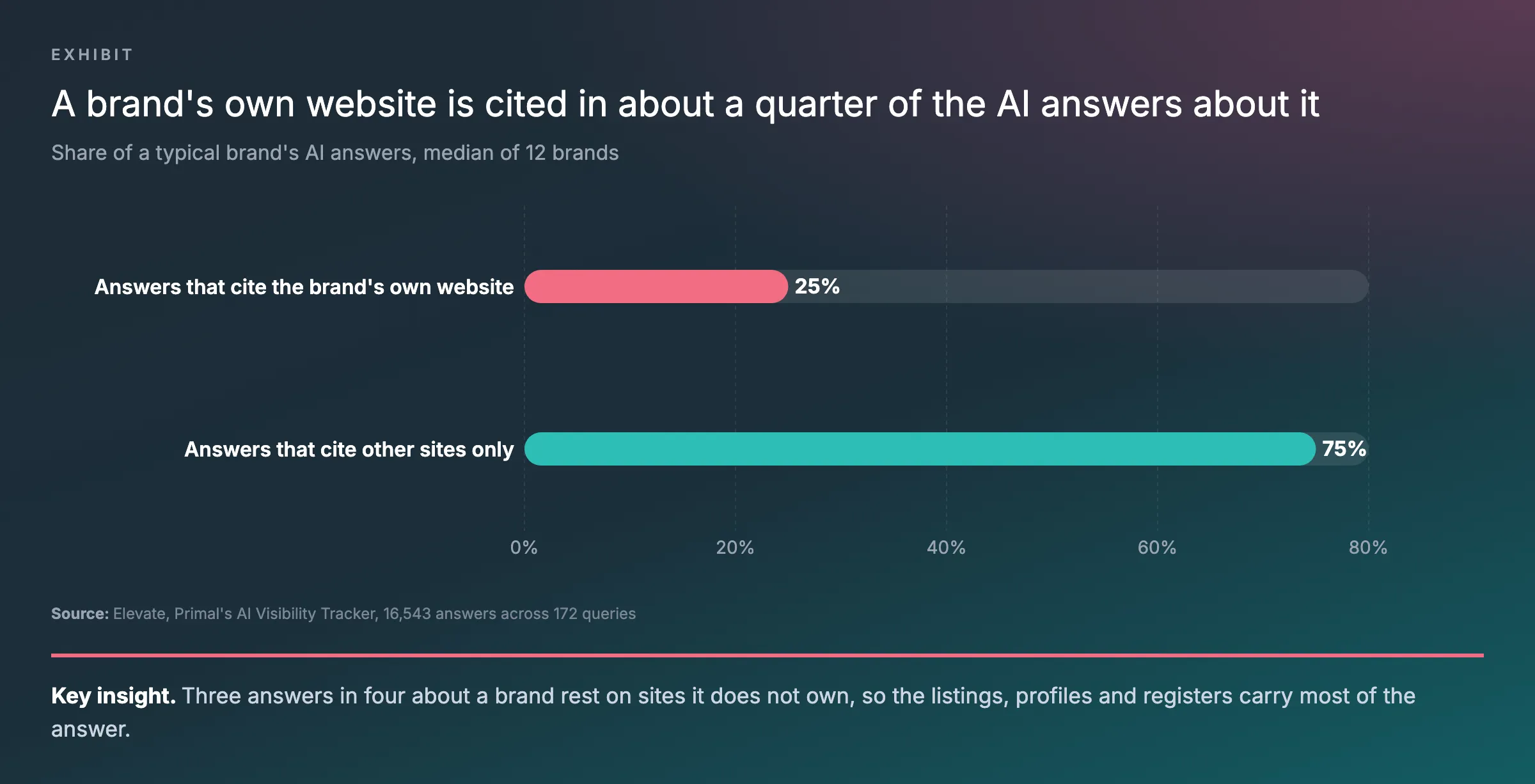
- Most AI answers skip the brand's own site. Over the last month Elevate, Primal's AI Visibility Tracker, logged 16,543 AI answers across 172 queries, and a brand's own website was cited in only about a quarter of the answers about it.
- Report the other sites the answers cite. A competitor's site was cited about as often as the brand's own, so the citations line in a report should list them.
- Check listings before writing another post. Marketplaces and comparison sites appeared in the AI answers for 11 of the 12 brands.
- Read AI metrics as monthly averages. AI answers change from one run to the next, so read visibility, share of voice, mentions and citations as an average per platform.
- Every site gets Google's AI report. Search Console's Generative AI performance report shows how often Google's AI Overviews and AI Mode display your pages.
What A Month Of AI Answers Showed
A brand’s own website is cited in only about a quarter of the artificial intelligence (AI) answers about it. That is what a month of AI answers about 12 brands shows. It changes how to measure AI search visibility. So read four numbers each month, per platform, and list the sites the answers cite. Then add the platform reports that show what reaches your own site.
The data comes from Elevate, Primal’s AI Visibility Tracker. Over the last month it logged 16,543 AI answers across 172 queries about 12 brands. The brands come from 12 industries, from a university to an online florist. The queries are the questions a buyer asks, such as which brand is best and where to buy. A competitor’s site was cited about as often as the brand’s own. Most other sources were places a buyer goes to compare and check. Marketplaces, review sites, registers and Facebook were among them.
Each of those sources is a page a brand can check and correct. A report that rolls everything into one score hides them.
The Four Numbers That Measure AI Search Visibility
AI search visibility is how often AI answers name or cite your brand when people ask the questions your buyers ask. Four numbers measure it. They are visibility, share of voice, mentions and citations. They measure different things, so a monthly report needs all four.
| Number | What it measures | What it can hide |
|---|---|---|
| Visibility | The share of answers that name the brand | A strong total can hide a weak topic |
| Share of voice | The brand’s share of all mentions of the brands you track | It changes with the list of rivals you chose |
| Mentions | Answers that name the brand | An answer can name you and link to someone else |
| Citations | Answers that link to the brand’s own site | Most cited pages belong to other sites |
Read on their own, the numbers mislead in different ways. Share of voice depends on the brands you choose to track. Add a stronger rival to the list and your share falls, even if the answers stay the same. Visibility does not depend on who else you track. That makes it the better number to compare month to month.
The gap between mentions and citations matters most. An assistant can name a brand while it links to other people’s pages. So the citations line in a report should list the other sites the answers cite, beside your own pages. A tracker’s list of cited pages shows them.
Which AI Platforms To Measure
Start with Google’s AI Overviews and AI Mode, and with ChatGPT. Then add Gemini, Perplexity or Microsoft Copilot where your buyers use them. Track each platform on its own line, so a change on one is not hidden by the others.
Visit data puts ChatGPT first among the assistants. In Malaysia, StatCounter’s AI chatbot figures show ChatGPT sent about 8 in 10 of the visits that AI chatbots referred to websites. Gemini sent about 1 in 7. AI Overviews and AI Mode sit inside Google Search, so their visits arrive as Google search visits.
Check the split for your own market before you choose.
How To Measure AI Overviews And AI Mode In Search Console
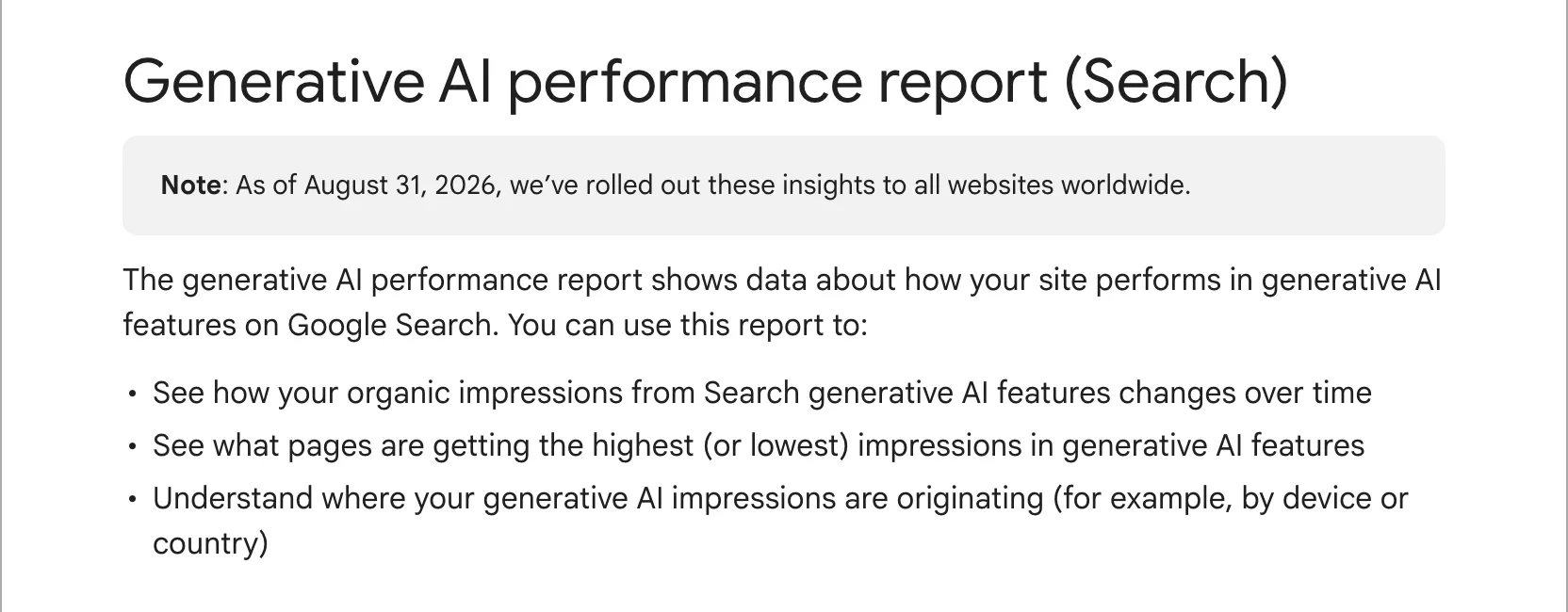
Use the Generative AI performance report in Google Search Console. It records an impression each time a link to your site appears in an AI Overview or in AI Mode. Google has opened it to every website, according to its help page for the report.
- Open Search Console, then Performance, then the Generative AI report.
- Set the dates to the last full month and compare it with the month before.
- Open the Countries tab and pick the markets you sell in.
- Open the Pages tab to see which of your pages Google shows most in its AI features.
The report shows impressions only. You can group them by page, country, device and date, and filter text searches from image searches. It does not show the searches behind each impression. If the report is missing, Google gives two likely reasons. The site may not have enough impressions in AI features yet. Or it may be excluded from Search generative AI features.
How To Measure Copilot Citations In Bing Webmaster Tools
Bing Webmaster Tools has an AI Performance report, still in public preview. It shows when Microsoft Copilot and the AI summaries in Bing cite your pages.
Microsoft’s help page for the report lists your total citations, the pages cited, and the grounding queries. Those are the short phrases the AI searched for before it cited you. Microsoft also says a citation is not a click, and the data is a sample.
Copilot sent only a small share of AI chatbot visits in StatCounter’s Malaysian figures. I would still set the report up. It is the only platform report that shows the phrases behind the answers.
How To See AI Visits In Google Analytics
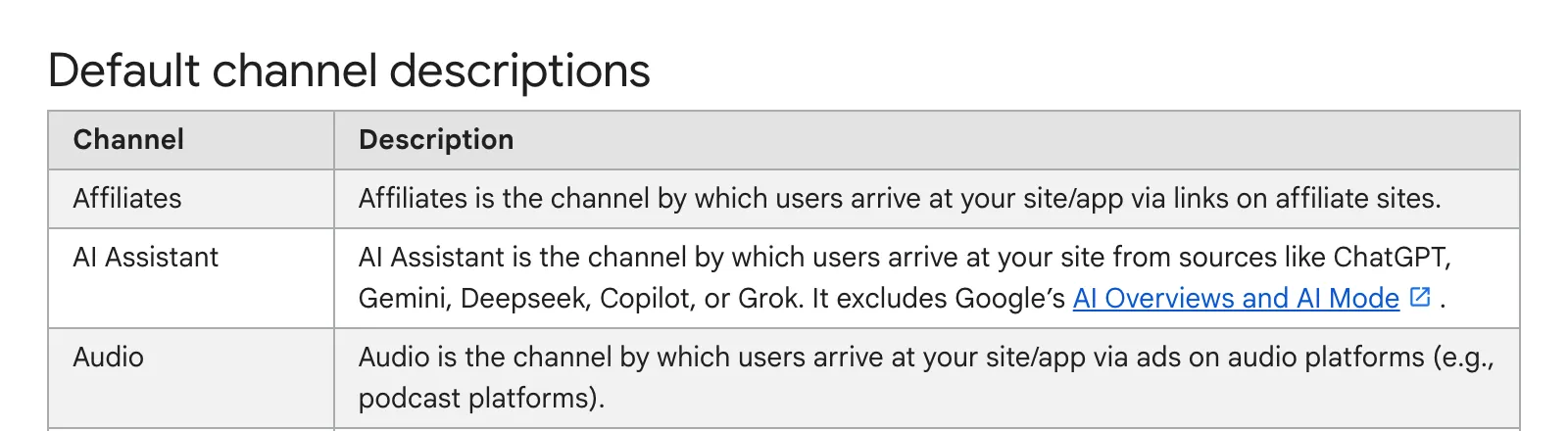
Google Analytics has an AI Assistant channel in its default channel group. It groups visits from assistants such as ChatGPT, Gemini, DeepSeek, Copilot and Grok. Visits from Google’s AI Overviews and AI Mode are left out and stay in Organic Search.
- Open Reports, then Acquisition, then Traffic acquisition.
- Set the table to Session default channel group and find the AI Assistant row.
- Add landing page as a secondary dimension to see where AI visitors start.
- Read the key events column to see what they do next.
This tells you what AI visitors do once they arrive. It cannot tell you how often an answer mentioned you.
Which Tools Track AI Answers
A prompt tracker asks AI platforms a fixed set of prompts and stores each answer. It records which brands are mentioned and which pages are cited. It is the only way to get visibility, share of voice and mentions. The platform reports cover your own site and nothing else.
Ahrefs Brand Radar and Semrush’s AI Visibility Toolkit are two options. Dedicated trackers such as Peec AI and Profound work the same way. Ahrefs Brand Radar draws its prompts from Ahrefs’ keyword database, according to its help centre. It asks each prompt in the country its keyword came from. Custom prompts let you add your own questions, pick a location and check them as often as daily.
Semrush’s AI Visibility Toolkit holds prompts and answers from ChatGPT, Gemini, Google AI Overviews and AI Mode. Its Prompt Tracking tool checks your own prompts every day, in the location you set. Check that its ready-made database covers your country before you rely on it.
My video on measuring whether AI is recommending your brand, from my YouTube channel.
I would set up the three platform reports before paying for a tracker. They cost nothing beyond a verified site. Add a tracker when you need competitor figures. Add one too when you need to know what ChatGPT says about you, since no platform report shows that. The figures in this post come from Elevate, Primal’s AI Visibility Tracker, which works the same way.
Why One Day Of AI Answers Misleads
AI answers change from one run to the next, so one check is a sample of one. SparkToro’s study shows how much. Volunteers ran the same prompts through ChatGPT, Claude and Google’s AI many times over. The chance of getting the same list of brands twice was less than 1 in 100.
SparkToro judged that the share of answers that mention a brand, across many prompts run several times, is a fair measure. It found a brand’s position inside an answer too random to use.
So fix the method before you read the results.
- Choose the prompt set at the start of the period and keep it. Then a change in the numbers comes from the answers.
- Group the prompts by topic, from first questions to comparisons between brands.
- Ask each prompt on each platform daily where the tool allows it.
- Report the month’s average per platform and per topic, next to last month.
- Leave out position inside an answer.
A Monthly AI Visibility Report On One Page
Put six lines on one page, each from one source, and compare each line with last month. The first three come from your tracker. The last three come from the platforms.
| Line | Source | What to write down |
|---|---|---|
| Visibility and mentions | Your prompt tracker, fixed prompt set | The month’s share of answers that name you, per platform and per topic |
| Share of voice | The same tracker, with your main competitors | Your share of brand mentions, and who gained |
| Citations | The same tracker | Answers that link to your site, and the other sites cited most |
| Google AI impressions | Search Console, Generative AI report | Impressions this month and last, and the pages shown most |
| Copilot citations | Bing Webmaster Tools, AI Performance | Citations, and the grounding queries that cite you most |
| AI visits | Google Analytics, AI Assistant channel | Sessions, first pages and key events |
Then read a handful of answers yourself. A tracker can score sentiment. Only reading the answer shows whether it describes your services and locations correctly.
What To Do With The Numbers
Each number points to a different fix. The split by topic tells you where to start. Begin with the topic where your share is lowest.
The type of question matters as well. Over the last month, Elevate, Primal’s AI Visibility Tracker, logged 3,693 answers across 66 queries about agencies and search, and on the general search engine optimisation (SEO) questions no agency was mentioned at all. For a how-to question, the number to watch is whether your page is cited.
When citations trail mentions, look at whose pages the assistants trust. Across the 16,543 answers in Elevate, Primal’s AI Visibility Tracker, marketplaces and comparison sites were cited for 11 of the 12 brands. Facebook was the most-cited social source for 8, and government registers appeared for 6. The chart shows the share of a typical brand’s AI answers that cite its own website, which is the number to track month by month.
A business that wants to be recommended should check those pages before it writes another blog post. Start with its Facebook page and its marketplace, directory and register listings. Google’s own Business Profile and Maps results were cited for more than half of the brands. Keep that profile current too. Our post on how to get cited in AI search covers the pages themselves. The one on AI Overviews explains how Google picks its sources.
Some pages collect AI impressions but few clicks. Give the reader of those pages a reason to visit, such as a calculator or a booking form.
Primal started in 2015 and has offices in Kuala Lumpur, Bangkok and Singapore. Our ElevateSEO™ team measures and grows brands’ visibility in Google AI Overviews, ChatGPT and Gemini, alongside their SEO.
Frequently Asked Questions About AI Search Visibility
How many prompts should I track?
Enough to cover each topic you sell in, asked on every platform you report on. SparkToro’s study found that dozens to hundreds of prompts, each run more than once, give a fair measure. The data in this post rests on 172 queries about 12 brands.
Can I measure ChatGPT visibility without a paid tool?
Partly. Google Analytics shows the visits ChatGPT sends you, and you can ask your own prompts and note the answers. The answers change from run to run. So a few manual checks give you examples, and a tracker gives you a share you can compare month to month.
Am I able to see the referral sources, like publications or my competitors?
Yes, with a prompt tracker. It stores the pages each AI answer cites. So you can see whether they are publications, directories, marketplaces or a competitor’s site. In the data from Elevate, Primal’s AI Visibility Tracker, a competitor’s site was cited about as often as the brand’s own.
How often should I report AI search visibility?
Once a month, as the average per platform and per topic. AI answers change from one run to the next, so a single day can sit far from the month’s average.
Is a visit from ChatGPT considered organic?
No. Google Analytics puts visits from ChatGPT and other assistants in its AI Assistant channel. That channel sits apart from Organic Search. Visits from Google’s AI Overviews and AI Mode are the exception and stay in Organic Search.
Does Google Analytics show visits from AI Overviews?
No. Google puts visits from AI Overviews and AI Mode in Organic Search, and its AI Assistant channel leaves them out. Use the Generative AI report in Search Console to see how often those features show your pages.
Founder and Chief Executive Officer
Mark McDowell is the Founder and Chief Executive Officer of Primal, which he started in Bangkok in 2015. He is on the Forbes 30 Under 30 Asia 2020 list and was Campaign Asia’s Southeast Asia Young Achiever of the Year in 2018. He writes about AI search and search engine optimisation.
About The Author


