



By Mark McDowellPosted: Updated: 9 min read
AI Overviews: What They Are and How to Optimise for Them
AI Overviews are short answers written by Google's AI at the top of some search results, with links to the pages they draw on. Google takes those pages from its normal search index, so pages that rank well are cited most. A page needs to be indexed and allowed to show a snippet, and Google says the rest is standard search engine optimisation (SEO) with something original on the page.
Key Takeaways
- Pages that rank well get cited most. AI Overviews are written from pages in Google's normal search index.
- Most AI answers skip the brand's own site. Over the last month Elevate, Primal's AI Visibility Tracker, logged 16,543 AI answers across 172 queries, and each brand's own website was cited in only about a quarter of the answers about it.
- Listings need the same care as your website. Marketplaces and comparison sites appeared in the answers for 11 of 12 brands, and Facebook was the most-cited social site for 8.
- Judge a page on citations and visits. Fewer people click a result when an AI summary sits above it.
- Check AI Overview impressions in Search Console. Its Generative AI report shows the impressions each page earns, and leaving the opt-out control switched on keeps your citation.
What Are AI Overviews
AI Overviews are the short answers Google’s AI writes at the top of some search results, with links to the pages it used. Google shows one only when its systems judge that a summary will help, so many searches get none.
Over the last month, Elevate, Primal’s AI Visibility Tracker, logged 16,543 AI answers across 172 queries about 12 brands in 12 industries. In about three answers of every four, the brand’s own website was not among the sources. So getting into an AI answer is two jobs. One is making your own page the best one to cite. The second is keeping the listings and profiles an answer reads about you right and up to date.
Google sets out how AI Overviews are made in its guide to generative AI features for site owners. The AI runs several related searches at once, which Google calls query fan-out. It then pulls pages from Google’s normal index and writes a summary from them. The sources come from the same index and ranking systems as the results below the summary.
A featured snippet quotes one page word for word. An AI Overview writes new text from several pages and links to each one. A Pew Research study of Google searches by US adults found that most AI summaries cited three or more sources. Google’s help page lists the countries and languages where they appear. Malaysia and Malay are both on it.
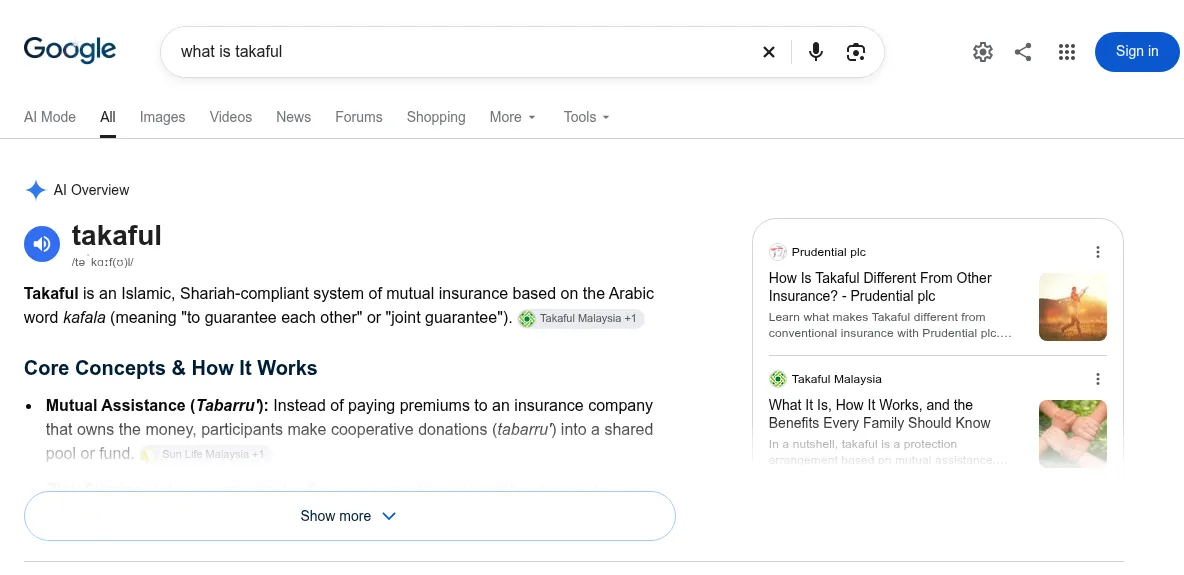
The capture below is Google’s AI Overview for the search “what is takaful”. The summary sits on the left, and the pages it draws on sit in the panel on the right.
What AI Answers Cite Besides Your Website
AI answers cite the brand’s own site, its competitors’ sites and the places buyers go to compare and check. A brand’s own site was cited in about a quarter of the answers about it, across 16,543 answers logged by Elevate, Primal’s AI Visibility Tracker, over the last month. A competitor’s site was cited about as often.
Marketplaces and comparison sites showed up for 11 of the 12 brands. In answers about cars, universities, skincare and flowers, they were cited about as often as the brand itself. Facebook was the most-cited social site for 8 of the 12. Government registers showed up for 7. A university’s answers, for one, cited the body that checks its courses. Google’s own Business Profile and Maps results were cited for most of the brands too.
The chart puts those kinds of source side by side. Each bar shows how many of the 12 brands had that kind of source in their AI answers.
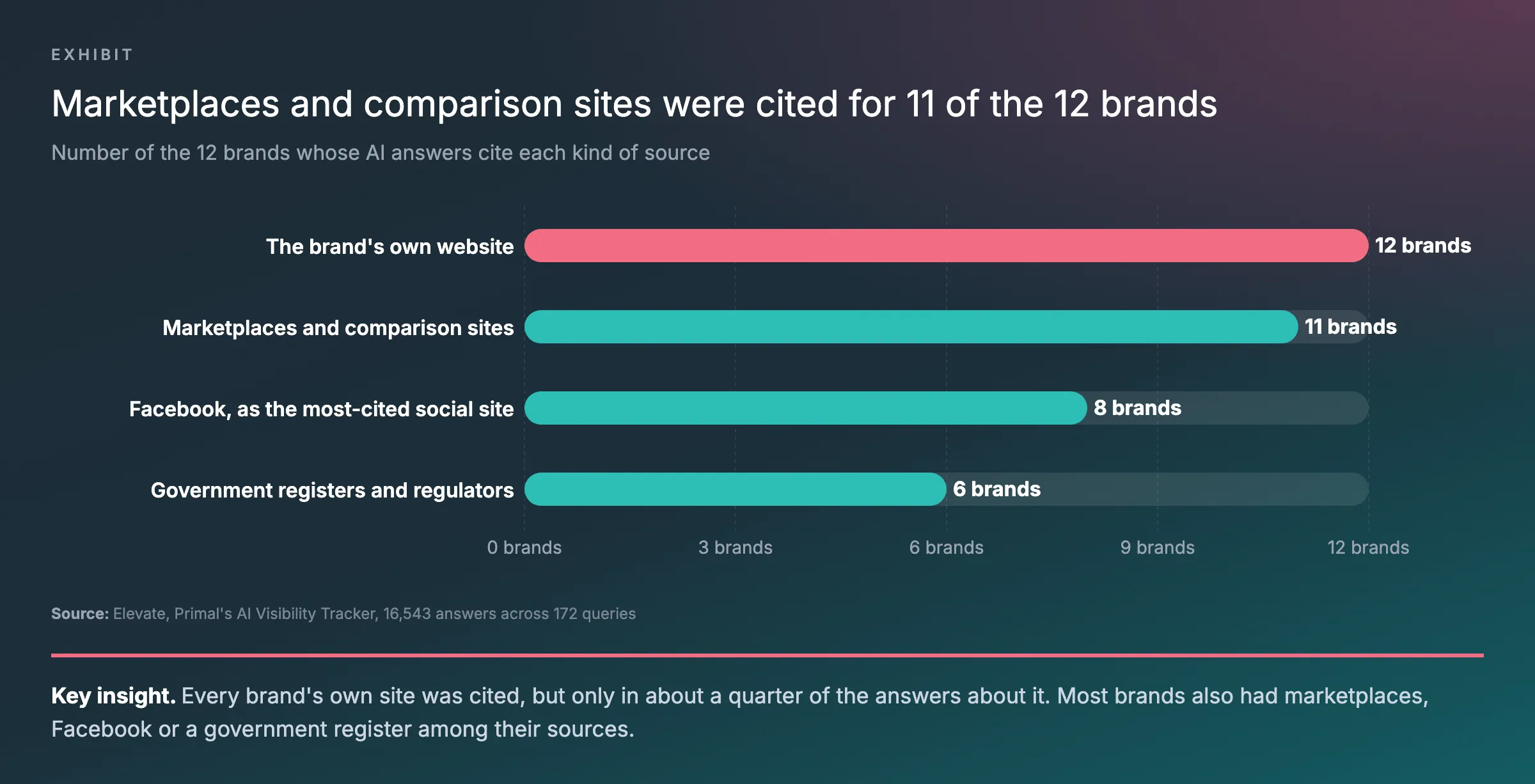
All 12 brands had their own website among the sources, so the site still matters. An answer about your brand may quote a marketplace listing, a review site or your Facebook page first. Those pages need the same care as the website, which means the same name and details, and real reviews.
Plain how-to questions are not the same. Elevate, Primal’s AI Visibility Tracker, also logged 3,693 answers across 66 queries about agencies and search over the same month. In that set, the general questions about search engine optimisation (SEO) were answered from publishers and Google’s own pages. No agency was mentioned in them at all. On a “what is” search, the page that explains the topic best is the one that gets cited, whoever owns it.
Why AI Overviews Send Fewer Visitors
The answer is already on the results page, so fewer people need to click. In the same Pew study, people clicked a normal result on 8% of visits when an AI summary appeared, against 15% when none did. They clicked a link inside the summary on about 1% of visits.
That is often why a brand shows up in AI answers and still sees few visits from search.
In my view, a page written only to collect clicks on a “what is” search is worth less than it used to be. I would judge those pages on whether Google cites them, and the site as a whole on the enquiries and orders it brings in.
How To Optimise For AI Overviews
Rank the page, answer the question early and say something nobody else can. Google’s guide asks for very little on the technical side. A page has to be indexed, able to show a snippet, and on a site that has not opted out in Search Console.
Ranking matters most. Ahrefs studied the pages cited in AI Overviews and found that about three in four of them also ranked in Google’s top 10. It also found only a moderate link between rank and citation.
- Check that the page can be cited. Inspect it in Search Console to confirm it is indexed. Remove any nosnippet tag, or a max-snippet value of 0, that you did not mean to set. Make sure robots.txt and your hosting let Googlebot reach the page. Then open Settings, find Search generative AI and confirm your site is included.
- Find the searches that show one. Take the 20 queries that matter most in Search Console’s Performance report and search each one yourself. This month Primal checked 38 everyday searches in Ahrefs’ stored Google results. Almost every question, comparison and price search showed one. Most “near me” searches did not, and on many of those Google showed its map of local businesses instead.
- Rank in the top 10 for those searches. That is the standard SEO work on content, links and the technical health of the site.
- Answer the question first. Under each heading that matches a question, give the answer in one or two sentences, then the detail. Google says you do not need to write in a special way for AI, and readers want the answer first anyway.
- Add what only you have. Google’s guide asks for original content, such as first-hand experience, your own figures and a clear point of view. For a brand, that can be the timelines from your own jobs or photos of your own work.
- Keep your details right in the other places an answer reads. Google’s guide says AI responses can include local business and product details. So your Google Business Profile and product feed need to be current. The chart above adds your listings on marketplaces, comparison sites and government registers, and your Facebook page.
- Earn real mentions. Google says its AI features can draw on what people write about a brand in blogs, videos and forums. Reviews from real customers and news stories about you help.
In this video on my YouTube channel, I explain how to rank in Google AI Overviews.
What You Can Skip
Google’s guide says you do not need llms.txt files, special schema markup or pages cut into small chunks to appear in AI Overviews. Its systems can find the right part of a long page on their own. They also understand synonyms, so a page does not need every wording of a phrase.
Google still recommends structured data for rich results, but its AI features do not require it. The guide also warns against writing a separate page for every related question just to rank. That breaks Google’s policy on scaled content abuse. Chasing fake mentions on other sites does not help either, because the same ranking and spam systems apply.
How To Measure AI Overviews In Search Console
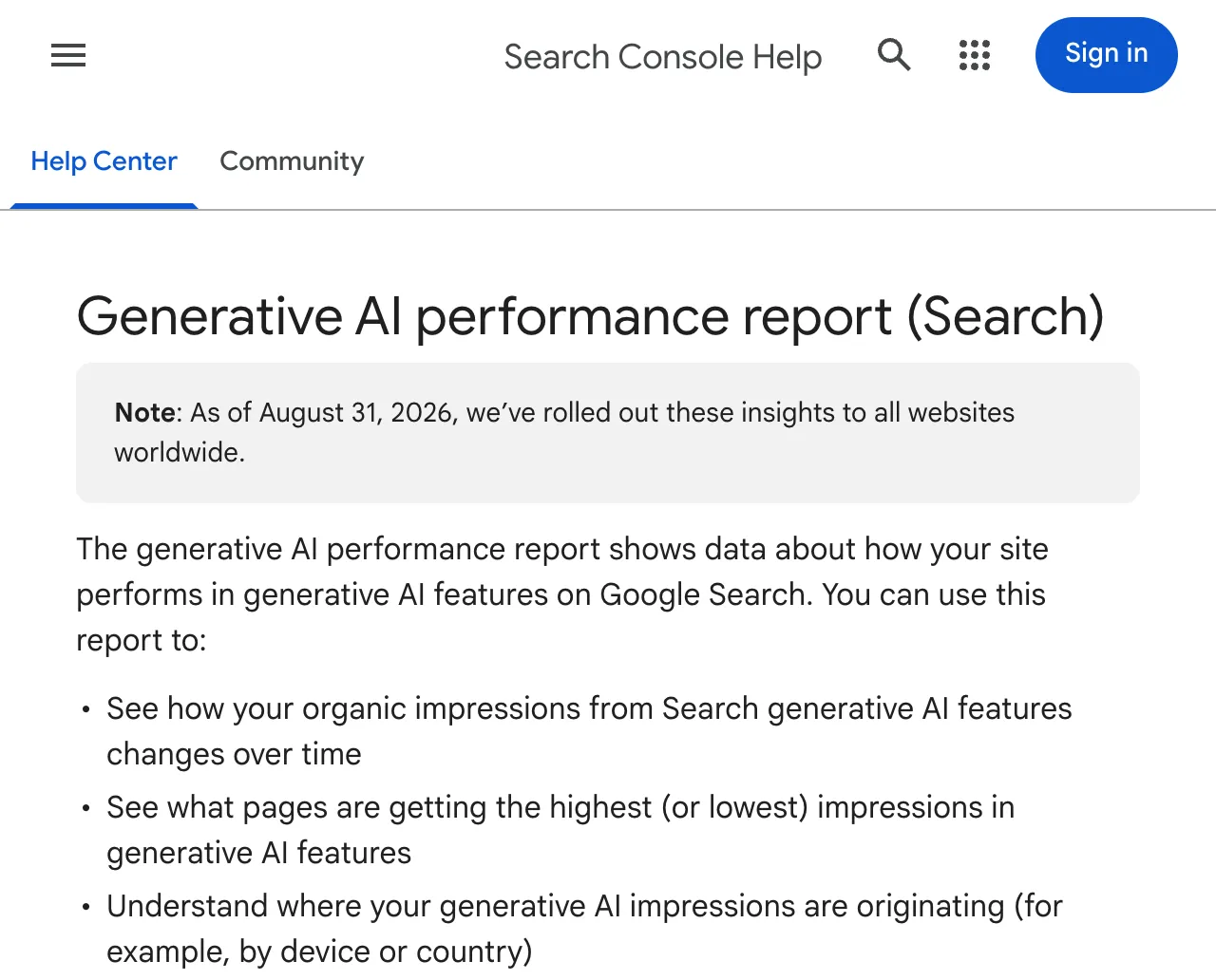
Use the Generative AI report in Search Console. It records an impression each time a page from your site appears in an AI Overview or in AI Mode. Google’s help page for the report says every site now has it.
The help page opens with a short list of what the report lets you see. This capture shows that opening section.
- Open Search Console, go to Performance and choose the Generative AI report for Search.
- Check the Countries breakdown for each market you sell in.
- Sort the Pages breakdown by impressions to see which pages Google cites most.
- Open the standard Performance report for the same pages and dates, and compare their clicks.
The report shows impressions by page, country, device and date. It shows no clicks, no position and no search queries. These impressions also show in the standard Performance report, so your totals already include them.
Read the two reports together. A page whose AI impressions rise while its clicks stay flat is being cited and read on Google. Give that page a reason to visit, such as a calculator, a price list or a booking form. Or judge it on a different goal.
Should You Opt Out Of AI Overviews
For almost every brand, no. Excluding your site removes your links from AI Overviews, but Google says the summary still appears, written from other sites.
The Search generative AI control sits under Settings in Search Console and has three options. Include is the default. Exclude removes your links and content from AI Overviews, AI Mode and the AI features in Discover. Inherit follows the setting of the parent property. Google says the choice does not affect ranking in the rest of Search. A change takes effect within 1 to 2 days.
The control does not stop Google training its models on your pages. That needs Google-Extended, a separate robots.txt instruction.
I would leave it switched on. Excluding makes sense for a site that earns from the page view itself, such as a publisher paid per ad impression. Even then, wait until the Generative AI report shows that the summaries are taking its visits.
What This Means For Your Brand
AI Overviews now answer many searches on the results page, and each answer cites a handful of sources. Your own site is one of them, and your listings and profiles elsewhere are often the others. The work is to make your page the best answer and get it to rank, and to keep your listings elsewhere current. The Generative AI report then shows, page by page, whether Google cites you.
Primal started in 2015 and has offices in Kuala Lumpur, Bangkok and Singapore. Our AI SEO team works on getting brands cited in Google AI Overviews, ChatGPT and Gemini, alongside their SEO.
Frequently Asked Questions About AI Overviews
Is An FAQ Section Still Relevant For AI Overviews?
Yes, when it answers questions your buyers really ask. Google’s guide says you do not need a special format for AI features. Its systems can find the answer inside a longer page. Put the answer in the first sentence under each question, so the reader gets it at once.
Is Optimising For AI Overviews Different From ChatGPT?
The groundwork is the same, but each one finds pages in its own way. Google says AI Overviews draw on its normal index and ranking. A page that ranks on Google is already within reach. ChatGPT runs its own search, and our post on ChatGPT SEO covers what that needs.
Why Am I Not Seeing An AI Overview On Google?
Google shows one only when its systems judge that a summary will help, so many searches get none. In Primal’s check of everyday searches, “near me” searches were the least likely to show one. On many of those, Google showed its map of local businesses instead.
Why Does My Page Rank But Not Appear In The AI Overview?
Ranking raises the chance of a citation, but it does not promise one. Ahrefs found most cited pages rank in the top 10, and only a moderate link between rank and citation. Check that the page has no snippet limits and that your site is included in the Search generative AI control. Then make sure the page says something the other pages do not.
Founder and Chief Executive Officer
Mark McDowell is the Founder and Chief Executive Officer of Primal, which he started in Bangkok in 2015. He is on the Forbes 30 Under 30 Asia 2020 list and was Campaign Asia’s Southeast Asia Young Achiever of the Year in 2018. He writes about AI search and search engine optimisation.
About The Author


