



By Mark McDowellPosted: Updated: 11 min read
How To Get Backlinks From The Sites Your Buyers Read
You get backlinks by giving the sites your buyers already read a reason to link to you: a listing on a directory that checks who it lists, data a writer can cite, a fix for a broken link, a link on a mention they already made, or a paid placement. Pick each site by its readers and its relevance to your business, not by a metric.
Key Takeaways
- Listing sites get cited for almost every brand. In 16,543 AI answers about 12 brands in 12 industries, logged by Elevate, Primal's AI Visibility Tracker, over the last month, marketplaces and comparison sites were cited for 11 of the 12 brands.
- Get links where buyers already read. That means the pages buyers and AI assistants already read, such as marketplace and comparison listings, your Facebook page, your Google Business Profile, registers and publications.
- Give the other site a reason to link. Each method gives one, such as a fixed broken link, data a writer can cite, a member listing or a paid placement.
- Pay for placements on sites buyers read. Pick each site by its readers, its relevance to your business and its editorial standards, not by a metric.
- Aim new links at pages on page 1. Across 67,000 keywords tracked in Keyword.com for Primal's clients, about one in three ranks on page 1 of Google this month and one in six in the top 3.
Which Backlinks Are Worth Getting
The backlinks worth getting sit on the sites your buyers read and AI assistants cite. Buyers ask artificial intelligence (AI) tools such as ChatGPT and Google AI Overviews which supplier to choose. The answers cite other sites as their sources. Over the last month, Elevate, Primal’s AI Visibility Tracker, logged 16,543 AI answers to 172 buyer questions about 12 brands in 12 industries.
Every brand’s own website was among the sources, and so were the places buyers compare and check. Marketplaces and comparison sites were cited for 11 of the 12 brands. Facebook was the most-cited social site for 8 of them. Google’s own Business Profile and Maps results were cited for 7, and government registers and regulators for 6. Publishers and YouTube appeared too.
The chart below shows how many of the 12 brands had each kind of source in their AI answers.
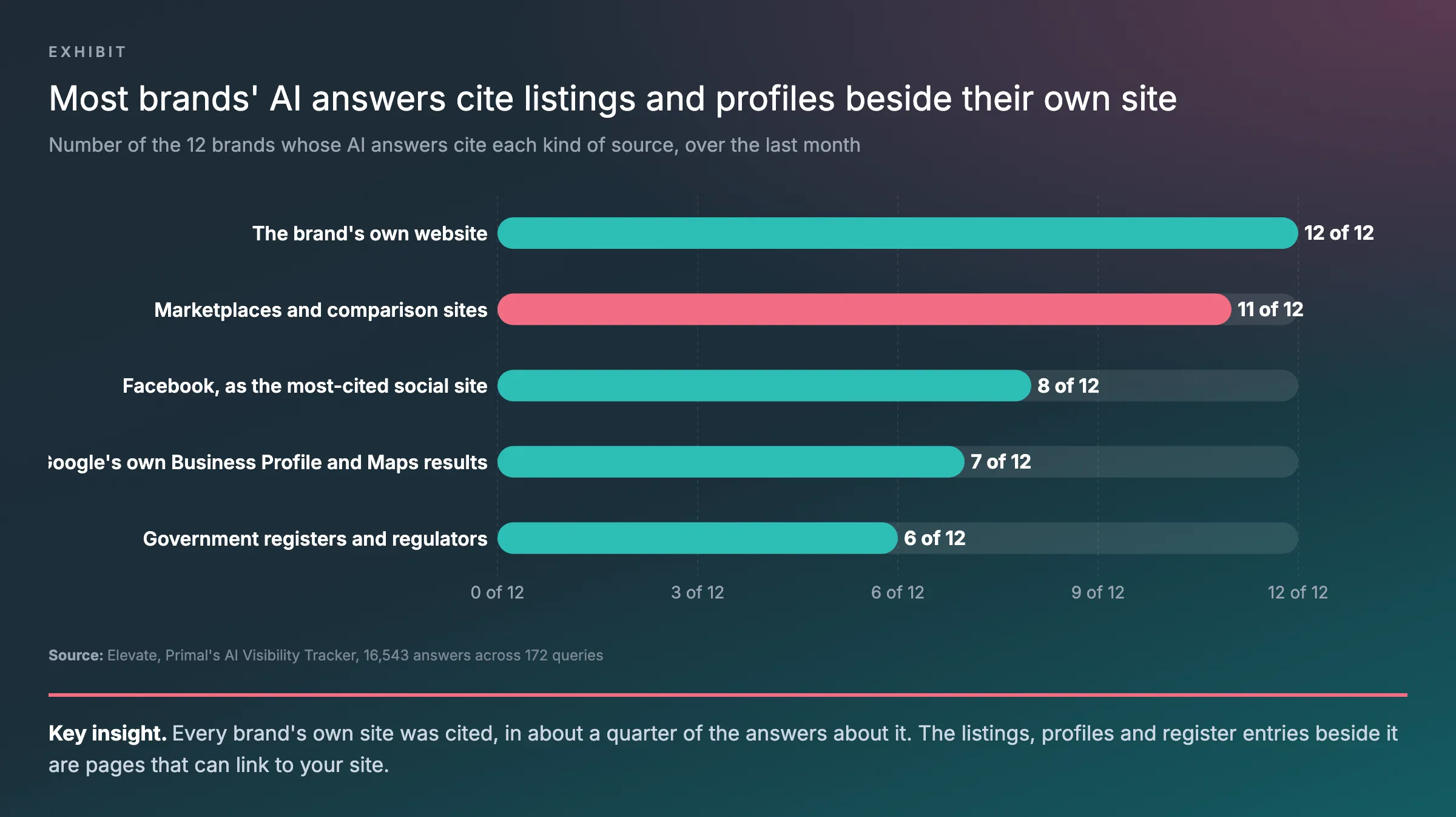
Each of the others is a page about your business on someone else’s site, and most can carry a link to yours. Think of a marketplace or comparison listing, a Facebook page, a Business Profile or an entry in a register. That makes this list the best guide I know to where a backlink is worth having. A listing on one of these sites can send you buyers and put your name in an assistant’s answer. When its link passes ranking credit, it can help your Google rankings as well.
Google still reads links. Its guide to ranking systems says it studies how pages link to each other to judge what a page is about. PageRank, one of the systems Google started with, is still part of its core ranking systems.
So the job is to get onto the sites your buyers and the assistants already read, and to give each one a reason to link to you.
How To Get Backlinks
You get backlinks by earning a place on sites people already use, one reason at a time. Start with the directories and publications the assistants cite in your field. Then work out to the groups and writers your buyers know. I have put the methods in the order I would start them, quickest first.
1. Get Listed Where Buyers Compare Suppliers
Marketplaces, comparison sites and directories exist so buyers can compare suppliers. Every industry has its own, such as a software review site, an education portal, a car marketplace or a trade association’s member page. For agencies and technology firms, Clutch and The Manifest do the same job. Fill in each listing in full, keep it current, and ask real customers for reviews where the site takes them.
Give the profiles the answers read the same care. Keep your Facebook page and your Google Business Profile complete, with your website address on both. Some industries have a register or a regulator that lists firms, such as a construction board or a qualifications agency. If yours does, check that your entry is correct.
Pick lists that check who they include and that buyers actually use. A paid listing on a directory your buyers use is worth its fee.
2. Turn Mentions Of Your Business Into Links
Some pages write about your business and do not link to it, which search engine optimisation (SEO) tools call an unlinked mention. A supplier’s stockist page, an event recap and a local news story are common examples. Search Google for your business name in quotation marks and add -site: with your own domain, so your own pages drop out.
Check that each mention is accurate. Then write to the person who published it and thank them. Ask if they would link your name to the page that matches what they wrote. They already chose to mention you, so this is the easiest request on the list.
3. Replace Broken Links On Other Sites
Many pages still link to pages that are gone. The dead page might be a closed supplier, an old report or a product that was taken down. If you have a page on the same subject, send the site owner the dead address and your page as a replacement. One email fixes a fault on their page and earns you a link.
Check your own site too. When you change a page address, a permanent (301) redirect from the old address keeps every link that pointed at it working.
4. Give Writers Data Or A Quote
Writers link to a source when their story depends on it. Digital public relations (PR) gives them that source. It could be a survey of your customers or an index of prices in your category. Make the data first and publish the method beside it, so a writer can trust it. Then send each writer the one finding that fits their subject.
Trade publications deserve as much effort as the big news sites. On technical and health topics, the AI answers in the same data leaned on document and research sites such as Scribd, ResearchGate and PubMed. A published specification or paper can earn citations that a product page does not.
Reporters also ask for expert comment on LinkedIn and through services that match journalists with sources. Answer the exact question in a few sentences, say why you are qualified, and point to the page that backs up your answer. The editor decides whether the article links to you.
5. Write For Publications Your Customers Read
A guest article on a site your buyers read puts your name in front of them. The author bio or the article can carry a link back to you. Write for that site’s readers and take the link the editor allows.
Link with your business name or a plain description of the page as the anchor text, the words the link sits on. Some sites charge a fee to publish a guest post. Judge that fee as you would any paid placement, by the site’s readers and its relevance to your business.
6. Ask The Sites That Link To Your Competitors
A backlink tool such as Ahrefs or Semrush lists the sites that link to your competitors but not to you. These tools call them referring domains. Find the reason behind each link, such as an interview, a supplier list, a comparison article or a sponsorship. Where the same reason fits your business, ask. A sponsorship or a paid placement on the same site may be open to you as well.
How To Write An Outreach Email That Gets A Reply
Write to one person about one page, say what your page adds for their readers, and follow up once. Expect silence from most people. A Backlinko and Pitchbox study of outreach emails found that fewer than 1 in 10 got a reply. One follow-up raised replies by about two thirds.
- List the pages you want a link from, with the reason each one would link to you.
- Find the person who wrote each page or keeps it up to date.
- Write to them by name and mention their page. Say in a sentence or two what your page adds for their readers.
- Give one address to link to.
- If nobody replies within about a week, send one short follow-up. Then stop.
What To Check For Each Method
The table gives one check for each method above, and for the ones businesses are often sold, before you start.
| Method | What to check |
|---|---|
| Directory and member listings | The site checks who it lists, and buyers use it |
| Turning mentions into links | The mention is accurate, and you ask once |
| Replacing broken links | Your page covers what the dead page covered |
| Data and expert quotes for writers | The method sits beside the data, and the writer chooses the link text |
| Guest articles | The site’s readers are your buyers, and the link uses your business name or a plain description |
| Sponsorships, sponsored articles and paid listings | The site’s readers, its relevance to your business and its editorial standards |
| Products sent for review | The reviewer’s readers are your buyers |
| Link swaps | The other site is one your own readers would want |
| Link software, forum signatures and blog comments | Someone reads the page the link sits on; most of these pages have no readers |
Can You Pay For Backlinks
Yes, and a placement on a site your buyers read is worth paying for. Sponsorships, sponsored articles and paid listings are all ways to get one. Pick the site by its readers and its relevance to your business, not by a metric.
A score from an SEO tool tells you about the links that point at a site. It does not tell you who reads the site or whether they buy what you sell. So look at the site itself before you pay. Check that people in your field read it and respond to it, and that its subject is close to yours. Check too that an editor holds paid pieces to the same standard as the rest of the site.
A paid placement on the right site puts your name in front of buyers, on a page an AI assistant can read.
Do Backlinks Help You Appear In AI Answers
Customers often ask us whether backlinks from high domain authority websites will get them a spot in Google’s AI Overviews and in ChatGPT. They help when they sit on the pages the assistants already read. Domain authority is a score SEO tools give a site for the links pointing to it. It does not tell you which pages the assistants read.
In the answers about the 12 brands, a brand’s own website was cited in about a quarter of the answers about it. A competitor’s site was cited about as often. A listing or a mention on those pages puts your name where the assistant looks. I would put one of those ahead of many links from sites nobody reads.
Your own site is still one of the sources the answers read. So your links have to point at a page worth citing, and our guide on how to get cited in AI search covers that page.
Is It Hard To Get Backlinks In Malaysia
It is harder in a narrow industry, because the pool of local sites is small. Malaysia’s domain registry MYNIC lists about 700,000 .my domain names. In a narrow field, the local publications, associations and directories may be a handful. Your competitors write to the same editors.
Some of the comparison sites in AI answers, such as Clutch and The Manifest, list businesses from many countries. A Malaysian business can use them as well as any other.
Write each pitch in the publication’s own language, Malay or English. In a narrow field, expect the first links to take longer than in a broad one.
Do My Backlinks Need To Come From Malaysian Domains
Customers often ask us whether their links need to come from domains that are from Malaysia. Relevance matters more than the country ending. A link helps most on a site your buyers read. For a page aimed at Malaysian buyers, many of those sites will be Malaysian.
For an exporter, a trade magazine read by its buyers abroad is worth more than a .my site about something else. Check each site against the list in the next section, whatever its domain ending.
How To Check A Site Before You Ask For A Link
Ask for a link, or pay for a placement, only on a site that people read and that Google shows for its own subject. Check each site against this list before you write.
- It appears in Google when you search for a topic it covers.
- It has recent articles, an author or editor you can identify, and readers who respond.
- Its subject or its readers overlap with yours.
- Its outbound links make sense. A page packed with links to casinos, loans and unrelated shops belongs to a site with no editorial standards.
- Its paid pieces meet the same editorial standard as the rest of the site.
- An AI assistant cites it, or a buyer in your field would know it.
- You would be glad for a customer to find your business there.
How To See The Links You Earn
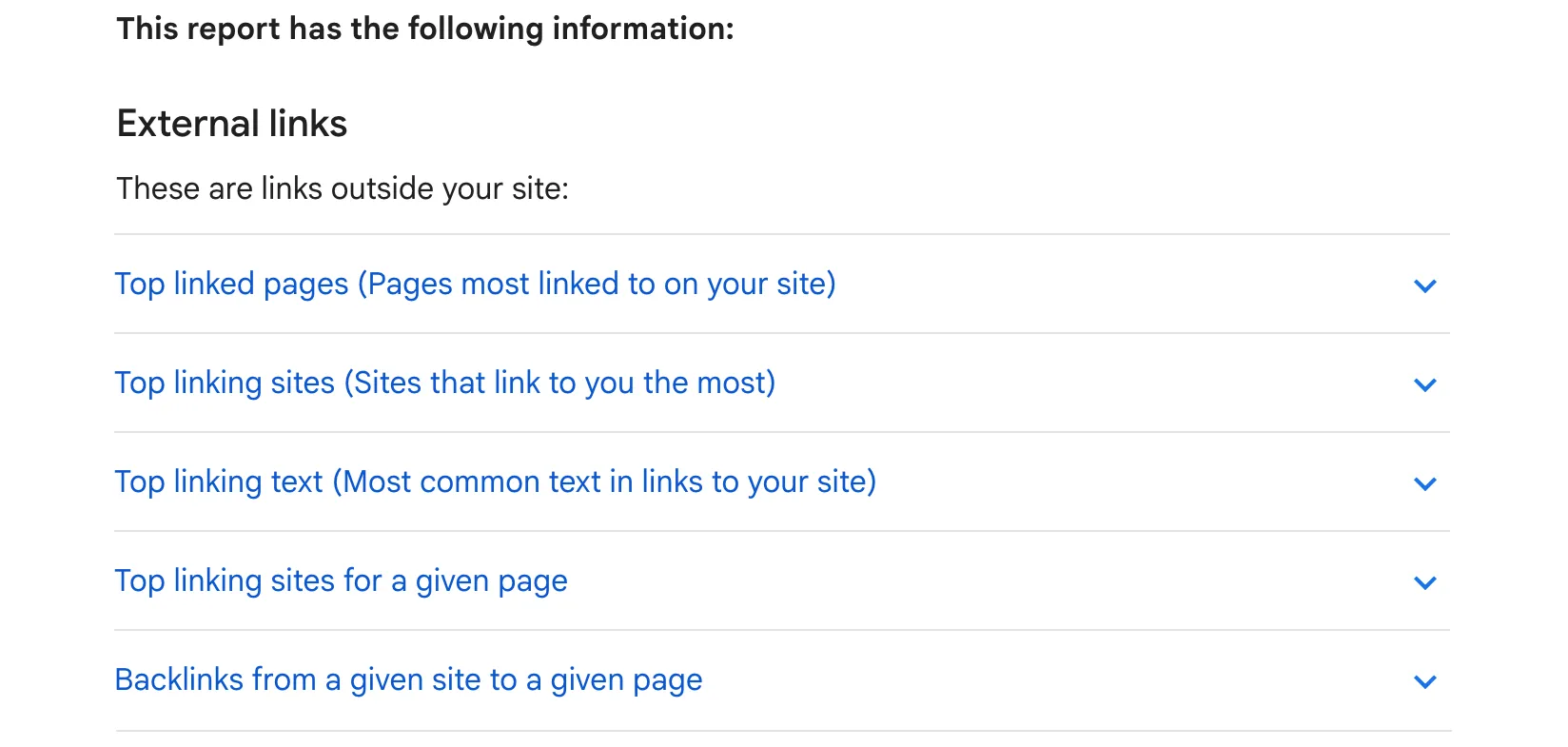
Search Console, Google’s tool for site owners, shows the links to your site at no cost. Its Links report lists your most-linked pages, the sites that link to you most and the words they link with. Each table stops at 1,000 rows and does not say whether a link is nofollow. Open the linking page to confirm a new link is live.
The help page lists the tables the report holds. This is that list, so you know which table to open for each question.
Look at the link text table every few months. Odd sites with keyword-stuffed links are rarely worth any action. The same help page says Google typically ignores links from known spam sites.
Google’s disavow help page says most sites will never need the disavow tool. Use it only when many spammy or artificial links have caused a manual action, or are likely to. If your site already has a manual action for unnatural links, our page on Google penalty recovery covers the next steps.
Where Link Building Fits In Your SEO
Across 67,000 keywords tracked in Keyword.com for Primal’s clients, about one in three ranks on page 1 of Google this month. About one in six sits in the top 3. So about half of the keywords that reach page 1 stop below the top 3. That is where I would point the links you earn, at a page that already ranks on page 1 for a search that matters.
Fix that page first, so it answers the buyer’s question better than the pages above it. Then earn links to it from the sites your buyers and the assistants read.
Primal started in 2015 and has offices in Kuala Lumpur, Bangkok and Singapore. Our link building team earns those links for the pages a brand needs to rank, as part of our wider SEO work.
Frequently Asked Questions About Backlinks
What is a backlink?
A backlink is a link on another site’s page that points to a page on yours. If an industry association lists you as a member and links to your site, that link is a backlink. Google reads links to judge what a page is about, which is why they still matter for SEO.
How long does it take to get a backlink?
It depends on the method. A mention or a broken link can become a link as soon as the site owner edits the page. Data for writers takes longer, because you have to make it and pitch it before anyone cites it. Allow a week for a reply and one follow-up before you judge a request.
Are link exchanges safe?
An occasional link between two related sites is normal. A page of partner links made only to trade links has no readers, so it sends neither site any buyers. Link to another site when it helps your reader.
Do nofollow links help?
Google’s page on qualifying outbound links says links marked nofollow, sponsored or ugc (user-generated content) will generally not be followed, so they are not meant to pass ranking credit. They still send readers to your site, and the mention around the link is text an AI assistant can read. A nofollow link from a page your buyers read is still worth having.
Founder and Chief Executive Officer
Mark McDowell is the Founder and Chief Executive Officer of Primal, which he started in Bangkok in 2015. He is on the Forbes 30 Under 30 Asia 2020 list and was Campaign Asia’s Southeast Asia Young Achiever of the Year in 2018. He writes about AI search and search engine optimisation.
About The Author


