



By Mark McDowellPosted: 8 min read
What Is Pay Per Click (PPC) Advertising?
Pay per click (PPC) advertising is a way of buying ads in which you pay when someone clicks your ad, and an auction sets the price of each click. In Primal's own Google Ads account this year, a click cost about RM27 on average and a lead about RM850, so the cost of a lead is the number to plan on.
Key Takeaways
- Pay per click charges for the click. On Google an auction for each search sets that price from your bid, the quality of your ad and page, and the ad ranked below yours.
- Few viewers click a search ad. In Primal's own Google Ads account this year, people clicked our search ads 3.9% of the times they saw them, and the average click cost about RM27.
- The keyword sets the click price. The price of a click in that account ran from about RM15 for the phrase "digital marketing" to about RM89 for "aeo", in the same months.
- Judge pay per click on cost per lead. A lead from the same ads cost about RM850, so we treat the cost of a click as a clue.
- Social and search clicks do not compare. Meta and TikTok usually charge for impressions, so a cost per click from either one does not compare directly with a Google search click.
What Pay Per Click Advertising Means
Pay per click (PPC) advertising is a way of buying ads where you pay when someone clicks your ad. When people only see it, you pay nothing. Primal buys these clicks for its own business. Our account shows that you pay by the click, but the cost of a lead decides whether the ads work, so that is the number to plan on.
In Primal’s own Google Ads account this year, our search ads showed about 169,000 times. People clicked them about 6,500 times and sent us 205 enquiry forms. The average click cost about RM27. The average enquiry cost about RM850, so it took about 32 clicks to get one lead.
A campaign can look cheap per click and still cost too much per customer.
How Google’s Auction Sets The Price Of A Click
When someone searches, Google runs an auction among the ads that fit the search. The result decides which ads show, in what order and at what price. Google’s help page on Ad Rank says each ad gets a score called Ad Rank, and your bid is only part of it.
The other parts are about quality and context. They are the quality of your ad and landing page, and the minimum score an ad needs to show. Then come the strength of the competition and the context of the search, such as the words, the place and the device. The last is the expected effect of extras, such as a phone number under the ad.
You set a maximum cost per click (max CPC), the most you agree to pay. You are charged the actual cost per click (actual CPC). Google’s page on actual CPC says this is the least you need to beat the ad just below yours and clear the minimum. So the charge is often lower than your bid. The same page says automated bidding can sometimes take a click above it.
Quality Score is often mixed up with the auction. Google’s Quality Score page calls it a diagnostic score for each keyword. It comes from expected click-through rate, ad relevance and landing page experience. The page says it is not an input in the auction. The auction uses its own quality measures at the moment of each search.
A clearer ad and a page that answers the search raise your Ad Rank without a higher bid. The Ad Rank page says higher quality ads can often lead to a lower cost per click. When a keyword costs too much, I would fix the ad and the page before I raised the bid.
Why One Keyword Costs More Than Another
Each search runs its own auction, so the price of a click depends on the words people type. It also depends on how many advertisers want those words. In Primal’s own Google Ads account this year, a click on the phrase match “digital marketing” cost about RM15 and “seo” about RM21. “seo agency” cost about RM65, “seo company” about RM82 and “aeo” about RM89.
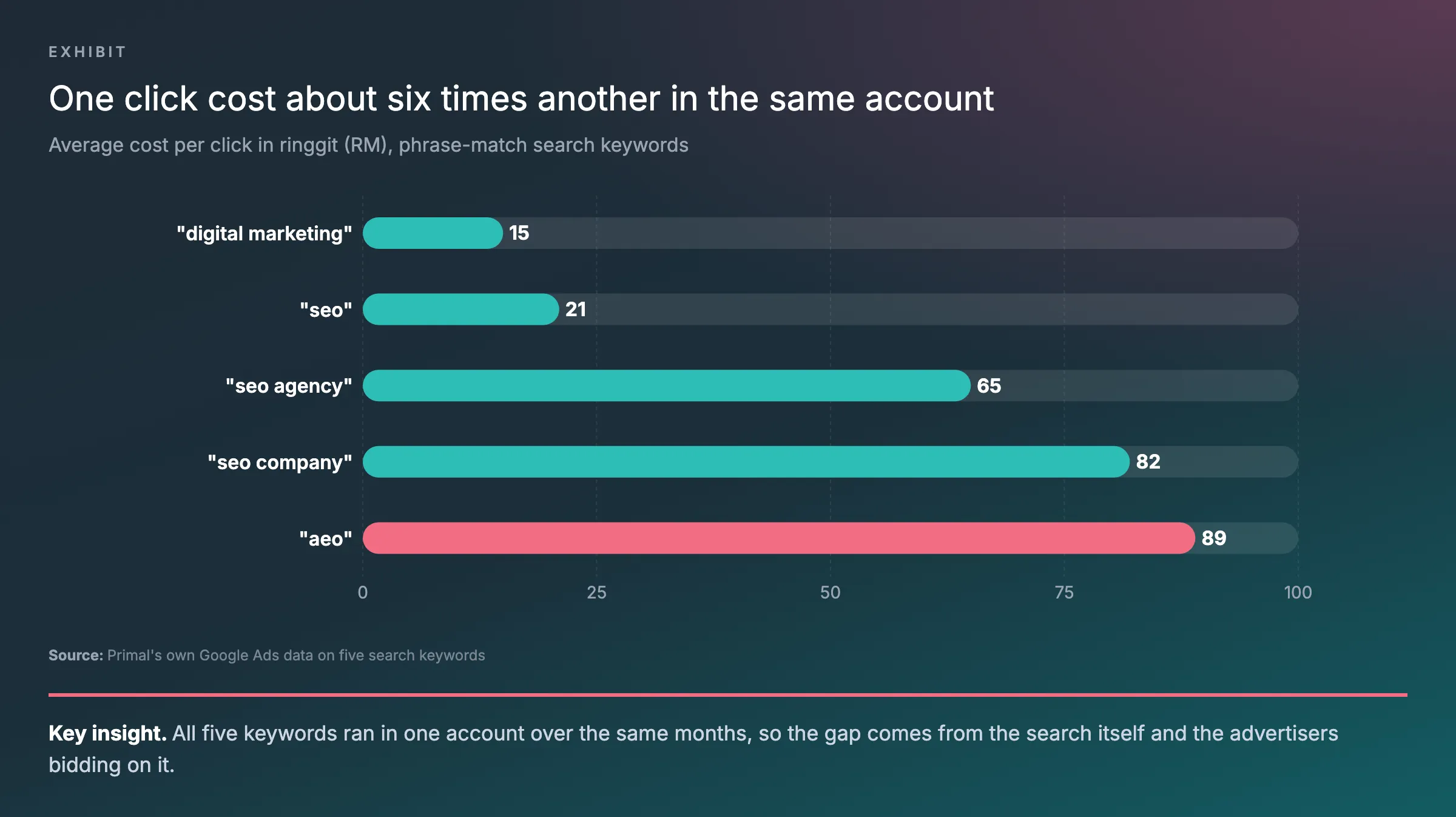
The price of a click told us little about the price of a lead. In Primal’s own Google Ads account, a click on “seo” cost about RM21, and about one click in 20 became an enquiry. Each lead from it cost about RM460. A click on “aeo” cost about RM89, and 88 of those clicks brought fewer than two enquiries. That put the cost of a lead from it above RM5,000.
The likely reason is that a new term draws many people who are still finding out what it means, and few of them are ready to ask an agency for a proposal. Before you add a keyword, decide what a lead from it is worth to you. After a month, compare its cost per lead with that figure. If a lead costs more than it is worth, rewrite the ad or drop the keyword.
Which Ad Platforms Charge Per Click
Google search ads and Shopee’s Shop Ads charge for the click as standard. Meta and TikTok usually charge for impressions, and a click charge is an option you choose. “Pay per click” describes how you pay, and the same platform can bill you either way.
| Platform | What it usually charges for | Can you choose a click charge? |
|---|---|---|
| Google search ads | The click, at the actual CPC | Yes, it is the normal charge |
| Meta (Facebook, Instagram, Messenger, WhatsApp) | Impressions | Yes, for goals that offer link clicks as the charge |
| TikTok | Impressions, through optimised cost per thousand impressions (oCPM) for conversion campaigns | Yes, cost per click is offered for some goals |
| Shopee Shop Ads | The click, paid from your ads credit | Yes, it is the normal charge |
Meta’s page on how it charges for ads says you usually pay for the impressions your ad gets. That holds unless you pick another charge when you create the ad. TikTok’s help page on bidding methods makes oCPM the default for conversion and app install campaigns, and oCPM bills by impression. Shopee’s guide to Shop Ads says a seller pays only when a shopper clicks. It adds that invalid clicks, such as repeated clicks from one user, are not charged.
A cost per click from a Meta campaign billed by impression measures something different from a Google search click you bid for. So check how each campaign was billed before you put them side by side, and compare the cost of a lead or an order.
Can Pay Per Click Ads Show In AI Overviews
Yes. In some countries, ads can now appear inside Google’s AI Overviews, the summaries Google’s artificial intelligence (AI) writes above some search results. Google’s page on ads and AI Overviews lists Malaysia, Indonesia, the Philippines and Singapore among those countries. These ads run in English on mobile and desktop.
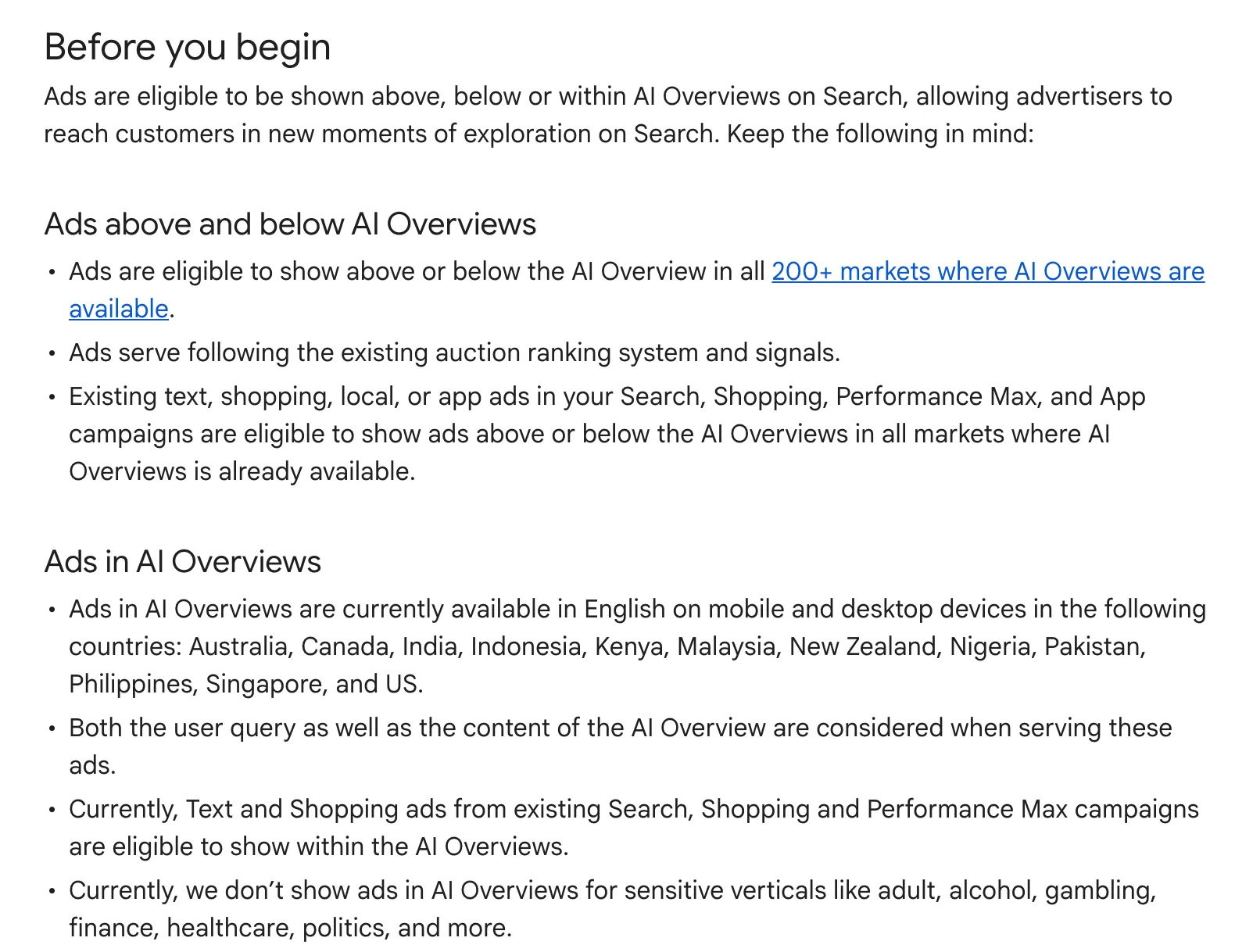
Ads above and below AI Overviews show wherever AI Overviews run, and the page says they follow the same auction. You cannot target the placement inside the summary or opt out of it. Google Ads gives no separate report for it, and Google does not show these ads for sensitive categories such as finance and healthcare.
The ad is matched to what the AI Overview says as well as to the search. So the page says it needs broad match keywords on Search, or keywordless targeting. Examples are AI Max for Search campaigns and Performance Max. A campaign that runs only on exact match keywords will not reach the placement.
How To Tell Whether Pay Per Click Is Working
Pay per click is working when a lead or an order costs less than it is worth to you. Every other figure in the account helps you see why it does or does not.
| Figure | How it is worked out | Primal’s own account this year |
|---|---|---|
| Click-through rate (CTR) | Clicks divided by impressions | 3.9% |
| Cost per click (CPC) | Cost divided by clicks | About RM27 |
| Conversion rate | Conversions divided by clicks | About 3% |
| Cost per lead | Cost divided by conversions | About RM850 |
Read the table from the bottom up. The cost per lead is the figure the business pays for, and the rows above it explain it. A low click-through rate points at the ad, and a low conversion rate at the landing page. When the cost per click is high, look at the keyword and the competition for it.
An online shop uses return on ad spend (ROAS) in place of cost per lead. It is the value of orders from the ads divided by what the ads cost. Google’s Quality Score page says the score is not a key performance indicator (KPI). Use it to find weak keywords, and leave it out of the monthly report.
How To Start A Pay Per Click Campaign
Start with conversion tracking, a short list of searches from people ready to buy, and a page for each group of searches. Then set a budget you can hold for a month. These steps are for a first Google search campaign, and most carry over to other platforms.
- Decide what a result is: a form, a phone call, a WhatsApp message or an order. Set up conversion tracking for it before the first click. Then you and Google’s bidding judge the campaign on enquiries.
- Write down the searches your customers type, in English and Malay if they use both. Group them by product or service. Add negative keywords for searches you do not want, such as job searches.
- Send each group of searches to the page that answers it. A landing page made for one service lets the ad and the page make the same promise.
- Work out what one lead is worth before you set a bid. Use how many leads turn into customers and what a customer brings in. That figure is the most a lead should cost.
- Set a daily budget you can hold for at least a month, so each keyword gets enough clicks to judge. Start with your own bids or automated bidding for clicks. Switch to bidding for conversions once enquiries come in regularly.
- Read the search terms report every week. It lists the searches that showed your ads. The ones that do not fit your business become new negative keywords.
Pay Per Click Or SEO
Run both when your customers search for what you sell. Paid search buys a place on the results page as soon as an ad is approved, and it stops when the budget stops. Search engine optimisation (SEO) earns a place that carries no charge per click, though it takes longer.
Our post on the difference between SEO and search engine marketing (SEM) covers the wider term for both.
The two help each other. In Primal’s own Google Ads account this year, “seo company” cost about RM82 a click, and searches with a price like that are where an organic ranking saves the most. Paid search also shows within weeks which searches bring enquiries, and that tells you which pages are worth the slower SEO work.
Primal has offices in Kuala Lumpur, Bangkok and Singapore. Our Google Ads team plans and runs Search, Shopping, Performance Max and YouTube campaigns. Our SEM team runs paid search and SEO together.
Frequently Asked Questions About Pay Per Click Advertising
Is Pay Per Click The Same As Google Ads?
No. Google Ads is one platform that charges per click, mostly for search ads. Shopee’s Shop Ads charge per click too. Meta and TikTok offer a click charge for some goals, but both usually bill for impressions.
How Much Does Pay Per Click Advertising Cost?
There is no set price, because an auction prices each click and you set the budget. As one reference, Primal’s own Google Ads account paid about RM27 a click on average this year. A lead cost about RM850, on searches for marketing and SEO services. Your figures will differ by industry, keyword and the quality of your ads and pages.
Is A Higher Bid The Only Way To Rank Higher On Google?
No. Your bid is one input to Ad Rank. The others are the quality of your ad and landing page, the thresholds, the competition, the context of the search and your ad assets. Google’s Ad Rank page says higher quality ads can often lead to a lower cost per click.
Founder and Chief Executive Officer
Mark McDowell is the Founder and Chief Executive Officer of Primal, which he started in Bangkok in 2015. He is on the Forbes 30 Under 30 Asia 2020 list and was Campaign Asia’s Southeast Asia Young Achiever of the Year in 2018. He writes about AI search and search engine optimisation.
About The Author


