



By Mark McDowellPosted: 11 min read
SEO Agency vs Freelancer vs In-House And How To Decide
An SEO agency gives you a team of specialists, a freelancer gives you one person, and an in-house hire gives you your own employee. Pick by the work your site needs and who will direct it. A freelancer suits one defined job, an agency suits technical, content and link work at the same time, and an in-house hire suits a business where search is a main channel and the site changes often.
Key Takeaways
- Hire for work beyond your own site. Over the last month, Elevate, Primal's AI Visibility Tracker, logged 16,543 AI answers about 12 brands, and a brand's own website was typically cited in only about a quarter of the answers about it.
- Each option suits a different job. A freelancer suits one defined job with an end date, an agency suits technical, content and link work at the same time, and an in-house hire suits a site that changes every week.
- In-house roles combine several jobs. In Primal's read of 24 SEO job ads on JobStreet this year, all 11 companies hiring for their own site wanted content work, 10 wanted technical SEO, and 5 also wanted link building from the same person.
- Keep ownership of every account. That means the owner role in Google Search Console, the Administrator role in Google Analytics and primary ownership of your Business Profile, with a lower role for any provider.
- Delete old verification tokens. Google lets a removed Search Console owner verify again while their verification token stays on the site, so delete it when a freelancer, an agency or an employee leaves.
Where Advice On SEO Agency vs Freelancer vs In-House Comes From
Buyers ask artificial intelligence (AI) assistants such as ChatGPT and Google AI Overviews whether to use a search engine optimisation (SEO) agency, a freelancer or their own hire. In Elevate, Primal’s AI Visibility Tracker, a set of 3,693 answers across 66 queries, mostly about choosing an agency, cited Clutch, a directory of agency reviews, in about 4 answers of every 10, more often than any agency’s own website.
AI answers about other kinds of business also use many sites besides the business’s own. Over the last month, the same tracker logged 16,543 AI answers across 172 buyer questions about 12 brands in 12 industries. A brand’s own website was cited in about a quarter of the answers about it, and a competitor’s site about as often. Marketplaces and comparison sites appeared in the answers for 11 of the 12 brands. Facebook was the most-cited social source for 8 of them, Google’s own Business Profile and Maps results came up for 7, and government registers for 6.
So a buyer who asks an assistant this question gets an answer put together from listings and articles. The first page of Google for the same search is mostly agency blogs. This post is one more of those, because Primal is an agency. None of these sources can see your site or know how much work it needs. The work you hire for also reaches past your website, to the listings and profiles that AI answers cite.
My advice is to decide on the things those sources cannot see. List the work your site and your listings need, and decide who inside the business will direct it. Then agree, before anything starts, what you keep when the arrangement ends. Why assistants cite the pages they do is covered in our post on answer engine optimisation.
How The Three Options Differ
An SEO agency is a company whose team works on many clients’ sites. A freelancer is one self-employed specialist. An in-house hire is your own employee, or a team of them, working on your site alone.
| SEO agency | Freelancer | In-house hire | |
|---|---|---|---|
| Who does the work | Several specialists on one team | One person | People on your payroll |
| Who covers a holiday or a resignation | Someone else on the team | Often nobody | Depends on the size of the team |
| How well they know your business | From your briefs and data | From your briefs and data | Better with every working day |
| Who decides what comes first | You and the agency, in a plan | You and the freelancer, job by job | You |
| How it ends | Notice under the contract | Notice under the agreement | Resignation notice under the contract or the law |
| What it asks of you | Briefs, approvals and developer time | Briefs, checking the work and developer time | Hiring, managing, training and tools |
Price is not in the table, because it depends on scope. Our post on what SEO costs in Malaysia gives the published market ranges and the cost of a hire. Google’s own advice on hiring an SEO applies to all three. It also says a small local business can probably do much of the work itself.
What An SEO Agency Does Well And Where It Falls Short
An agency is the right choice when your site needs technical fixes, writing and links at the same time. It fits best when nobody inside the business can direct all of that. Several people work on the site at once, so those jobs run side by side. When one of them is on leave, someone else picks up the work.
One agency ad in the job check further down asked its SEO specialist to coordinate writers, link builders and the client team.
Check these weak points before you sign.
- The people who pitch may not be the people who do the work. Ask who will work on your site each month, and meet them.
- Your site shares the team’s week with other clients’ sites.
- An agency learns your products from briefs and reports. That takes longer than learning them from the inside.
- Changes still need your sign-off and your developer’s time before they go live.
What A Freelancer Does Well And Where It Falls Short
A freelancer is the better choice for one job with a clear scope and an end date, such as a site migration or a list of technical fixes. You speak to the person doing the work. You can also buy part of a week, and one ad in the job check was a contract role for 15 to 20 hours a week.
The limits come from working alone.
- You get one person’s hours and one person’s skills. A technical specialist may not write well, and a good writer may not know how to fix a crawl problem.
- There is usually no cover. If they fall ill or take on a bigger client, your work waits.
- What they learn about your site leaves with them unless they write it down. Ask for a log of every change.
- Quality varies from person to person. Google’s hiring advice says to check references and ask past clients whether the work helped them.
I would try a freelancer first for a defined job. If search brings in most of your enquiries, I would want more than one person who knows the site.
What An In-House SEO Hire Does Well And Where It Falls Short
An in-house hire makes sense when search is a main channel, the site changes every week and you have a developer to work with. Your own employee knows the products and who signs off a change. They sit with the developer, so a fix can go live within days of being found. What they learn stays in the business for as long as they stay.
Hiring has costs beyond the salary.
- The job is often written for more than one person.
- Recruiting takes time. The person then needs managing, training and their own SEO tools. The employer also pays statutory contributions on top of the salary.
- When they resign, the work stops unless someone else knows the site.
Where the written contract says nothing, Malaysia’s Employment Act 1955 sets a minimum notice by length of service, and it binds both sides. It is 4 weeks under 2 years of service, 6 weeks from 2 years to under 5, and 8 weeks after that. A new SEO hire who resigns may give you a month to find cover.
Can One In-House SEO Person Do All Of The Work
Many employers expect one person to do it all. But the work needs several separate skills. Whether one person can cope depends on the size of the site and how much of each skill it needs.
This year Primal read 24 job ads with SEO in the title from JobStreet’s results for “seo”. Eleven came from companies hiring for their own site. All 11 wanted content and on-page work, 10 wanted technical SEO and 10 wanted reporting. Five also wanted link building. Five mentioned AI search, such as Google’s AI Overviews or generative engine optimisation (GEO). One added Google Ads and Meta ads for several brands. The chart shows how many of those 11 ads asked for each task.
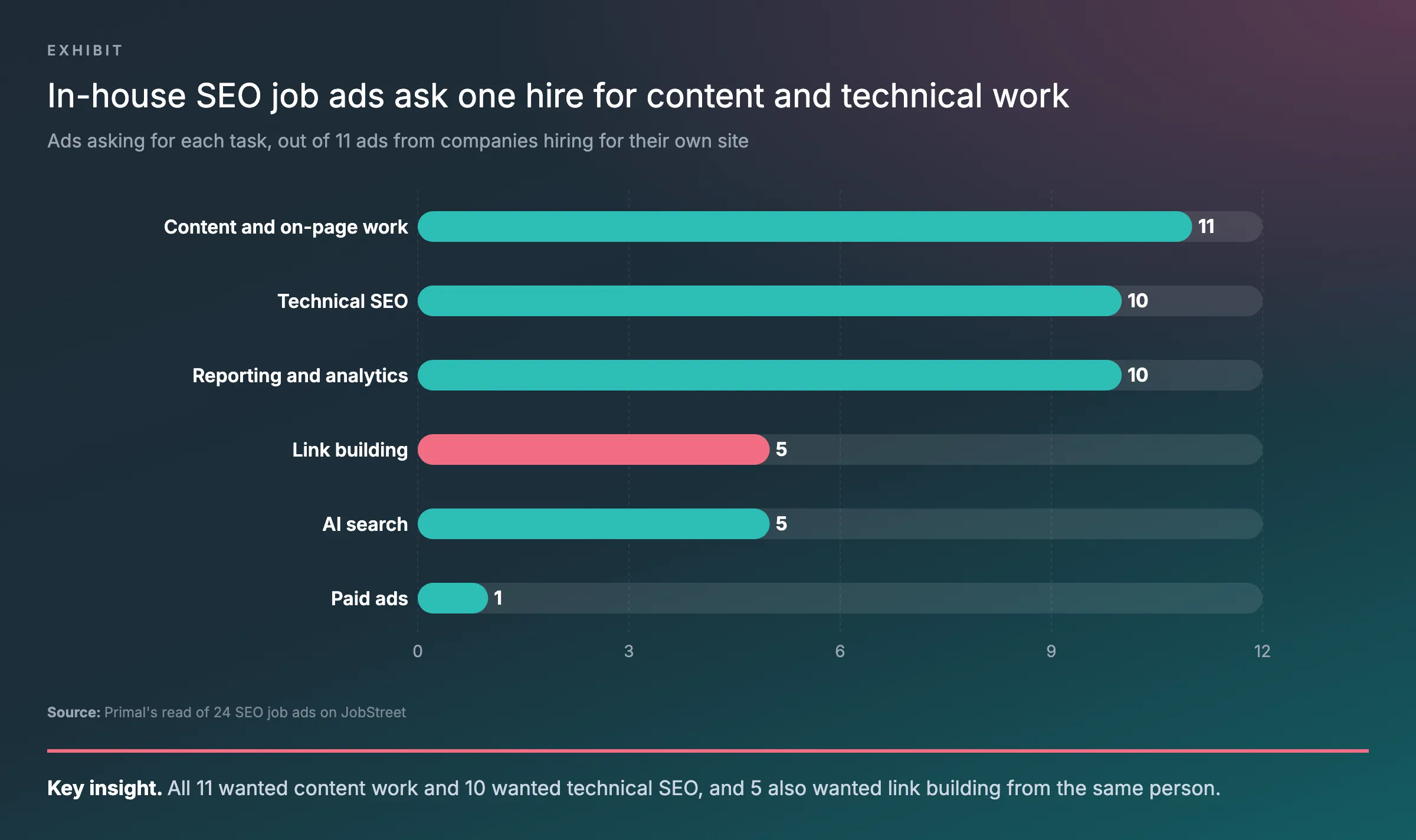
Writing, technical fixes and earning links are separate skills. In my view, an ad that asks for all of them plus AI search describes the work of a team. A few ads went the other way and hired for one part only, such as link outreach or reporting.
Read your own job ad before you post it. If it asks one person for technical fixes, writing, links and AI search, split the role. Hire for the part you need every day, and buy the rest from a freelancer or an agency.
How To Choose Between An Agency, A Freelancer And In-House
Start from the work your site needs and match it to the option that fits. Then put the same questions to every candidate, whether it is a firm or a person you might hire.
| Your situation | Usually fits | Why |
|---|---|---|
| One job with an end date, such as a site migration | Freelancer | One person’s hours and skills cover it |
| Technical, content and link work all needed at once | Agency | Several specialists work side by side |
| Search is a main channel, the site changes weekly and you have a developer | In-house lead | Daily access to the team and the site |
| A team that writes well but cannot fix technical problems | In-house team with a freelancer or an agency | Keep the writing inside and buy the missing skill |
| A small local business with one location | Your own team first | Google says much of the work can be done yourself |
Google’s hiring advice lists the questions to ask a provider. I would use the same list for a person you might hire.
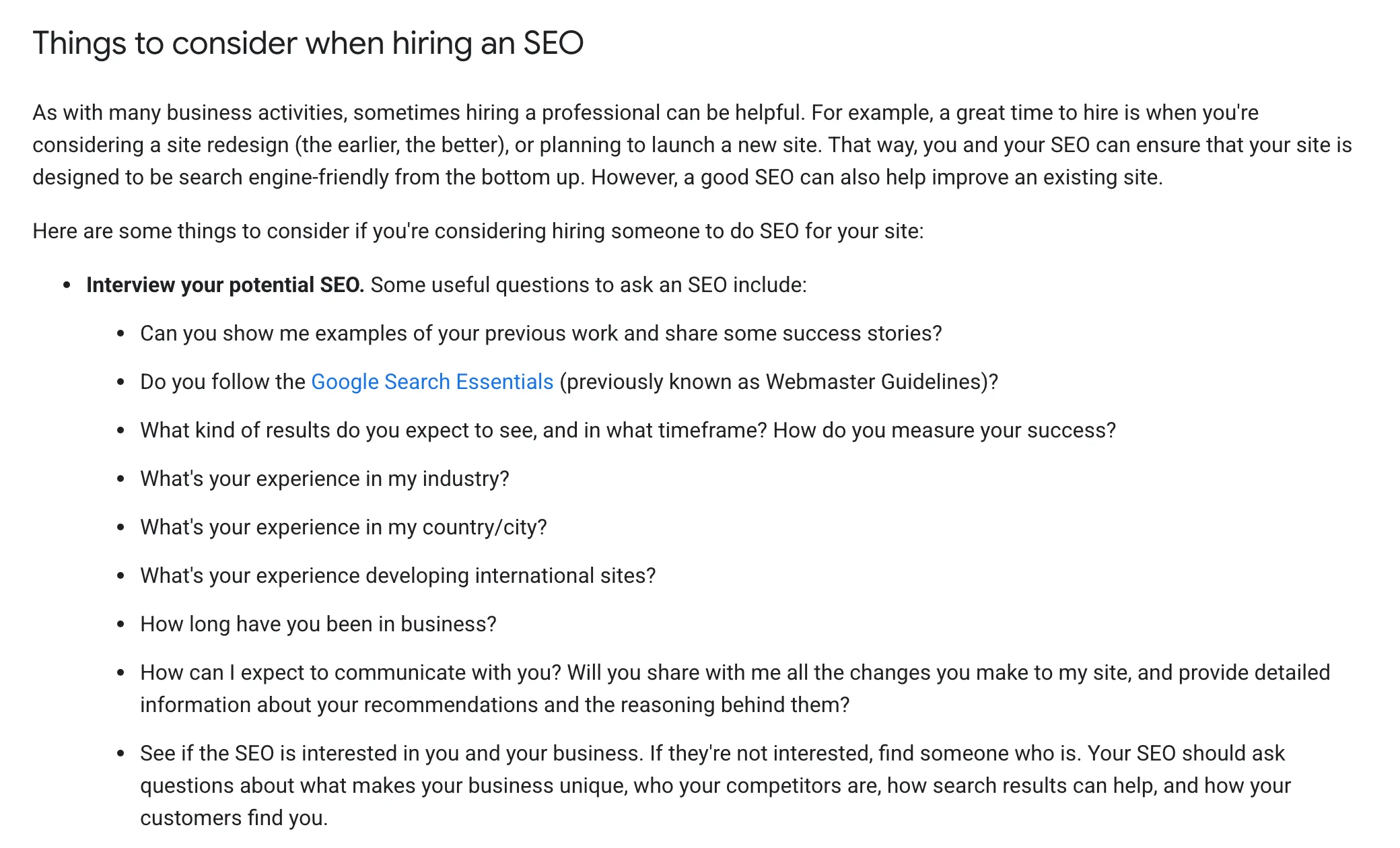
- Write down the work before you talk to anyone. List the technical fixes, the pages, the links and the reports.
- Ask each candidate which tasks they will do themselves and which they pass to someone else.
- Ask for examples of past work and for references you can call.
- Ask what results they expect, by when, and how they will measure them.
- Ask how they will tell you about each change they make to the site.
- Agree in writing what you keep when the arrangement ends.
A provider may offer to review your site before you sign. Google’s advice is to give read access to Search Console only at that stage. Wider access can wait until the work is agreed.
How To Use An Agency And An In-House Team Together
You can combine them. In a hybrid set-up, one person inside the business sets the priorities and signs off each change. An agency or a freelancer brings the skills that person lacks.
One ad in the job check described this from the inside. It asked a new SEO manager to decide which roles to fill in-house, by freelancers or by agencies. The same manager would then run the outside firms and freelancers against an agreed list of work.
A hybrid needs one plan and one owner. If an agency and an employee both edit the same pages, work gets done twice or undone. Google’s hiring advice also says you are responsible for the actions of any company you hire. That is one more reason for the in-house owner to approve every change before it goes live.
What To Keep In Your Own Name Whichever You Choose
Keep the highest role in every Google account that holds your search data, and give whoever does the work a lower one. Then ending the arrangement means removing their access, which you can do yourself on the day.
Google Search Console has owners, full users and restricted users. Google’s help page on permissions says an owner has full control and can add and remove users. A full user can see all the data and take some actions. Keep the verified owner role with your company. Give a provider full user access once the work is agreed. The help page lists each role and what it can do.
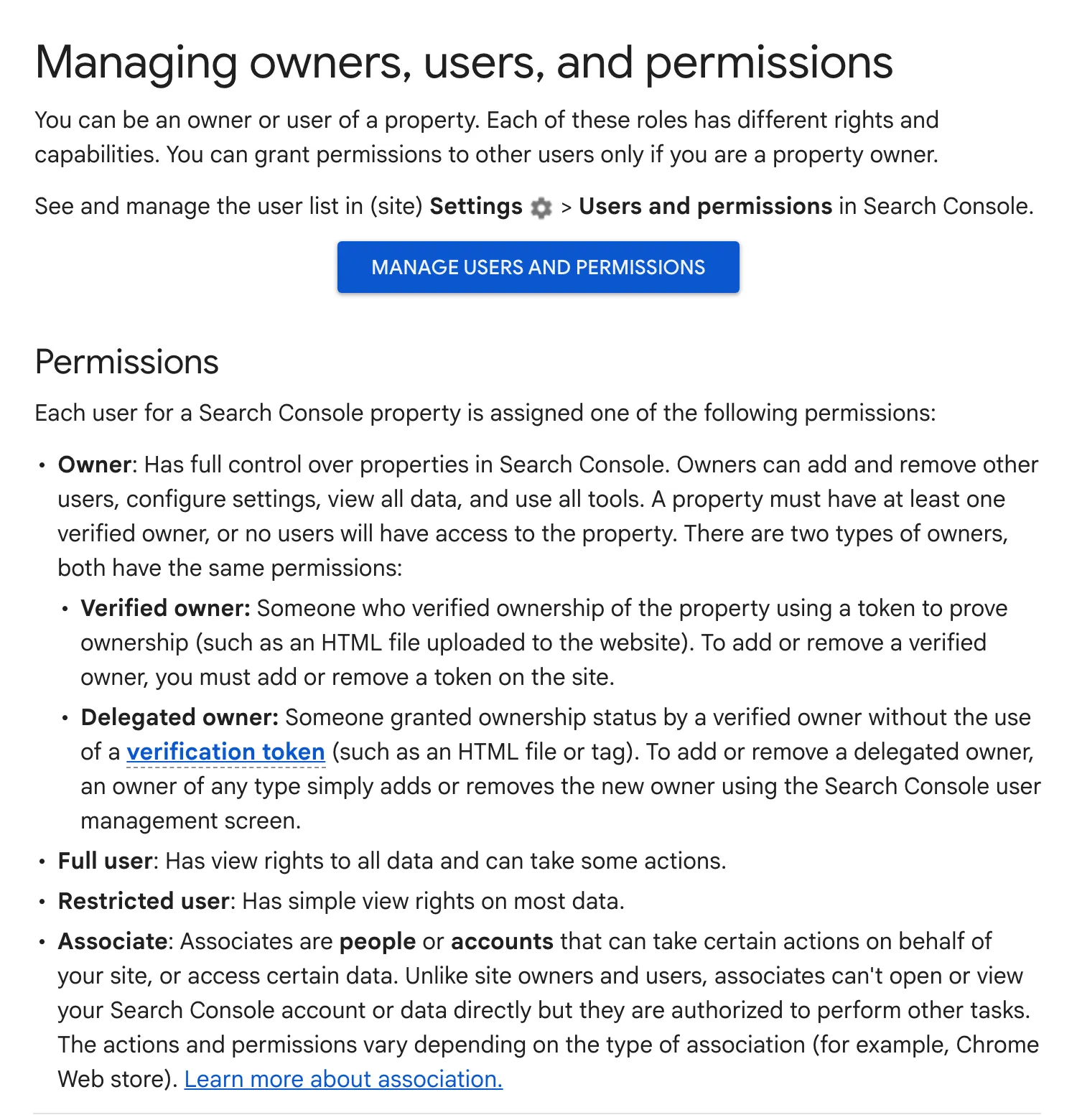
The same page says a removed owner can verify again as long as their verification token stays on the site. The token can be an HTML file, a meta tag or a DNS record, among other methods. When an owner leaves, remove their access and delete their token.
Google Analytics works the same way. Google’s help page on access says only an Administrator can add or remove users. An Editor can change the settings but cannot add users. Keep the Administrator role for your company and give a provider Editor or lower.
A Google Business Profile has a primary owner, other owners and managers. Google’s help page for the profile says managers can do almost all that owners can. They cannot add or remove users, and they cannot remove the profile. Keep the primary owner role and add providers as managers. The profile is also one of the sources AI answers cite, as the data at the top of this post shows, so it belongs in your own name.
When anyone who worked on the site leaves, go through this list.
- Remove their Search Console access and delete any verification token of theirs.
- Remove their Google Analytics role, or lower it to Viewer.
- Take them off your Business Profile.
- Change any shared passwords for the website, the hosting and the domain.
- Ask for a written record of the changes made, the pages written, the links earned and the work still open.
What I Would Do In Your Place
Each option solves a different problem. A freelancer is the simplest way to finish one defined job. An agency puts several specialists on the site and covers for absence. An in-house hire knows the business best, as long as the job you give them is one person’s job. Whichever you pick, keep the accounts in your own name from the first day.
Primal is an agency, so weigh this post with that in mind. If you have settled on an agency, our guide on how to choose an SEO agency lists the checks to run. Primal started in 2015 and has offices in Kuala Lumpur, Bangkok and Singapore. Our SEO services team works for companies that use an agency on its own. It also works beside in-house teams that need a specialist for technical work, content or links.
Frequently Asked Questions About SEO Agencies, Freelancers And In-House SEO
Is a freelancer cheaper than an SEO agency?
A freelancer bills for one person’s time and an agency for a team’s, so the two quotes buy different amounts of work. Compare the hours, pages, links and fixes in each quote before you compare the totals. Our post on SEO cost lists the published market rates for both.
When should you switch from a freelancer to an agency?
Switch when the work outgrows one person. The signs are technical, content and link work all waiting at once, or work that stops whenever the freelancer is away. Before the handover, get the change log. Then remove the freelancer’s access and their token.
Can we run our in-house team and an agency together to see who does a better job?
You can, as long as each side has its own part of the work. If an agency and an employee both edit the same pages, work gets done twice or undone, and you cannot tell whose work made the difference. Give each side a separate list of tasks, with one person inside the business who signs off every change. Then judge each side on the tasks it was given.
How much notice does an in-house SEO hire have to give?
Whatever the employment contract says comes first. Where it says nothing, Malaysia’s Employment Act 1955 sets the minimum. It is 4 weeks for under 2 years of service, rising to 8 weeks from 5 years.
What do AI assistants cite when you ask about SEO agencies?
Mostly sites other than the business’s own, such as directories and comparison sites. In the tracker data at the top of this post, a brand’s own site was cited in only about a quarter of the AI answers about it. Use the directories to find candidates, then judge each one on the work your site needs.
Founder and Chief Executive Officer
Mark McDowell is the Founder and Chief Executive Officer of Primal, which he started in Bangkok in 2015. He is on the Forbes 30 Under 30 Asia 2020 list and was Campaign Asia’s Southeast Asia Young Achiever of the Year in 2018. He writes about AI search and search engine optimisation.
About The Author


