



By Mark McDowellPosted: Updated: 12 min read
How To Choose An SEO Agency And Know When To Leave
Choose a search engine optimisation (SEO) agency on its proposal, its contract and its first 90 days. The proposal should list the work with dates, the contract should keep your accounts and content in your name and write any guarantee as a measure, a date and a remedy, and the report should show enquiries from search. Leave if the dated work is not live.
Key Takeaways
- Most AI answers skip the brand's own site. Elevate, Primal's AI Visibility Tracker, logged 16,543 answers across 172 queries over the last month, and a brand's own website was cited in only about a quarter of the answers about it.
- An AI shortlist says little about the work. On questions about which SEO agency to hire, the directory Clutch is cited more often than any agency's own site, so the list shows who is listed and reviewed.
- Put a fair guarantee in the contract. It sets out a measure, the date it is checked and the remedy if the target is missed.
- Judge the first 90 days on live work. Read the early signals in Search Console, and leave when the agency's conduct is the problem, such as a manual action or accounts it will not hand back.
How To Choose An SEO Agency In 6 Steps
When a buyer asks an artificial intelligence (AI) assistant about a typical brand, most answers do not cite the brand’s own website. Elevate, Primal’s AI Visibility Tracker, logged 16,543 answers across 172 queries over the last month, about 12 brands in 12 industries. A brand’s own site was cited in about a quarter of the answers about it. Marketplaces, review sites and comparison sites showed up in the answers for 11 of the 12 brands.
Search engine optimisation (SEO) agencies are no exception. The shortlist ChatGPT gives you shows which agencies are listed and reviewed. It tells you little about the work one would do on your site. You learn that from what an agency puts in writing. Judge its proposal, its contract and the work that is live after 90 days.
- Write down your goals for search. For most businesses that means enquiries, calls or orders from organic search.
- Treat the AI answers and the directories as a starting list. Read each agency’s own writing and ask for references before you meet. If price matters, our post on what SEO costs in Malaysia collects the published market rates.
- Send every agency the same questions in writing. Then lay the answers side by side.
- Read the contract for the work, the term, the notice period and who owns what.
- Agree a plan for the first 90 days, with dates and the numbers the report will show.
- Review the agency against that plan at day 90. Then decide whether to go on.
One step comes before all six. A small local business can often do much of the work itself, and Google’s SEO Starter Guide explains how search works. Read it before you meet anyone, because it makes a bad proposal easier to spot. If you do hire, a redesign or a new site is a good time to start, and the earlier the better.
Where The AI Shortlist Of Agencies Comes From
When you ask an AI assistant which SEO agency to hire, the source it cites most is a directory. Elevate, Primal’s AI Visibility Tracker, also logs answers to that question. In those answers the directory Clutch is cited more often than any agency’s own website, and Sortlist and GoodFirms appear among the sources too.
The wider data shows the same in other industries. Across the 12 brands, a competitor’s website was cited about as often as the brand’s own. The other sources were mostly places where buyers compare and check. They include marketplaces, review sites, government registers, publishers, Facebook and YouTube.
This means two things when you pick an agency. First, a directory listing shows that the agency looks after its listing and its reviews. It does not show you the work. So read the reviews for what was delivered and by when, and call the references.
Second, it changes what you are buying. Assistants read review sites, your Google Business Profile and your Facebook page as well as your site. Facebook was the most-cited social source for 8 of the 12 brands in the same dataset. A proposal that covers only your website covers only part of what the assistants read. So ask each agency which sources the AI answers about your brand cite today. Then ask what it will do about them.
We also read the seven buying guides on the first page of Google for this search. None says who owns your accounts and content when the contract ends, or lists the signs to check once work has started.
The Questions That Test An SEO Proposal
Ask every agency on your shortlist the same questions in writing. Judge each answer by how specific it is to your site. A strong answer points to your pages, your searches and dates, and a weak one would fit any business.
Ask about past work and experience as well.
| Question | A strong answer | A weak answer |
|---|---|---|
| What did you find on our site that we did not know? | Pages, searches or technical problems, and where the agency found each one | A general list that fits any site |
| What will be live by day 30, 60 and 90? | Fixes, new pages and changes, each with a date | “Ongoing optimisation” with no dates |
| Which number will you report each month, and where is it from? | Enquiries or orders from organic search in Google Analytics, beside clicks and impressions from Search Console | Rankings only, or a score from the agency’s own tool |
| How will you earn links, and will we see every site? | Outreach to sites your customers read, and a list of every link earned | A set number of links a month and no list |
| Who writes the content, and can we read live pages you wrote? | The writers and editors on your account, with links to their live pages | Samples in a slide deck |
| Which sources do the AI answers about our brand cite today? | The sites cited for your main questions, and which of them the agency will work on | A promise to get you into ChatGPT |
| What do you need from us? | Developer time, approvals and access, each with a date | Nothing at all |
The first question tests the main reason to hire outside help, which is a fresh view of your business. An agency that has studied your site answers with pages, searches and its own keyword research. One that has not answers with a checklist. If an agency wants to look at your site before you sign, give it read access to Search Console only.
Read two or three live pages the agency wrote, on its own site and on sites it works for. That is the simplest test of quality. If those pages are thin, expect the same on yours.
The link question matters because every link puts your name on another site, in front of its readers. Ask for the list of sites. Judge each one by its readers, its relevance to your business and its editorial standards. A link on a site your buyers never read does little for you.
What A Fair SEO Contract Says
A fair SEO contract lists the work with dates and sets the term and the notice period. It keeps your accounts and content in your company’s name, and it says what the agency hands back at the end. Read it for these six clauses before you sign.
- The work has dates. Put the 90-day plan from the proposal into the contract or an appendix. A contract that says “SEO services” and nothing more gives you nothing to check against.
- The term and notice are clear. Look for the minimum term, the notice to end it and whether it renews on its own. Pick terms you could accept if the work goes badly.
- The accounts are in your company’s name. That covers Google Search Console, Google Analytics, your Google Business Profile, the domain and the hosting, with the agency added as a user. Our comparison of an SEO agency, a freelancer and an in-house hire lists the role to give in each Google tool.
- The content is yours. The clause says who owns the pages, images and reports, and that you keep them when the contract ends.
- The methods are stated and the agency sends you a list of every link it places.
- The handover is listed. The contract says what comes back to you at the end, and by when. That means the change log, the content files, the link list and any logins the agency set up.
Who Owns The Content An Agency Writes
The contract says who owns the pages and the accounts, so read that clause before you sign. An agency’s standard terms may keep ownership with the agency, or let you use the pages only while you pay.
I would not sign terms that leave the pages with the agency after you have paid for them. If the content is a large part of what you are buying, ask a lawyer to read the clause.
What A Fair Guarantee Covers
When a milestone is missed, you get the remedy the contract names. That can be extra work at no added fee until the milestone is met, or the right to end the contract early with notice. A fair guarantee names the measure, the date it is checked and that remedy.
So write each milestone into the contract with its date. In the same clause, agree what happens when one is missed.
Some agencies, Primal among them, publish their performance guarantees. Check as well what it asks of you in return, such as access to your accounts and approvals on time.
When an agency guarantees a ranking, I would ask which searches it means. A ranking guarantee on the searches your buyers type is worth having. First place on a search nobody types is easy to promise and does nothing for your business.
Signs Your SEO Agency Is Not Working In The First 90 Days
In the first 90 days, the warning signs show in the work itself. Watch for dated work that is not live, changes with no log, accounts opened in the agency’s name and reports with rankings only.
Revenue comes later. Google’s SEO Starter Guide says some changes take effect in a few hours and others take several months. So wait a few weeks before you judge whether a change helped.
| By | What you should see | Warning signs |
|---|---|---|
| Day 30 | The agency added as a user on your accounts, the 90-day plan signed off, the first fixes live, a log of each change | Asks for owner access, opens accounts in its own name, makes changes with no log |
| Day 60 | New or better pages live, every earned link listed by site, the changed pages recrawled in Search Console | Task lists with no pages or dates, links from sites with no tie to your business, pages published without your sign-off |
| Day 90 | More impressions and clicks on the pages worked on, organic enquiries tracked in Google Analytics, a plan for the next three months | Rankings for searches you never agreed, no enquiry tracking, the same report each month, a manual action |
What The Monthly Report Should Show
The monthly report should tie organic search to enquiries or orders. Those come from Google Analytics, shown beside the clicks and impressions from Google Search Console. Rankings alone do not tell you whether search brings in business.
Customers often ask us whether organic search can be tied to leads. It can, once the enquiry forms and calls are tracked from the first month. The report should also list the work done, with dates and links to the pages that changed. Our post on SEO key performance indicators (KPIs) explains how to read the two tools and why their numbers differ.
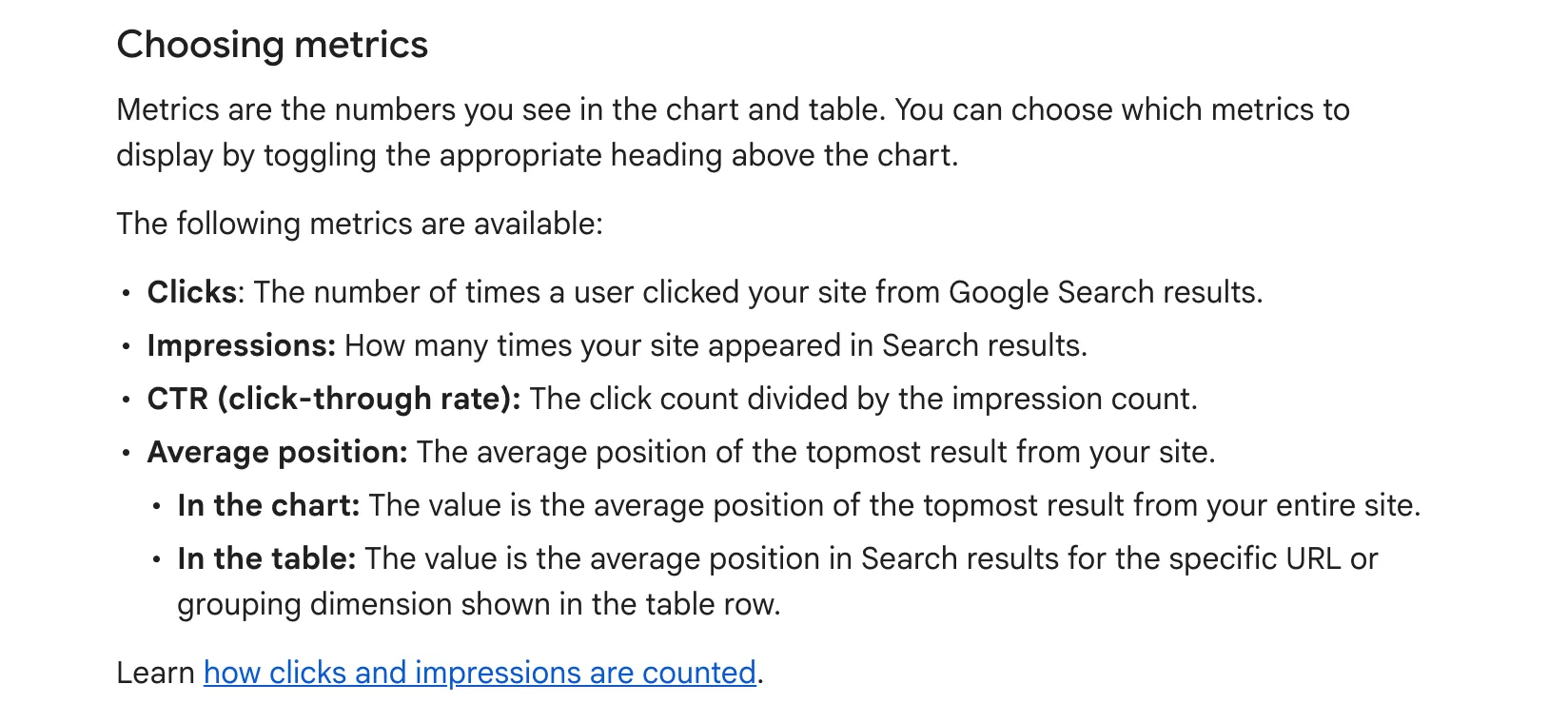
The four numbers in the Search Console part of the report are clicks, impressions, click-through rate (CTR) and average position. This is the part of the Performance report help page that defines each one, so you can check that the agency’s report uses them the same way.
Checks You Can Run Yourself
You can check the work without the agency’s report. Each check needs only Search Console or the live site.
- Open the Manual actions report in Search Console. It should say that no issues were detected.
- Open the Links report and read the sites that link to you most. Ask about any with no tie to your business.
- Pick three pages the last report says were changed. Open them on the live site and compare them with the change log.
- Take the main number in the report and find the same figure in Search Console or Google Analytics. If the agency can show it only in its own tool, you cannot check it.
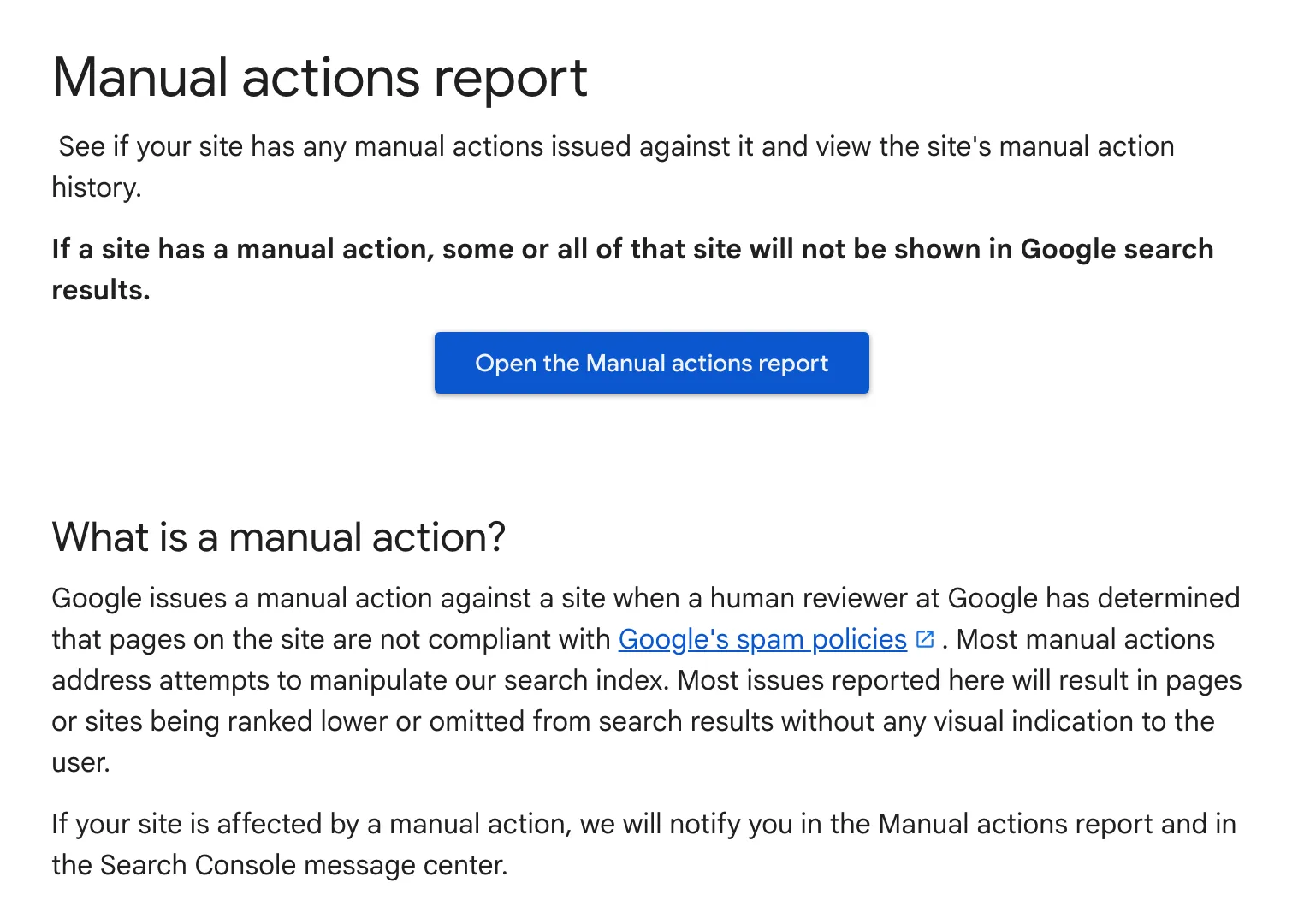
The first check matters most. Google’s help page on the Manual actions report explains when Google issues one. It happens when a human reviewer finds that pages on a site do not comply with Google’s spam policies. Some or all of that site is then left out of Google’s results. One of the actions it lists is for unnatural links to your site.
This is the top of that help page, where Google explains what a manual action does.
Google says most reconsideration reviews take several days or weeks, and link reviews can take longer. You are responsible for the work of any company you hire, so a manual action caused by an agency’s work is still your site’s problem.
When To Leave An SEO Agency
Leave when the problem is the agency’s conduct or its delivery. Stay when the work is live and the early signals are rising. Customers often ask us whether to go on with an agency or exit, and that is the answer.
Leave at any point for one of these reasons.
- A manual action on your site caused by links or content the agency produced.
- The agency will not show you what it changed, or will not share the list of links it earned.
- Your accounts or domain sit in the agency’s name and it will not transfer them.
- By day 90 the dated work in the contract is not live, and the agency cannot say when it will be.
Give it more time in these cases.
- The work is live and Search Console shows impressions rising on the pages worked on, while enquiries have not risen yet.
- The agency has explained a drop with evidence from Search Console, and has a plan to fix it.
When you decide to go, follow the contract. Give notice in writing and ask for the handover it lists. Then remove the agency’s access to your accounts and any verification it added to the site. The comparison post linked above has a leaving checklist for each Google tool. Keep the content the agency wrote, as long as the contract gives it to you.
What To Take Into Your Next Agency Meeting
An AI assistant will give you a list of agencies drawn from directories and reviews. Use it to start. Then ask each agency to write down what will be live by day 90 and who owns the accounts and content. Ask it as well what it will do about the sources the assistants read. Judge the agency at day 90 on those answers, and judge revenue later.
This post comes from an agency, so read it with that in mind. Primal started in 2015 and has offices in Kuala Lumpur, Bangkok and Singapore. If you would like to put these questions to us, our SEO services page sets out what our Kuala Lumpur team covers.
Frequently Asked Questions About Choosing An SEO Agency
Can an SEO agency guarantee first place on Google?
An agency can write a ranking target into the contract, with a date and a remedy if the target is missed. A fair target covers searches your buyers type, such as a share of agreed keywords on page 1 of Google by a set date. If an agency promises first place, ask which searches it means and how many people type them each month.
How long should I give an SEO agency before judging it?
Judge the work at 90 days and the revenue later. Google’s SEO Starter Guide says some changes take hours to show and others take several months. By day 90 the planned work should be live. The pages worked on should also show early signals, such as rising impressions in Search Console.
Can we have a mutual termination clause if there is no improvement by month six?
Yes, you can ask for one, and it is a fair request. First agree what improvement means, in numbers both sides can read in Search Console or Google Analytics. Put the notice period in the same clause. A clause with no definition only leads to an argument at month six.
Should I hire an SEO agency or do the work myself?
A small local business can often do much of the work itself, starting with Google’s SEO Starter Guide. An agency makes more sense when the site needs technical SEO, content and link building at once. A redesign or a new site is a good time to bring one in.
Founder and Chief Executive Officer
Mark McDowell is the Founder and Chief Executive Officer of Primal, which he started in Bangkok in 2015. He is on the Forbes 30 Under 30 Asia 2020 list and was Campaign Asia’s Southeast Asia Young Achiever of the Year in 2018. He writes about AI search and search engine optimisation.
About The Author


