



By Mark McDowellPosted: 10 min read
SEO KPIs To Track And How To Read Them In Month 1
SEO KPIs are the few numbers you judge search engine optimisation (SEO) on, such as clicks and impressions in Google Search Console, key events in Google Analytics, mentions and citations in AI answers, and the leads they bring. In month 1 they mostly set starting values, because Google says crawling a new or changed page can take from a few days to a few weeks.
Key Takeaways
- Month one sets each KPI's starting value. Google says crawling a new or changed page can take from a few days to a few weeks, so enquiries rarely change yet.
- Report clicks from the Search Console chart totals. Across 87 client websites Primal reports on, the queries table listed about a third of the clicks on the median site this month.
- Track AI mentions and citations as two KPIs. In Primal's data on AI answers about 12 brands, the median brand's own site was cited in about a quarter of the answers about it.
- Judge SEO on enquiries and orders. Take them from organic search, and compare 28-day periods instead of calendar months.
What SEO KPIs Are
SEO KPIs are the few search numbers you agree to judge the work on. A key performance indicator (KPI) is a metric with a target and a date. Search engine optimisation (SEO) produces dozens of metrics. Only a handful deserve a target.
The first month of SEO work mostly sets the starting value for each one. Primal’s data shows how easily those first numbers are misread. Reports often quote the Search Console queries table. It lists only about a third of the clicks on a typical site. A rank report can average keywords on the first page with keywords that rank nowhere. AI answers need a line of their own as well. In Primal’s data on AI answers about 12 brands, the typical brand’s own site was cited in only about one answer in four.
In the first month, I would record every starting value, AI visibility included. I would also read each tool the way it measures. Then I would judge the work on enquiries and orders once they have had time to come in.
The SEO KPIs To Track
Track a few KPIs at each stage, from being seen in search to being chosen by a buyer. Visibility numbers change first and visits follow. Enquiries, orders and revenue change last. Those decide whether SEO pays off.
| KPI | Where to find it | What month 1 can show |
|---|---|---|
| Indexed pages | Search Console, Page indexing report | New and fixed pages picked up |
| Impressions | Search Console, Performance report | The starting value, and early gains on recrawled pages |
| Clicks and click-through rate (CTR) | Search Console, Performance report | The starting value, page by page |
| Average position and keyword rankings | Search Console, or a rank tracker on a fixed keyword list | Direction only, read beside impressions |
| Organic sessions and engagement rate | Google Analytics, Traffic acquisition report | The starting value |
| Organic key events | Google Analytics, Key events | Whether the tracking works |
| AI mentions and AI citations | Search Console’s Generative AI report and an AI visibility tracker | The starting value for each AI platform |
| Referring domains | Search Console’s Links report or a backlink tool | The starting value |
| Core Web Vitals | Search Console, Core Web Vitals report | Fixes still waiting for data |
| Leads and revenue from search | Your customer relationship management (CRM) system or enquiry log | Rarely a change yet |
Pick one number from the last row as the KPI that decides. For most businesses it is enquiries or orders from organic search. The rest of the table explains why that number goes up or down.
Split branded searches from the rest as well. Searches that include your business name measure demand you already have. The others show whether SEO is reaching people who did not know you.
What A Month 1 SEO Report Can Show
A first-month report records starting values and checks that the measurement works. It rarely shows a rise in enquiries that SEO can claim. Google’s guide to recrawling says crawling a new or changed page can take from a few days to a few weeks. A fix made late in the month may not reach the report before it closes.
A useful first report covers four things.
- The starting value of each KPI over the 28 days before the work began, so later months have a fair comparison.
- Proof that the tracking works. Search Console is verified for the whole domain, and each key event is tested with a real enquiry.
- Each fix and the day it went live, so a later change can be traced to its cause.
- The first signals, such as pages indexed after a fix and impressions on pages Google has recrawled.
If a first report claims a jump in enquiries, ask which pages and which searches produced it. I would judge the first month on clean starting values and on fixes that are live.
How To Read Search Console In Month 1
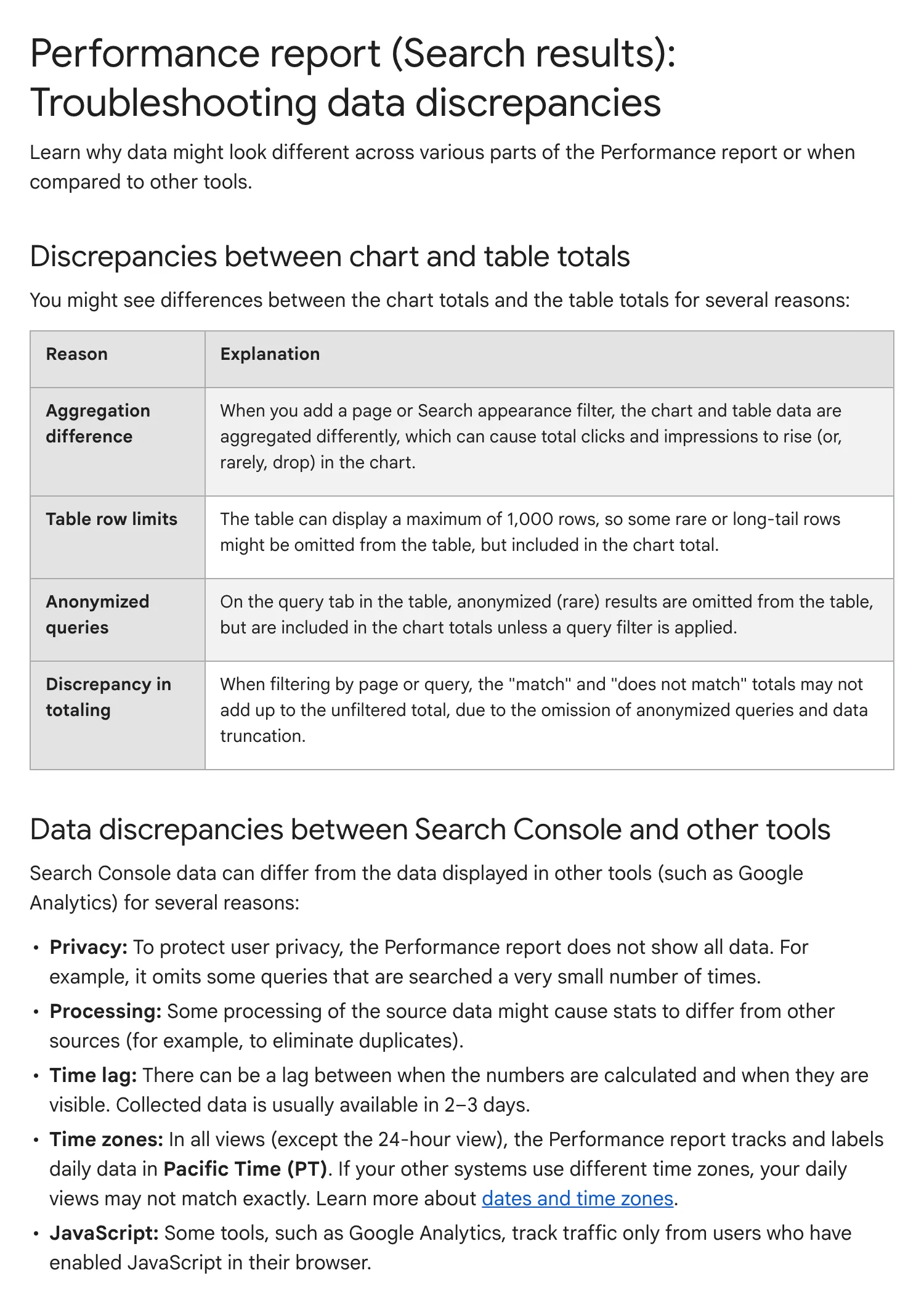
Take clicks and impressions from the chart at the top of the Performance report. Do not report the sum of the table below it.
Google’s help page on Performance report data discrepancies explains why the two disagree. The table shows at most 1,000 rows. It also leaves out anonymised queries, which are rare searches Google hides to protect privacy. The chart total still includes them.
Across 87 client websites Primal reports on, we compared the queries table with the chart total this month. On the median site the table listed 36% of the clicks. On 68 of the 87 it listed less than half.
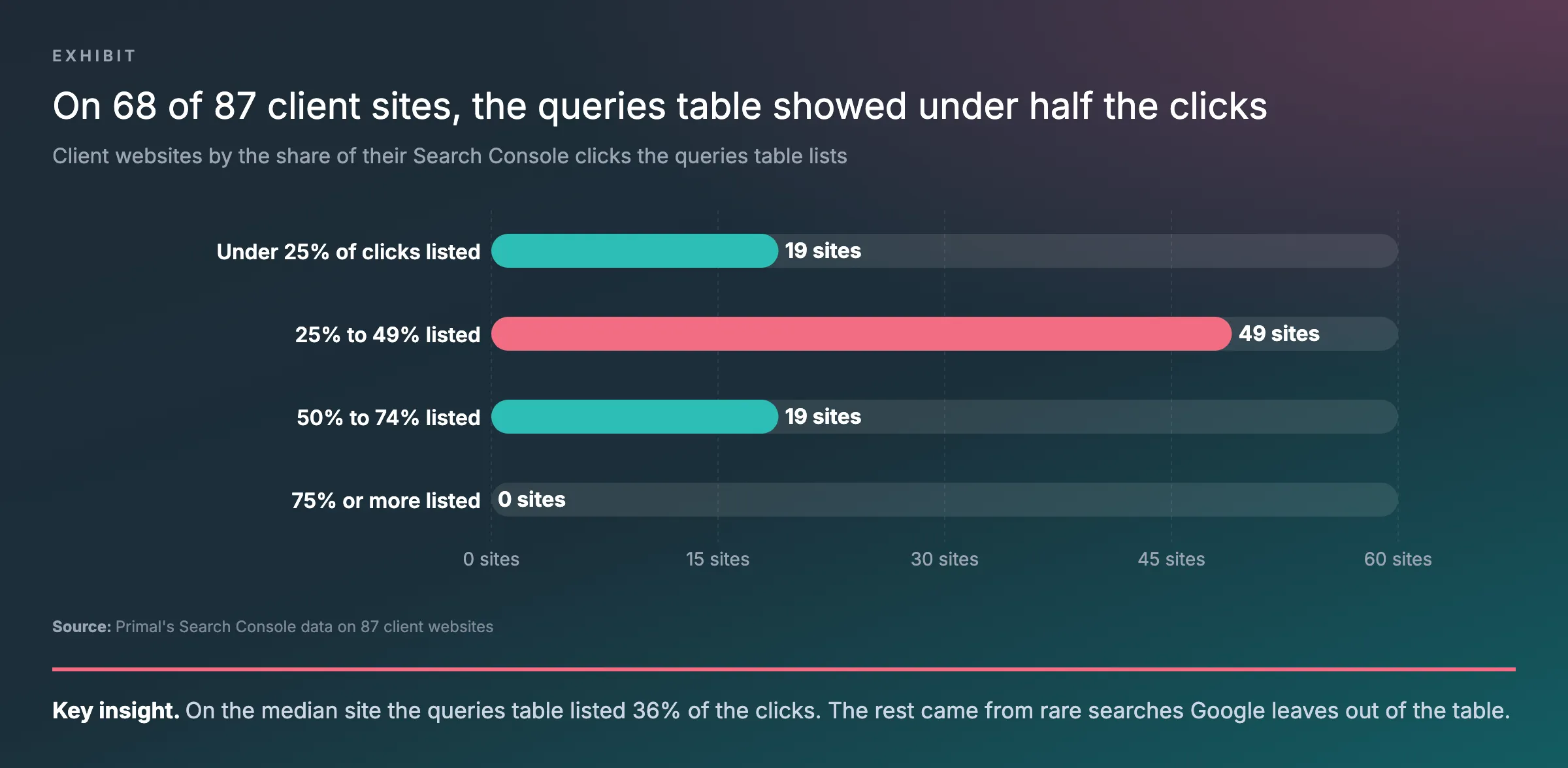
That gap matters most for the branded split. A split made from the table covers only the clicks the table lists. Show it as a share of those, with the chart total beside it.
Google’s page also gives two more reasons for odd numbers. Search Console shows data a few days after it is collected, and it labels each day in Pacific Time. Click-through rate needs care too, because it depends on what Google shows above your link. Compare each page’s CTR with its own earlier figure. A benchmark from someone else’s site says little about yours.
Why Average Position Can Get Worse While SEO Works
Average position can get worse because new searches join the average. Google defines it as the topmost position of your site in a result, averaged across every time it was seen. A site may start to appear for searches where it sits far down the page. Those impressions pull the average down even when no ranking drops.
The table works through a made-up site with round numbers.
| Month 0 | Month 1 | |
|---|---|---|
| Impressions at position 4, on searches it already ranked for | 1,000 | 1,000 |
| Impressions at position 35, on new searches | 0 | 1,000 |
| Total impressions | 1,000 | 2,000 |
| Average position | 4 | 19.5 |
The site kept every ranking and gained a new set of impressions. Its average position still went from 4 to 19.5. Read average position for a fixed group of searches or pages, with impressions beside it.
Rank reports have the same weakness at a larger size. Across 67,000 keywords tracked in Keyword.com for Primal’s clients, one in three sits on the first page of Google this month. About half rank nowhere in the first 100 results. An average rank across a list like that describes the list more than the work. Agree the keyword list before the work starts and keep it fixed. Then report how many of those keywords reach the first page each month.
How To Compare One Month With The Next
Compare the last 28 days with the 28 days before, because each period holds four of every weekday. A calendar month can hold four Saturdays or five. Two months side by side then mix the SEO work with the calendar.
Search Console labels days in Pacific Time. Its Saturday runs from Saturday afternoon to Sunday afternoon in Kuala Lumpur, Bangkok or Singapore.
That shifted Saturday is the day to watch. Across 137 client websites Primal reports on, it was the quietest day on most sites this year.
Mark public holidays in the report too. A holiday week will not compare cleanly with a normal one, whatever the SEO work did.
How To Read Google Analytics In Month 1
Expect Google Analytics and Search Console to disagree. Check that their trends point the same way.
They measure different things. Search Console records clicks on Google’s results. Google Analytics records sessions on your site, and only from browsers that run JavaScript.
The figure to set up properly is organic key events. Google Analytics now calls the actions you mark as important key events, which older reports called conversions. In the first month, mark the enquiry form, the call button, the WhatsApp button and the checkout as key events. Then test each one with a real action.
After that, the Organic Search row of the Traffic acquisition report shows how many of those actions came from search. Read engagement rate by landing page beside it, as context for the key events. Organic traffic on its own shows how many people came. Key events show whether they asked for anything.
How To Track AI Visibility As An SEO KPI
Track two AI numbers and keep them apart. One is how often answers mention your brand, and the other is how often they cite your pages. A mention puts your name in front of the reader. A citation links the reader to a page, which is the part that can bring a visit.
Start with the share of answers that cite your own site. Elevate, Primal’s AI Visibility Tracker, logged 16,543 AI answers about 12 brands in 12 industries over the last month. Every brand’s own site was cited in some of the answers about it. The share ran from 10% to 69%, with a median of 25%.
The chart below shows that spread. Use it as a guide when you record your own starting value.
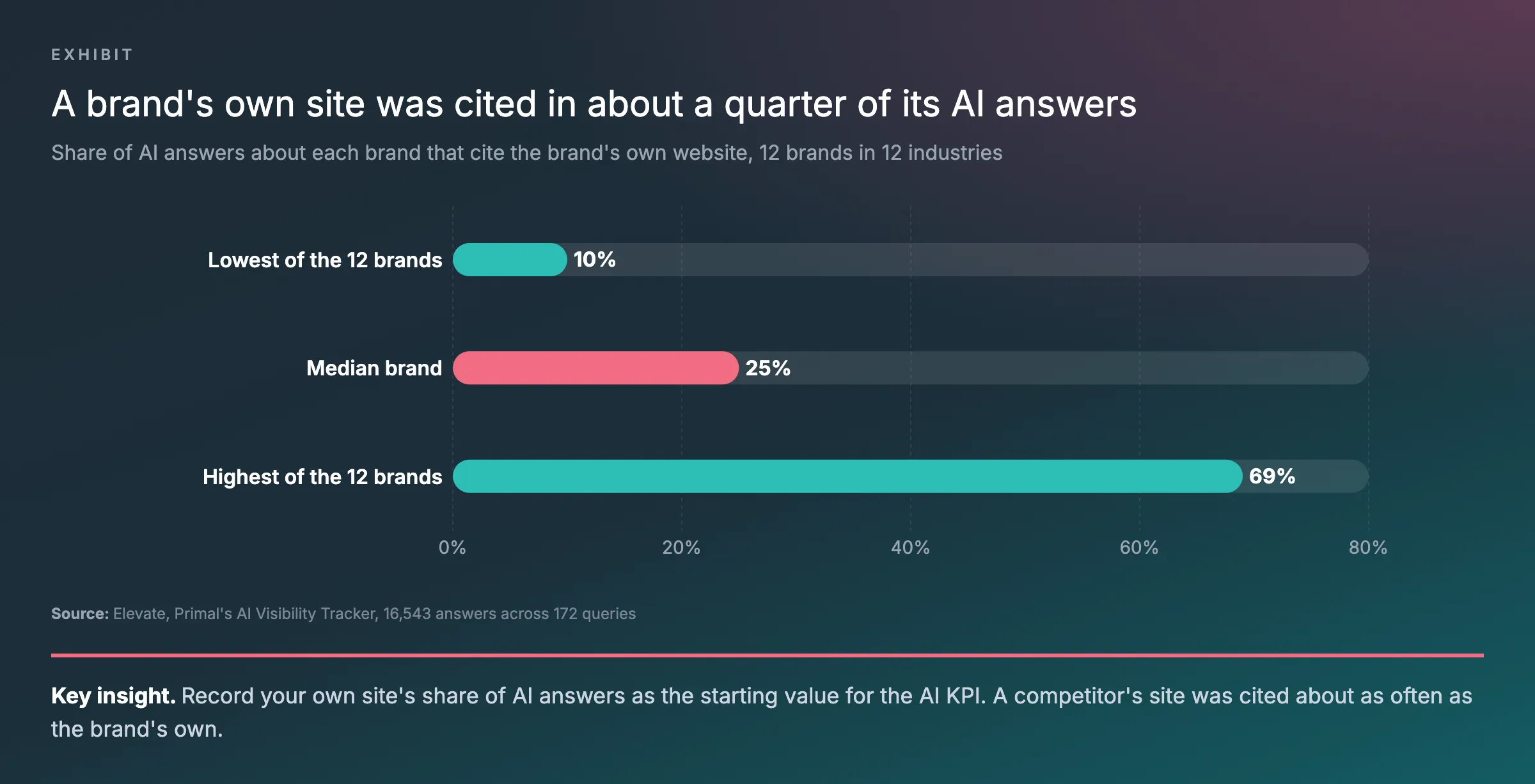
A competitor’s site was cited about as often as the brand’s own. Marketplaces and comparison sites showed up in the answers for 11 of the 12 brands, and Google’s own Business Profile and Maps results for 7. Facebook pages and government registers came up too.
The type of question changes what the answers cite. In a smaller set of 3,693 answers across 66 queries in the same tracker, the answers to general SEO questions mentioned no agency at all and cited publishers and Google’s own pages.
So the AI KPI has two parts. The first is how often answers cite your own pages, since a general question may mention no business at all. The second is whether the marketplaces, review sites and profiles the answers cite list you correctly. Record both in the first month.
In this video on his YouTube channel, Mark McDowell walks through how to measure whether AI assistants recommend a brand.
Clicks are why this belongs in an SEO report. Ahrefs found that the first result gets about 58% fewer clicks when an AI Overview sits above it. A page can hold its rank and still lose clicks. Only the AI numbers show whether the answer above it mentions you.
Search Console now has a Generative AI report that shows how often your pages appeared in AI Overviews and AI Mode. Our posts on AI Overviews and measuring AI search visibility explain that report and the trackers beside it.
Which SEO KPIs Change Later
Several KPIs only show a change after the first month. The Core Web Vitals report uses the last 28 days of real visitor data. Confirming a fix takes another 28 days. So a speed fix made early in the first month shows as fixed in the second at the soonest.
Backlinks and referring domains grow as other sites find your pages and link to them. That depends on the content and outreach in the plan. Keyword rankings on competitive searches follow, and enquiries and revenue come after those. Return on investment (ROI) settles last. Our post on how to measure SEO ROI works through the formula with an example.
What To Do In The First Month
Write the KPIs down before the work starts, each with its starting value. Agree which one decides whether SEO pays off. Add AI mentions and AI citations to the list from the start. Then read each tool the way it measures. That means chart totals in Search Console, 28-day periods, and average position only beside impressions.
Primal started in 2015 and has offices in Kuala Lumpur, Bangkok and Singapore. Our SEO team reports rankings, organic leads and AI citations against the targets agreed in each plan. Each report starts from the values recorded in the first month.
Frequently Asked Questions About SEO KPIs
What Are The Most Important SEO KPIs?
The most important SEO KPIs sit closest to revenue. They are enquiries, orders or revenue from organic search, recorded as key events in Google Analytics or in your CRM. Clicks, impressions and position from Search Console explain why those numbers change. AI mentions and citations now sit beside them.
How Long Before SEO KPIs Improve?
Visibility numbers change first. Google says crawling a new or changed page can take from a few days to a few weeks. Search Console shows the data a few days after that. Enquiries and revenue follow later, depending on how hard your searches are to rank for.
Why Don’t Search Console Clicks Match Google Analytics Sessions?
They measure different things. Search Console records clicks on Google’s results, labels days in Pacific Time and hides rare searches for privacy. Google Analytics records sessions only from browsers that run JavaScript, so compare the trends and expect the totals to differ.
Should AI Mentions Or AI Citations Be The KPI?
Track both and report them apart. A mention puts your name in front of the reader, while a citation can send them to your page. In Primal’s data on AI answers about 12 brands, a competitor’s site was cited about as often as the brand’s own. So the share of answers that cite your own pages is the number to raise first.
How Do I Show A Board That SEO Brings Leads?
Customers often ask us how to show a board that SEO brings leads, when the board does not read rankings or impressions. Report organic key events and the leads in your CRM, grouped by the page each visitor arrived on. Search Console shows which searches bring clicks to that page, and Google Analytics shows which key events it records.
Keep rankings and impressions in the report as the reason the lead number goes up or down.
What If SEO Brings Traffic But No Enquiries?
Customers often ask us why SEO traffic grows while qualified enquiries do not. Read organic key events by landing page to see where the visits arrive. If most visits arrive at posts that answer general questions, put more of the work into the service and product pages where buyers ask for a quote. Judge the work on enquiries, with traffic as one reason they change.
Founder and Chief Executive Officer
Mark McDowell is the Founder and Chief Executive Officer of Primal, which he started in Bangkok in 2015. He is on the Forbes 30 Under 30 Asia 2020 list and was Campaign Asia’s Southeast Asia Young Achiever of the Year in 2018. He writes about AI search and search engine optimisation.
About The Author


