



By Mark McDowellPosted: 10 min read
A One-Page Digital Marketing Strategy For SMEs
A digital marketing strategy for small and medium enterprises (SMEs) is a one-page plan. It sets one goal, the customer, the places that customer checks before buying, a budget and one number to review each month. Across 16,543 AI answers in Elevate, Primal's AI Visibility Tracker, over the last month, the typical brand's own website was cited in only about a quarter, so the plan covers more.
Key Takeaways
- Your website is only part of the plan. Over the last month, Elevate, Primal's AI Visibility Tracker, logged 16,543 AI answers about 12 brands, and the typical brand's own website was cited in only about a quarter of its answers.
- Plan for Facebook and your listings too. Facebook was the most-cited social source for 8 of those 12 brands, and marketplaces or comparison sites appeared in the answers for 11 of them.
- A small budget buys few clicks. In Primal's own Google Ads account this year a click cost RM26.74 on average, so a RM2,000 monthly ad budget buys about 75 clicks and has to go to the searches closest to buying.
- The whole plan fits on one page. It runs to seven lines, from the goal to the date you review it.
- Give each channel about three months. Then keep what reached its goal and change one or two things at a time.
What A Digital Marketing Strategy For An SME Includes
The digital marketing of a small and medium enterprise (SME) has to reach every place its buyers check, and they check far more than its website. Over the last month, Elevate, Primal’s AI Visibility Tracker, logged 16,543 AI answers about 12 brands. For the typical brand, about three answers in four did not cite its own website at all. They drew on pages such as its Facebook page, its Google listing, a marketplace, a competitor’s site or a government register.
So a digital marketing strategy for SMEs starts with those places. Find out where your customers check before they buy. Make each of those places correct and complete. Then spend on ads only where the money brings enquiries.
The strategy is a written plan for how customers will find you and buy from you online over the next year. For an SME it answers seven questions. What does the business want? Who buys? Where do those people look before they buy? Why should they pick you? What will you spend? Which number shows it is working, and when will you review it?
I would keep the plan to one page. SME Corp Malaysia’s figures show that about three in four of the country’s SMEs are microenterprises. That means fewer than 5 full-time staff or turnover under RM300,000. In a firm that size, the owner is likely to write the plan and run it too.
Where Buyers Check A Business Before They Buy
Buyers check a business in many places besides its own website. They look at its Facebook page, its Google listing, the marketplaces and comparison sites in its trade, and official registers. AI answers make this easy to see, because they list the sources they used.
Those 16,543 answers came from 172 buyer questions about 12 brands in 12 industries. The brands range from a university and a used-car marketplace to an online florist and a precast concrete maker.
| What the AI answers cited | How often | What it means for your plan |
|---|---|---|
| The brand’s own website | In about a quarter of answers for the typical brand | Keep the service, price and contact pages current |
| A competitor’s website | About as often as the brand’s own | Ask an assistant your customers’ questions and see who else it cites |
| The most-cited social source for 8 of the 12 brands, in up to 28% of answers | Treat the page as a second website | |
| Marketplaces and comparison sites | In the answers for 11 of the 12 brands | List the business where buyers compare |
| Google Business Profile and Maps | In the answers for 7 of the 12 brands | Fill in every field and reply to reviews |
| Government registers and regulators | In the answers for about half the brands | Join the register your trade keeps, if it has one |
Several of these places cost an owner time and little money, the Business Profile and the Facebook page most of all. Fixing them helps with the AI answers and with the buyers who check by hand.
How To Write The Plan In One Sitting
Write the plan as seven lines on one page, with one short entry for each. A line you cannot fill shows you what to find out before you spend anything.
| Line | What to write | Where to find it |
|---|---|---|
| 1. Goal | One business result for the next 12 months, with a number and a date | Your accounts and enquiry records |
| 2. Customer | Who buys, where they are, and the words they use to ask for what you sell | Enquiries, WhatsApp chats and the searches listed in Google Search Console |
| 3. Places and channels | The places from the table above that your customers check, plus two or three channels to reach new customers, with who does the work each week | The channel notes below |
| 4. Offer and proof | One sentence on why a customer should pick you, and the proof you can show | Reviews, photos of finished work, certificates |
| 5. Budget | A monthly figure for ads, tools and outside help, less any grant that pays part of it | Your cash flow and the grant section below |
| 6. Measure | The one number you will check each month, taken straight from the goal | Google Analytics, your Business Profile or the ad platform’s report |
| 7. Review date | A date about three months away, when you read the numbers and change the plan | Your calendar |
Set the goal in enquiries, bookings or orders, because those are easier to check than reach or likes. Google Search Console is Google’s own tool for site owners. It costs nothing, and it lists the searches your site shows up for, in the words your customers type.
Run each channel in line 3 as a campaign, with a start date, a goal and an end date. Then you know when to judge it. The plan is done when every line has an entry and the measure in line 6 matches the goal in line 1.
Which Channels To Start With
Start with the places your customers already check, then add the channels that reach new customers. In the AI answers above, the Google Business Profile and the Facebook page were cited for most of the brands. Both are in the owner’s own hands. I would fix both before spending a ringgit on ads.
Google Business Profile
For a business that customers visit, or one that serves a local area, start here. Google’s help page on local ranking says local results depend mainly on relevance, distance and prominence. It adds that more reviews and good ratings can help a business rank. Fill in every field and add real photos. Reply to every review, good or bad. Our page on local search engine optimisation (SEO) covers the rest of that work.
Facebook And Other Social Media
Pick the one or two social media platforms your customers use. Post on a schedule you can keep for three months. In the data above, Facebook was the social source the assistants cited most. So its About section, opening hours, photos and reviews need the same care as the website.
Search Engine Optimisation
SEO gets your own pages into Google’s unpaid results. It takes time up front. Once a page ranks, it keeps bringing visits with no charge for each click. Ads stop when the budget stops.
Rankings also come slowly, even when an agency does the work. Across the roughly 67,000 keywords tracked in Keyword.com for the brands Primal works with, one in three sits on page 1 of Google this month. About half rank outside the first 10 pages. A small business does better with the exact searches its customers type, such as a service and an area, than with one broad term. A separate post compares SEO and search engine marketing (SEM).
Paid Search And Social Ads
Paid advertising on Google, Meta and TikTok reaches buyers from the first day. Use it when the goal needs enquiries this quarter, and judge it on what each enquiry costs. Our guide to pay per click advertising explains how the auction sets the price of a click.
Email And Messaging
Email marketing to your own customer list is a channel you hold yourself. No platform decides who sees the message. Ask for consent each time you collect a contact, as the FAQ below explains.
Does A Small Business Need A Website If It Has A Facebook Page?
A small business can start with a Facebook page, and it should add a website when it can. The page is quick to set up and reaches people where they already spend time. The website is the page Google ranks for a search, and the customer details it collects belong to you.
The Department of Statistics Malaysia (DOSM) ran a survey of how businesses use technology and e-commerce. It found that more businesses had a social media page than a website of their own. In the AI answers above, both were cited. A business with only one of them gives the assistants less to work with.
Primal’s advice is to start with a Facebook page when time or money is short. Once the product sells, add a website, and run both when you can so the customer data is yours.
How Much An SME Should Spend On Ads
Set the ad budget from the price of a click and the number of enquiries you need. A small budget buys a short list of clicks, so it has to go to the searches closest to buying.
In Primal’s own Google Ads account this year, 6,536 clicks cost RM26.74 each on average. Single keywords ran from about RM15 to about RM90 a click. A general search such as “digital marketing” sat at the low end. A search for a firm to hire, such as “seo company”, sat near the high end.
Take an ad budget of RM2,000 a month as a worked example. At RM15 a click it buys 133 clicks, and at the account’s average it buys 75. At RM90 a click it buys 22. The chart shows the same budget at the three prices.
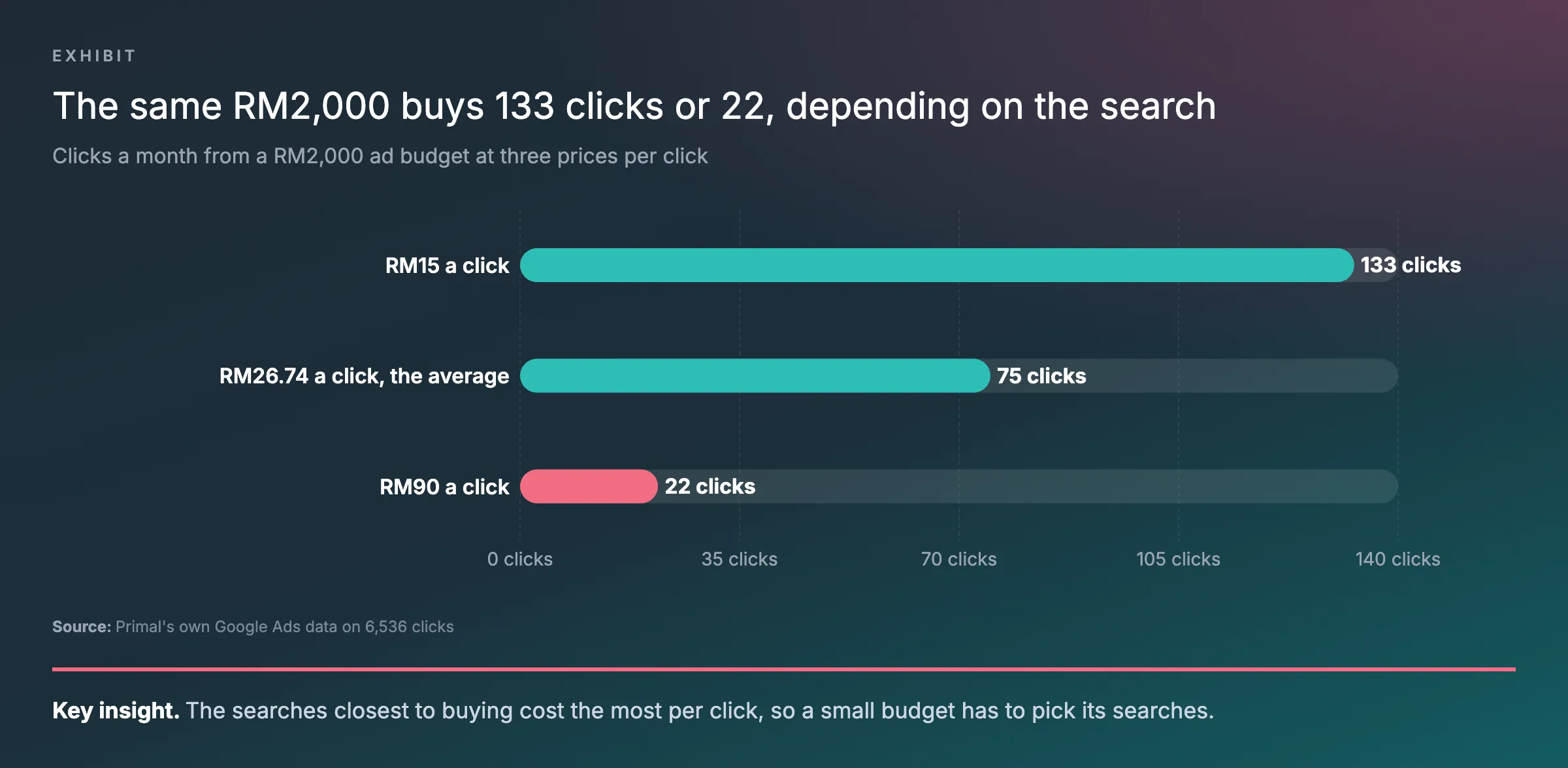
Every one of those clicks still has to turn into an enquiry. So work back from the goal line of your plan. Start with the enquiries you need each month and what you can afford to pay for one. Then test that budget for three months before you raise it.
Can An SME Get A Grant For Digital Marketing?
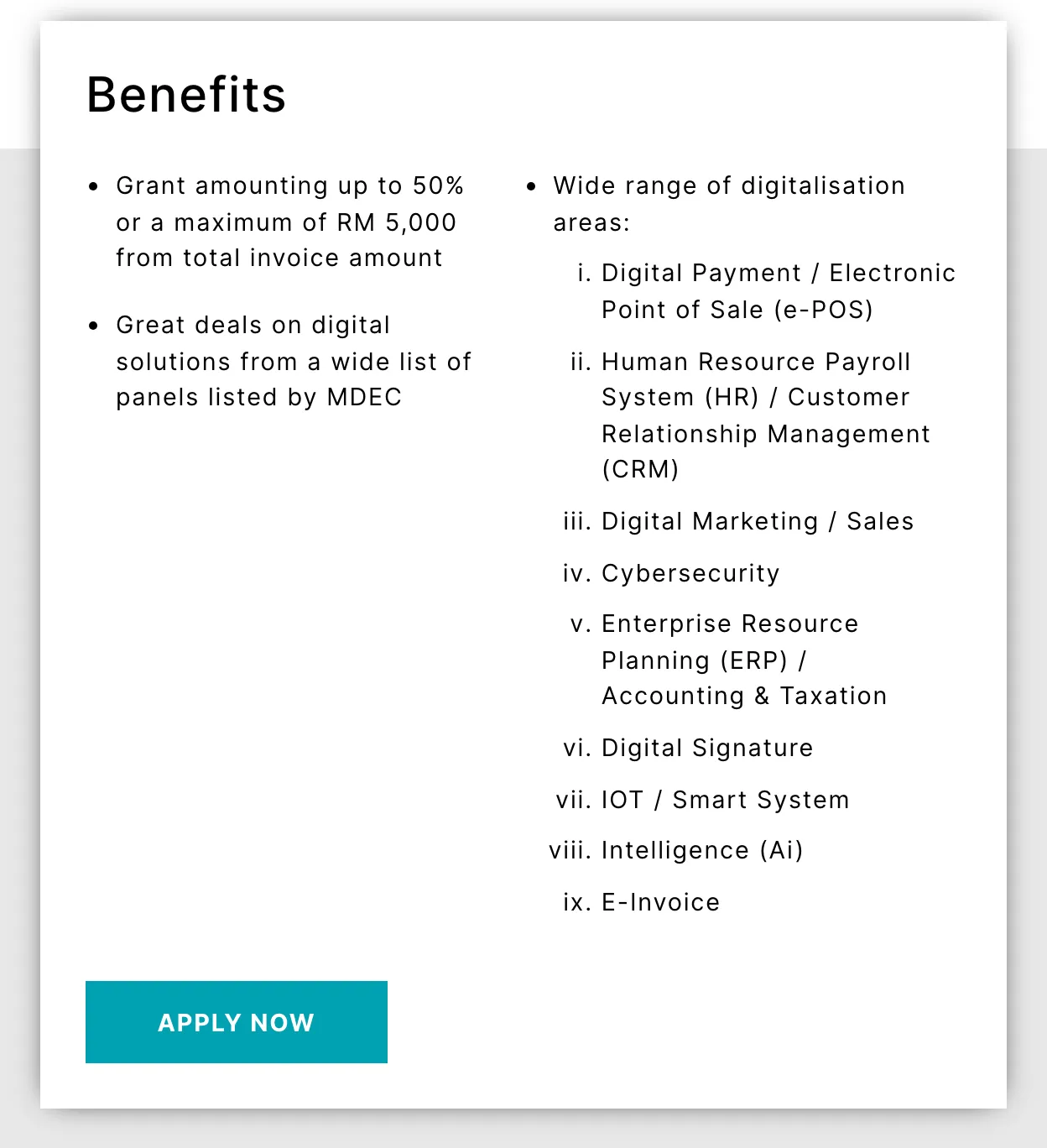
Yes, if the business qualifies for the MSME Digital Grant MADANI. The grant is for micro, small and medium enterprises and runs through Bank Simpanan Nasional (BSN). It pays up to half of an invoice for digital services, to a limit of RM5,000.
Digital marketing is one of the 9 areas the grant covers. The work has to come from a provider on the panel kept by the Malaysia Digital Economy Corporation (MDEC).
BSN’s page sets four conditions. The business must be at least 60% owned by Malaysian citizens, and registered with the Companies Commission of Malaysia (SSM) or a local authority. It must also have traded for at least 6 months, with average yearly turnover of at least RM50,000.
The capture below is the benefits panel from BSN’s page. It shows the grant amount and the 9 areas the grant pays for.
Check that applications are open before you write the grant into line 5 of the plan.
How To Measure And Review The Plan
Check the one number in line 6 each month, and review the whole plan on the date in line 7. That number is the plan’s key performance indicator (KPI). Write it beside the goal each month, so you can see which way it is going.
For website enquiries, read it in Google Analytics. Set up conversion tracking on the form, the call button and the WhatsApp link. For the Business Profile, use the profile’s own performance report. For ads, use the ad platform’s report.
How Many Months Before You Judge A Channel
Give each channel about three months before you judge it. Judge it against the goal you set for it. Ads show what they can do sooner, because they run from the first day. SEO takes longer, as the rank data above shows.
At the review date, keep what reached its goal and cut what did not. Then set the next three months. Change one or two things at a time, so you can tell which change made the difference.
What To Do This Week
Write the seven lines, even roughly. Then open your Google Business Profile and your Facebook page. Fix whatever is wrong or missing. Check that the BSN grant is taking applications before you pay for a tool or an outside provider.
Primal is a marketing agency started in 2015, with offices in Kuala Lumpur, Bangkok and Singapore. Our marketing strategy team works with brands whose plans have grown past one page and now cover several channels or markets.
Frequently Asked Questions About Digital Marketing For SMEs
Is My Business An SME In Malaysia?
Under SME Corp Malaysia’s Guideline for SME Definition, a services firm is an SME up to RM20 million in turnover or 75 full-time staff. A manufacturer qualifies up to RM50 million or 200 staff. Meeting either test is enough. Subsidiaries of large firms, multinationals and government-linked companies do not qualify.
Do I Need Consent To Send Marketing Messages?
Yes. Malaysia’s Personal Data Protection Act 2010 (PDPA) covers personal data used in commercial transactions. The Personal Data Protection Commissioner’s FAQ says promotional newsletters and updates need the customer’s consent. The same FAQ says a business that processes the personal data of more than 20,000 people must also appoint a data protection officer.
What Is The Difference Between A Marketing Strategy And A Marketing Plan?
The strategy is the choice of goal, customer and channels. The plan is the list of what happens, who does it and when. For a small business both fit on the same page, which is why the seven lines above cover the two.
How Often Should An SME Change Its Marketing Plan?
Read the measure every month and rewrite the plan every three months. Change it sooner only when something outside the plan changes, such as a new product or a channel that stops bringing enquiries.
Founder and Chief Executive Officer
Mark McDowell is the Founder and Chief Executive Officer of Primal, which he started in Bangkok in 2015. He is on the Forbes 30 Under 30 Asia 2020 list and was Campaign Asia’s Southeast Asia Young Achiever of the Year in 2018. He writes about AI search and search engine optimisation.
About The Author


