



By Mark McDowellPosted: 8 min read
Perplexity SEO And How Perplexity Decides What To Cite
Perplexity SEO is the work of getting your pages cited in Perplexity's answers. Perplexity searches its own index, drops pages that look out of date and scores single passages as well as whole pages, so a page gets cited when PerplexityBot can reach it and one section answers the question plainly on its own.
Key Takeaways
- One plain section can earn a citation. Perplexity searches its own index and scores single passages as well as whole pages, so a section that answers a question plainly can be cited even when the rest of the page covers other things.
- Most AI answers skip the brand's own site. Over the last month, Elevate, Primal's AI Visibility Tracker, logged 16,543 AI answers about 12 brands, and a brand's own site was typically cited in only about a quarter of the answers about it.
- Listings need the same care as your pages. Marketplaces and comparison sites were cited in the answers for 11 of those 12 brands.
- Check robots.txt and the firewall first. PerplexityBot follows robots.txt, but a firewall that turns away unknown bots can block it first.
- Perplexity on its own sends few visits. Perplexity sends under 3% of the AI chatbot visits StatCounter records in Malaysia, so the work only pays when it also serves ChatGPT and Google's AI Overviews.
What Perplexity SEO Comes Down To
Perplexity SEO is search engine optimisation (SEO) for Perplexity, the work of getting your pages cited when it answers a question. At Primal we record what artificial intelligence (AI) assistants say when buyers ask about a brand. Over the last month, Elevate, Primal’s AI Visibility Tracker, logged 16,543 of those answers about 12 brands in 12 industries.
A brand’s own website is cited in about a quarter of the answers about it. Most of the other sources are places where buyers compare and check, such as marketplaces, review sites, government registers and Facebook. Perplexity has published how its own search picks sources, so for Perplexity we can also read the method.
My advice is to let Perplexity’s crawler in and write sections that each answer one question in their first sentences. Keep those pages current, and be listed where your buyers compare. Then ask Perplexity your buyers’ questions yourself, because it shows every source it used.
How Perplexity Decides Which Sources To Cite
Perplexity picks its sources from its own search index, then ranks single passages as well as whole pages. Its help page on how Perplexity works explains the basic loop. For each question it searches, reads what it finds and writes a short answer. Numbered links in the answer point to its sources.
Perplexity’s engineering team described the search behind the answers. The index tracks more than 200 billion URLs (page addresses). A model decides which pages to fetch again and how often. Perplexity keeps pages from domains it judges to carry authority ready for the fastest retrieval.
A question then goes through four steps. Perplexity gathers candidate pages twice, once by matching words and once by matching meaning. Pages that do not answer the question, or that look out of date, are dropped. What is left is ranked in several rounds, and the last round reads the question and each passage together. Last, whole pages are scored and so are the sections inside them. An answer can use one paragraph of your page and leave the rest.
That last step is the one I write for. A section that answers its heading in its first two sentences can be cited even when the rest of the page covers other things. A section that only makes sense after the three above it is much harder to quote.
Some answers draw on paid content as well. Perplexity’s premium data sources give users searches across partners such as Statista and PitchBook. So a question about market size can be answered from a partner’s report.
What Perplexity’s Source Labels Check
Perplexity’s source labels mark whole sites as Government, Academic or Trusted after a review of how each site behaves. A labelled source shows a small shield icon beside its citation.
Perplexity’s help page on source labels lists the questions the review asks. Does the site correct its mistakes? Does it say who wrote each piece? Does it keep news apart from advertising and opinion?
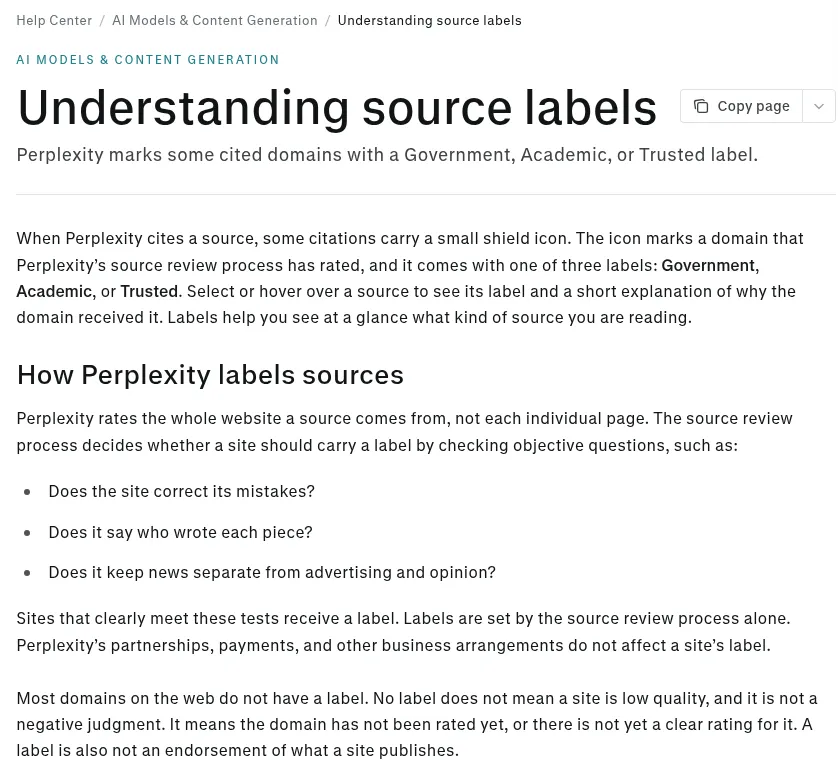
Most sites have no label, and Perplexity says that is not a judgement against them. It also says partnerships and payments do not change a label. Perplexity presents the label as help for the reader, to show what kind of source they are reading. So I would not treat it as a ranking factor.
I would still use the three questions as a checklist for any business site. Put an author’s name and role on every article. Fix errors in the open with a short note. Label paid or sponsored content clearly. A careful buyer looks for the same signs before trusting what you say.
What AI Answers Cite In Primal’s Data
In our data, a brand’s own website is one source among many in the AI answers about it. The data covers 16,543 answers to 172 buyer questions. Every one of the 12 brands had its own site cited, but for the typical brand only in about a quarter of the answers about it. A competitor’s site was cited about as often.
The chart shows how many of the 12 brands had each kind of source in their answers.
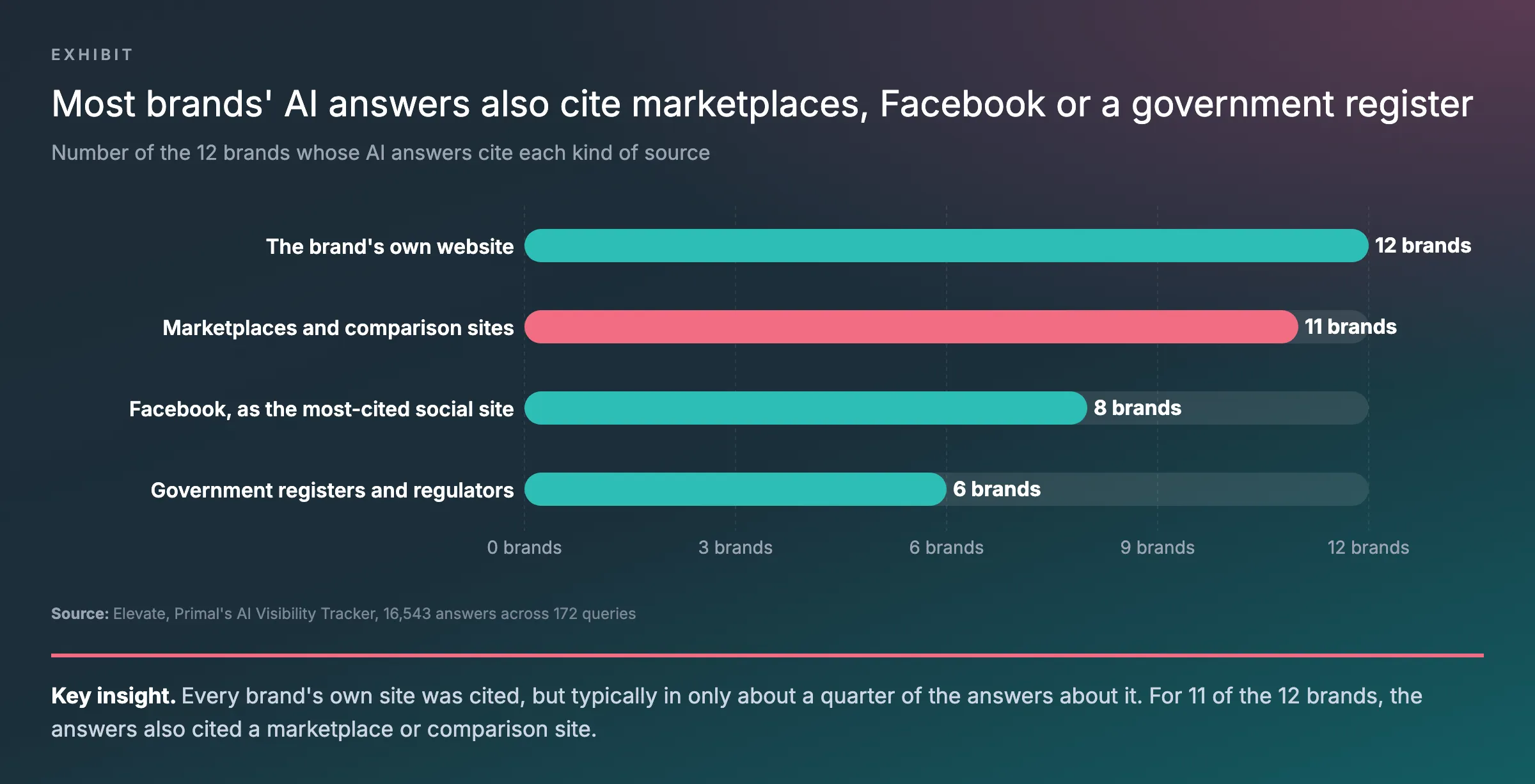
Marketplaces and comparison sites came up for 11 of the 12 brands. In consumer categories such as cars, education, skincare and flowers, they were cited as often as the brand itself. Facebook was the social site cited most for 8 of the brands, and YouTube, LinkedIn or Instagram for the others. Government registers came up for 6. Examples are the qualifications agency for a university and the road transport department for cars. Google’s own Business Profile and Maps results were cited for most of the brands too.
In the tracker’s narrower set of 3,693 answers across 66 queries, mostly about choosing an agency, Clutch, a review directory, was cited in about 4 answers in 10, more than any agency’s own site.
These figures are not split by assistant, so none of them is a Perplexity figure. On a buying question, I would expect Perplexity to rely on the same kinds of source. Those are marketplaces, comparison sites, directories, registers and the brand’s own pages. Perplexity runs its own index and ranking, so I would also expect its picks to differ from other assistants. You can check both points for your own category in a few minutes. Every Perplexity answer lists its sources.
How To Let PerplexityBot Crawl Your Site
To be cited, your site has to let PerplexityBot in, both in robots.txt and at the firewall.
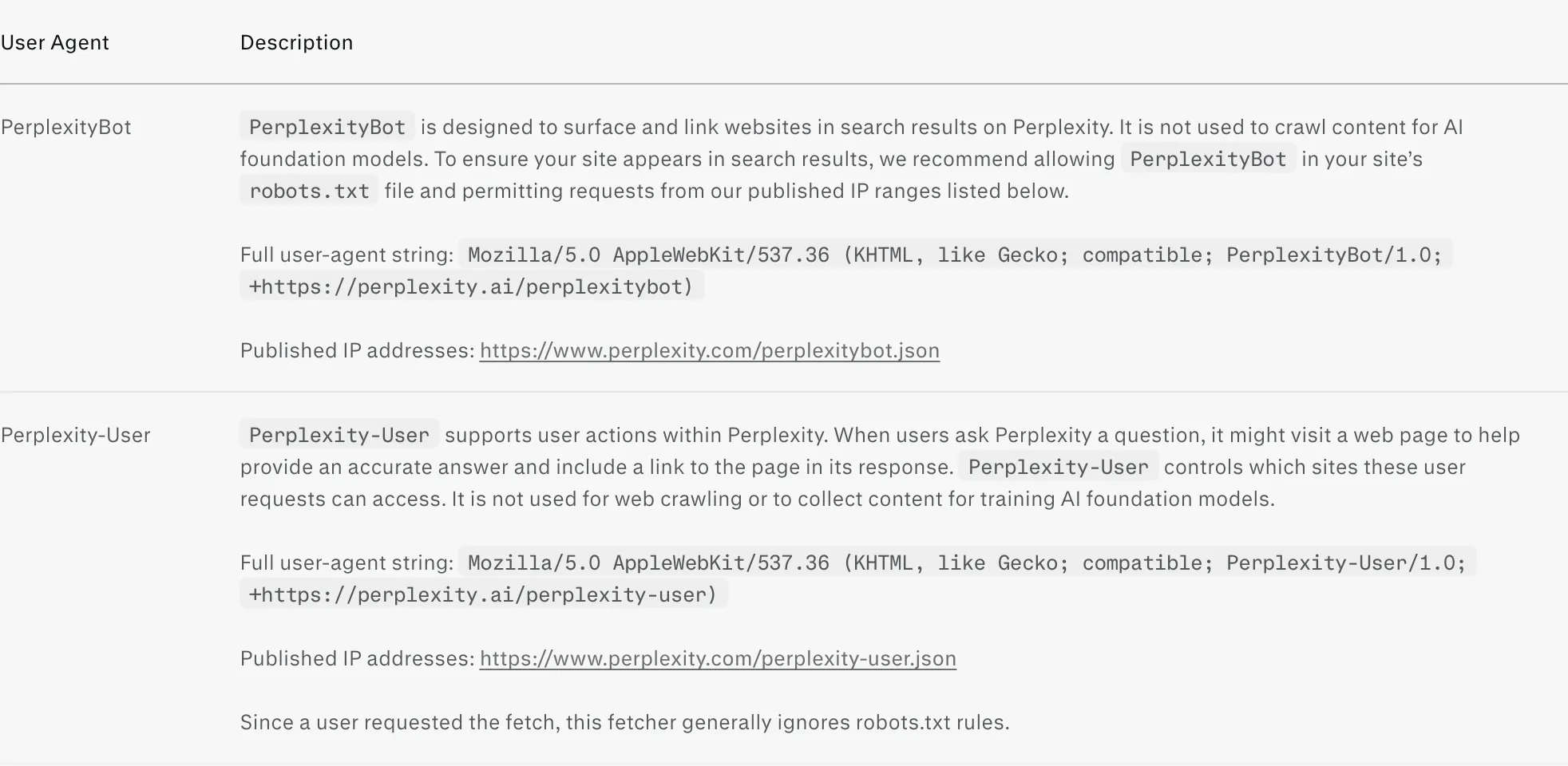
Perplexity’s crawler documentation lists two user agents, the names a bot gives when it asks for a page. PerplexityBot crawls sites so Perplexity can show and link them in its results. The company says it does not use this bot to collect training data for AI models. Perplexity-User fetches a page when a person’s question needs it. Because a person asked, this fetcher generally ignores robots.txt, according to the same page.
Two lines in robots.txt let PerplexityBot crawl the whole site.
User-agent: PerplexityBot
Allow: /
Perplexity says a change to robots.txt can take up to 24 hours to reach its systems.
Then check the firewall. A bot protection service can turn away crawlers it does not recognise, and when it does, robots.txt makes no difference. Perplexity publishes the address ranges for both agents. It also gives setup steps for Cloudflare and Amazon Web Services (AWS). It suggests allowing a request only when the user agent and the address both match its lists. If I could fix one thing on a site this week, it would be this check. Every other step depends on it.
How To Get Cited In Perplexity
You get cited in Perplexity when its crawler can reach your page and one section on it answers the question plainly and on its own. These steps follow from what Perplexity has published about its search and from what the AI answers in our data cite.
- Let PerplexityBot in, in robots.txt and at the firewall.
- Answer each question in its own section. Put the answer in the first one or two sentences under a heading that matches the question. Make the section readable without the rest of the page.
- Keep pages current. Perplexity drops content that looks out of date early in its ranking. Update the facts and show the date of the last real change.
- Pass the source label checks. Give every article an author, correct mistakes in the open and label paid content.
- Look after the pages you own beyond your website. Your Facebook page and your Google Business Profile are both sources AI answers cite, so keep them complete and current.
- Be listed where buyers compare. Keep your marketplace, directory and register listings complete and current. Earn mentions in the publications your buyers read.
How To Check Whether Perplexity Cites You
Ask Perplexity the questions your buyers ask and read the sources listed under each answer. Pick 20 questions in your buyers’ own words and ask each one. Note which sites are cited and whether yours is among them. Do it again every month and compare.
Answers change from day to day, so one check proves little. Ask each question more than once before you decide something has changed.
Then measure the visits. In Google Analytics 4 (GA4), look for sessions whose source is perplexity.ai. Our post on measuring AI search visibility covers the tools that track citations across platforms.
Is Perplexity Worth Optimising For
Perplexity is worth the work as part of what you do for every AI assistant. On its own it sends few visits. StatCounter records which AI chatbot referred each visit to the sites that carry its tracking code. In its figures for Malaysia, Perplexity sends under 3% of those visits and ChatGPT more than 80%.
So I would not write pages for Perplexity alone. The work that gets a page cited there is the same work that gets it cited in ChatGPT, Gemini and Google’s AI Overviews. Perplexity still deserves a monthly check. Its source list shows you quickly which sites AI answers rely on in your category. Most of the work underneath is standard SEO.
Primal started in 2015 and has offices in Kuala Lumpur, Bangkok and Singapore. Its AI SEO work covers citations in Perplexity, ChatGPT, Gemini and Google AI Overviews as well as search rankings.
Frequently Asked Questions About Perplexity SEO
Does Perplexity use Google’s search results?
Perplexity runs its own search index. Its engineering team says the index tracks more than 200 billion URLs. The team wrote that the first version of Perplexity, in late 2022, sent questions to other companies’ search services. It later created its own index because those services did not suit AI answers.
How do I stop Perplexity from using my site?
Add a Disallow line for PerplexityBot to robots.txt and allow up to 24 hours for the change, as Perplexity’s crawler documentation says. Perplexity-User fetches pages when a person asks a question and generally ignores robots.txt, so blocking it takes a firewall setting. Perplexity recommends allowing PerplexityBot if you want your site to appear in its results.
Can a business pay for a Perplexity source label?
No. Perplexity’s help page says only its source review sets a label, and partnerships and payments do not change one. Most sites have no label, and Perplexity says that is not a judgement against them.
How many sources does Perplexity cite in one answer?
The number changes from one question to the next. Every answer lists its sources as numbered links. The quickest way to know for your category is to ask your buyers’ questions and look at the list under each answer.
Does Perplexity cite the same sources as ChatGPT?
Expect differences, and check Perplexity on its own. Perplexity searches its own index and ranks pages its own way, so its sources for a question can differ from ChatGPT’s. Ask the same question on both and compare the lists under each answer.
Founder and Chief Executive Officer
Mark McDowell is the Founder and Chief Executive Officer of Primal, which he started in Bangkok in 2015. He is on the Forbes 30 Under 30 Asia 2020 list and was Campaign Asia’s Southeast Asia Young Achiever of the Year in 2018. He writes about AI search and search engine optimisation.
About The Author


