



By Mark McDowellPosted: 8 min read
What Is AI Search And How It Differs From Google
AI search answers a question with a short written reply and links to the pages that reply draws on. Google's AI Overviews, Google's AI Mode, ChatGPT, Gemini, Perplexity and Microsoft Copilot are the main ones. They find pages in different ways, so one question can get a different reply, with different sources, from each of them.
Key Takeaways
- AI search looks pages up as you ask. An AI search tool writes its reply from those pages and links them as sources.
- Most AI answers skip the brand's own site. Over the last month, Elevate, Primal's AI Visibility Tracker, logged 16,543 AI answers across 172 queries about 12 brands, and a brand's own website was cited in only about a quarter of the answers about it.
- Treat pages elsewhere like your website. Across the AI answers about those 12 brands, marketplaces and comparison sites were cited for 11 and Facebook was the most-cited social source for 8.
- Google access does not cover ChatGPT or Perplexity. Google's AI features read from Google's own index, while ChatGPT and Perplexity send their own crawlers, so a site Google can reach may still be closed to the others.
What Is AI Search
AI search hands you a written reply where a search engine would hand you links. You type a question in natural language, the way you would ask a person. The tool finds pages that match and reads them. Its reply runs a few sentences and links to the sources it drew on.
With a classic results page, the reading is your job. With AI search, the written reply decides which websites a buyer ever sees. So we read those replies closely at Primal. Over the last month, Elevate, Primal’s AI Visibility Tracker, logged 16,543 AI answers across 172 queries about 12 brands in 12 industries. A brand’s own website was cited in only about a quarter of the answers about it. A competitor’s website was cited about as often.
The other sources were the places buyers go to compare and check. Those were marketplaces, review and comparison sites, government registers, publishers, Facebook and YouTube. What I take from it is that AI search cites whichever page answers the question best, whoever owns it. A business has to look after those pages as well as its own site.
How AI Search Works
An AI search tool turns your question into searches. It pulls the best pages from an index and writes the answer from them. Google’s AI Mode help page calls the first step query fan-out. AI Mode breaks a question into smaller parts and runs a search on each part in parallel.
An index is the saved set of pages a crawler has already fetched. A large language model (LLM) then reads those pages and drafts the reply, citing them as it goes. ChatGPT and Gemini both run on LLMs. The technical name for this is retrieval-augmented generation (RAG).
The look-up step keeps the answer current. Without it, a model has only its training data, and that data ends on a fixed date. With it, the model can reply about something that changed last week and point to the page behind each claim.
Which AI Search Platforms People Use
The best-known AI search tools are Google’s AI Overviews, Google’s AI Mode, ChatGPT, the Gemini app, Perplexity and Microsoft Copilot. The first two sit inside Google Search. AI Overviews appear above the links on some Google searches as a short written summary, and AI Mode is its own tab in Google Search, where you can keep asking follow-up questions.
Each platform finds pages in its own way. Google’s AI features read from Google’s own index. Google’s guide to AI features for site owners says a page needs two things. It must be indexed, and it must be able to show a snippet. There are no extra technical steps.
ChatGPT and Perplexity send crawlers of their own. A crawler is a bot that visits pages and copies them. OpenAI’s crawler documentation says ChatGPT search does not show sites that block its OAI-SearchBot crawler. Perplexity’s crawler page says PerplexityBot finds the websites it links in its results.
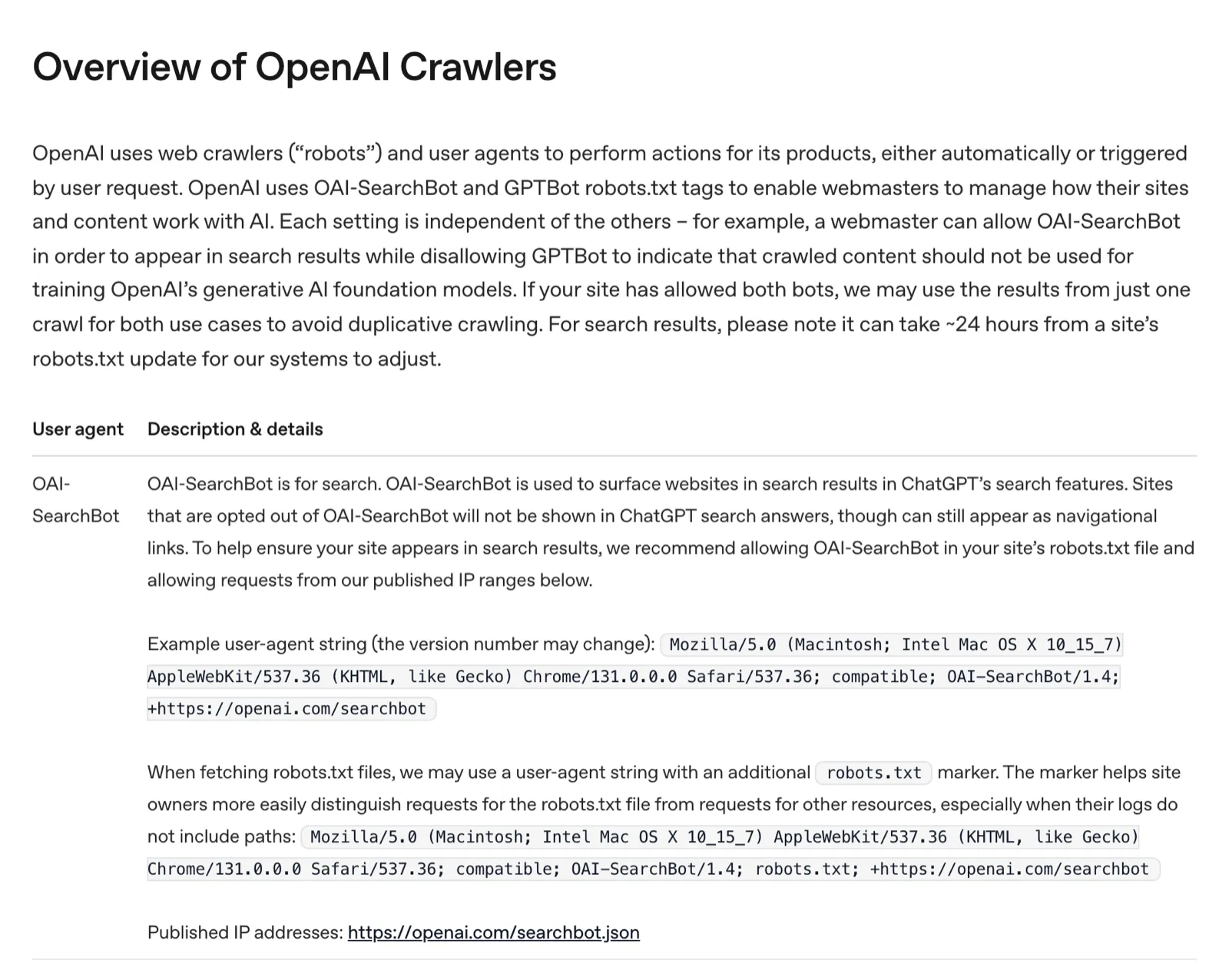
A site can block these crawlers by accident. Common causes are a security plugin, a firewall, or an old robots.txt line meant for scrapers. Robots.txt is the file that lists what crawlers may and may not fetch. Each of these can stop OAI-SearchBot or PerplexityBot and still let Googlebot through. The site then ranks on Google but never appears in a ChatGPT or Perplexity answer.
How AI Search Differs From Google Search
On a classic Google results page you get ranked links and choose which to open. AI search gives you a written answer with a few sources linked inside it. Google now runs both, through AI Overviews and AI Mode. So the useful split is between Google’s own AI features and the assistants that crawl pages for themselves.
| Google’s ranked links | Google’s AI Overviews and AI Mode | ChatGPT, Perplexity and Copilot | |
|---|---|---|---|
| What you get | Ranked links | A summary with source links, often above the ranked links | A chat reply with source links |
| Source of pages | Google’s index | Google’s index, via several searches per question | Their own crawlers (Copilot uses Bing) |
| What your page needs | To be indexed and rank | To be indexed and allowed a snippet | To be open to each crawler |
| Report to check | Search Console, Performance | Search Console, Generative AI performance | Bing Webmaster Tools (Copilot), analytics (visits) |
Clicks are the second difference. If the reply already answers the question, fewer people go on to visit a site. A search that ends without a click is called a zero-click search. Our post on Google’s AI Overviews goes through the research on the size of that drop.
Both kinds of AI search now have their own reports. Search Console has a Generative AI performance report. It shows how often AI Overviews and AI Mode showed links to your pages, by page, country, device and date. For Copilot, which draws on Bing, Microsoft offers Bing Webmaster Tools’ AI Performance report, with the number of times Copilot cited your pages.
Each AI Platform Gives A Different Answer
The same question can get a different answer on each platform. Each one reads from its own set of pages, so each can cite different sources.
The answer can also change from one day to the next. Each reply is written fresh from the pages found at the moment you ask, and those pages change. One check on one day tells you very little. I would read each platform over a full month before deciding anything.
How AI Search Picks The Pages It Cites
AI search cites the pages that answer the question in front of it, and the kind of page changes with the kind of question. A question about what something is, or how long it takes, goes to whoever explains it best. In a second set of 3,693 answers across 66 queries about agencies and search, the answers to the general SEO questions cited publishers and Google’s own pages, and no agency at all.
Questions about what to buy and who to buy from go wider. In the 16,543 answers about 12 brands, marketplaces, comparison or listing sites were cited for 11 of the brands. Facebook was the most-cited social source for 8 of them. Google’s own Business Profile and Maps results were cited for 7, and government registers for 6.
The chart below shows how many brands each kind of source was cited for. Every brand’s own site was cited, and marketplaces or comparison sites were cited for all but one.
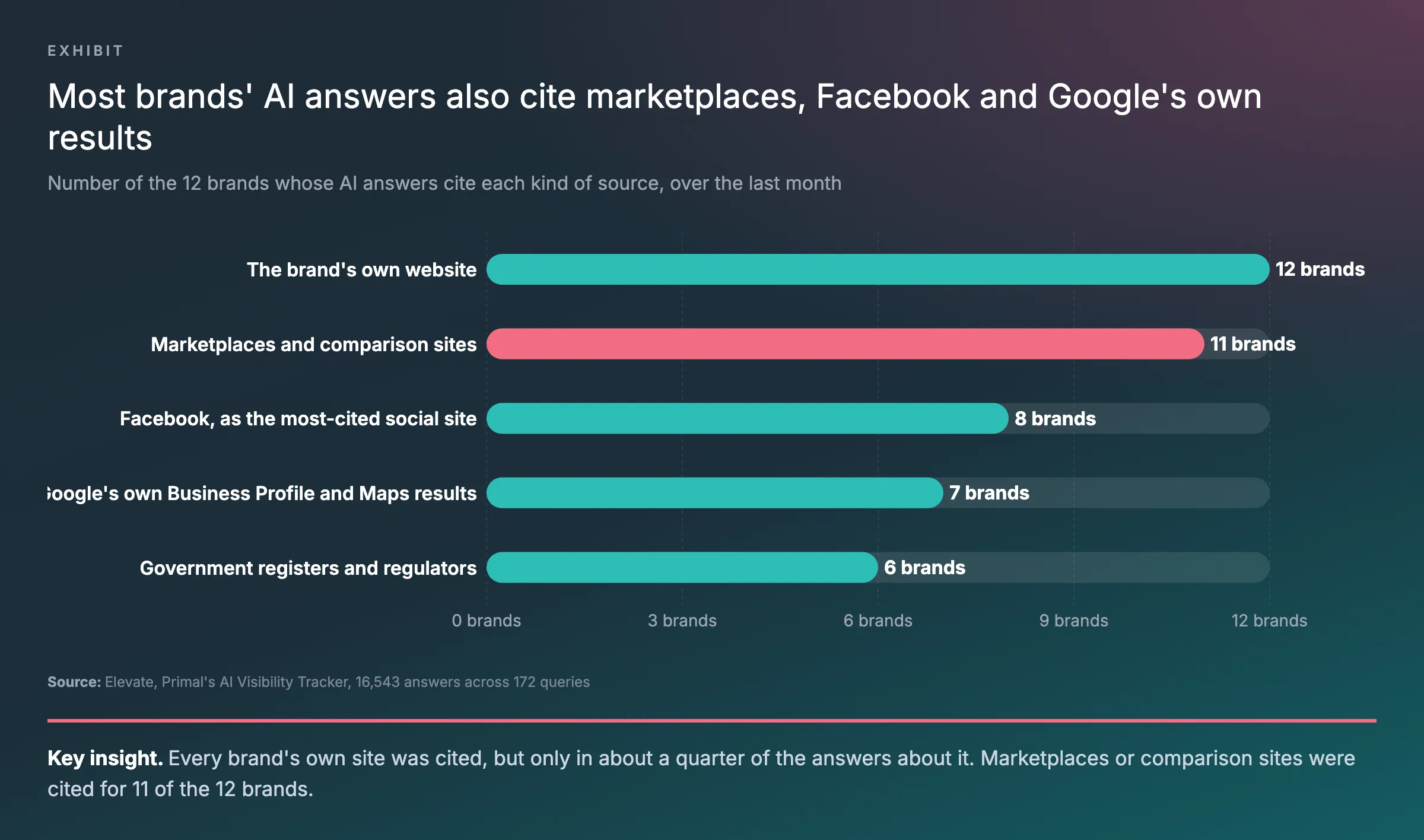
When a question asks for facts, the answer rests on whichever page explains it best. When it asks what to buy, the answer draws on the places buyers compare and check. A marketplace listing, a register entry or a Facebook page can then be cited beside the brand’s own site, or in its place.
What AI Search Means For Your Business
For most businesses, AI search means making the pages buyers need easy to find and cite on every platform. That covers your own site and the other pages buyers check. Start with Google, because Google still sends most of the clicks. In Malaysia last month, Google sent more than 99 of every 100 visits that StatCounter recorded from Google and ChatGPT combined.
Clicks do not show everything, because plenty of AI answers end with no click at all. Someone may read your brand in a ChatGPT answer, then search for it on Google later. That visit is recorded as a Google visit. So AI answers touch more buying choices than the click figures show.
How Do We Ensure We Get Noticed On AI Search Engines
Make your site easy for every AI tool to reach and read. Then give it the clearest answer to each buyer question. After that, look after your listings on the other sites AI answers cite, and check each platform every month.
- Open your site to the AI crawlers you want. Make sure robots.txt, the firewall and every security plugin allow OAI-SearchBot, PerplexityBot, Bingbot and Googlebot.
- Get your important pages indexed in Google and Bing. Google’s AI features only use pages in Google’s index. The URL Inspection tool in Search Console shows whether a page is indexed.
- Write the page that answers the question. Put a plain answer near the top. Below it, give the details nobody else has, like your delivery areas or how long a job takes.
- Keep your listings right on the other sites AI answers cite. That means the marketplaces and comparison sites in your industry and your Facebook page. It also means your Google Business Profile and any government register that lists you.
- Check each platform on its own every month. Put your buyers’ 10 most common questions to ChatGPT, Gemini, Perplexity and Google’s AI Mode, and write down who each one mentions and cites. The reports for this are in our guide to measuring AI search visibility.
Primal was set up in 2015 and works from offices in Kuala Lumpur, Bangkok and Singapore. Our AI SEO team helps brands get mentioned and cited by ChatGPT, Gemini, Perplexity and Google’s AI features, as part of their SEO.
Frequently Asked Questions About AI Search
Is AI search the same as a chatbot?
Not always. A chatbot can reply from what it learned in training and nothing else. AI search fetches pages first and links them. ChatGPT works both ways, depending on the question.
Is AI search accurate?
It can be wrong. Google’s AI Mode help page warns that AI Mode makes mistakes, such as misreading content or missing context. Before you act on a claim that matters, open the pages the answer links to.
Will AI search replace Google?
Not on current figures. Google also runs AI search of its own, through AI Overviews and AI Mode. StatCounter’s Malaysian figures show Google still sending far more visits than ChatGPT.
Is AI search available in Malay?
Yes. Google’s AI Mode help page includes Malaysia in its country list and Malay in its language list, beside English, Tamil and both written forms of Chinese. So a Malay page can be the source for a question asked in Malay.
How do I know if AI search cites my website?
For Google, use the Generative AI performance report in Search Console. Bing Webmaster Tools has the matching AI Performance report for Copilot. For ChatGPT, Gemini and Perplexity, ask your buyers’ questions each month and note which websites they cite, because the answers can change from one day to the next.
Should we be focusing just on the website, or more on other platforms?
Both matter. In the AI answers about 12 brands above, a brand’s own website was cited in only about a quarter of them. The other citations went to the sites buyers use to compare and check, such as marketplaces and Facebook. So keep your own site the clearest answer to each buyer question, and keep those other listings current.
Founder and Chief Executive Officer
Mark McDowell is the Founder and Chief Executive Officer of Primal, which he started in Bangkok in 2015. He is on the Forbes 30 Under 30 Asia 2020 list and was Campaign Asia’s Southeast Asia Young Achiever of the Year in 2018. He writes about AI search and search engine optimisation.
About The Author


