



By Mark McDowellPosted: 10 min read
What Generative Engine Optimisation Is And What Works
Generative engine optimisation (GEO) is the work of getting your pages cited, and your brand described correctly, in answers written by artificial intelligence (AI) tools such as ChatGPT and Google AI Overviews. These tools search, read a few pages and quote the ones that answer best. So GEO means checkable facts on your own pages and accurate mentions on the sites the answers already cite.
Key Takeaways
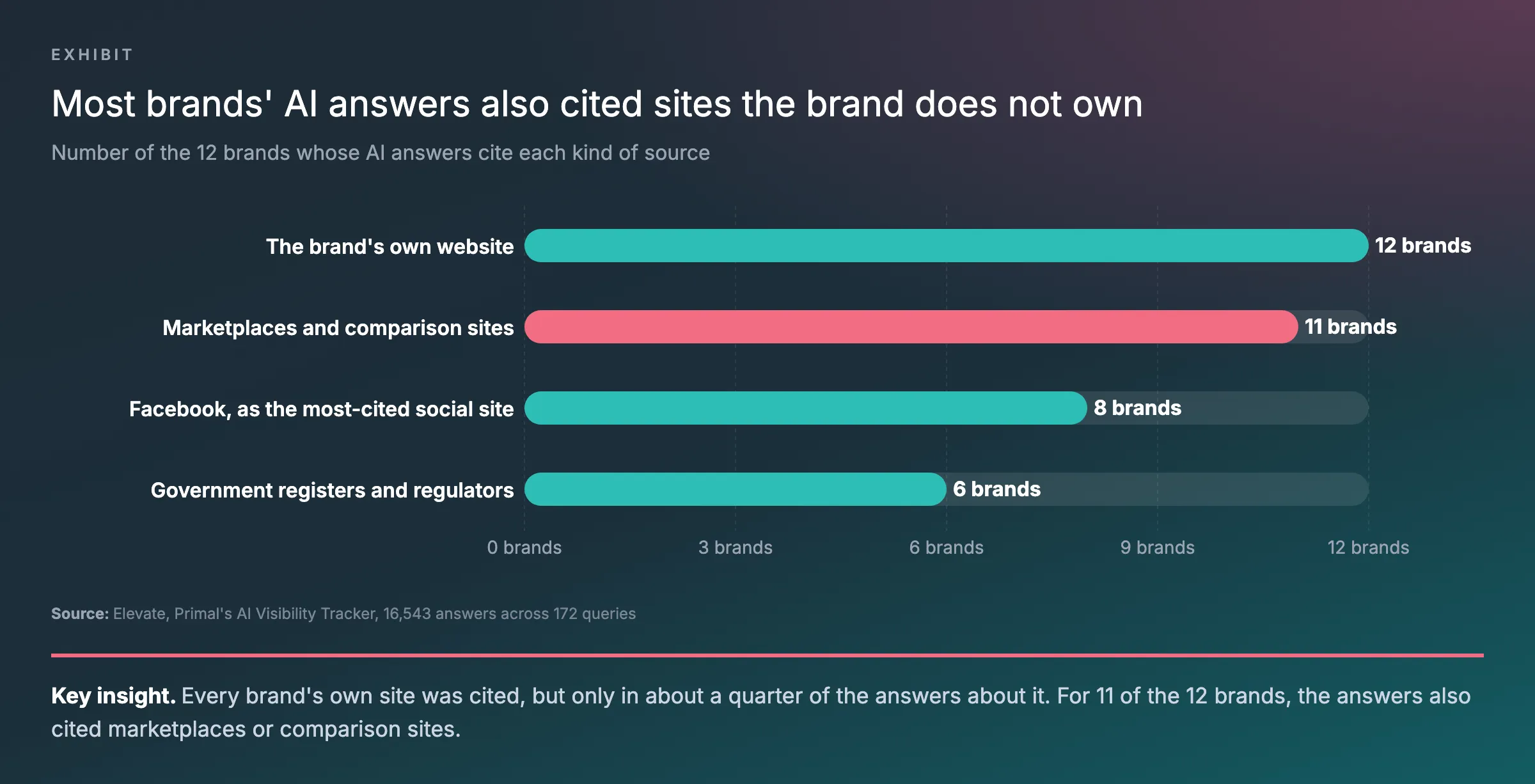
- Most AI answers skip the brand's own site. Over the last month, Elevate, Primal's AI Visibility Tracker, found that a brand's own website was cited in only about a quarter of the AI answers about it.
- Much of GEO happens on other sites. For 11 of the 12 brands in that data, the answers also cited marketplaces or comparison sites.
- Quotes, statistics and sources raise visibility. The research paper that introduced GEO found that adding quotations, statistics and cited sources made a page more visible in AI answers, while keyword stuffing made it less visible.
- Many GEO hacks do nothing in Google Search. Google's guide says suggested hacks such as llms.txt files and splitting pages into chunks do nothing there.
- ChatGPT cites only pages its crawler may reach. Its search crawler is OAI-SearchBot, and that setting is separate from GPTBot, its training crawler.
What Is Generative Engine Optimisation
Generative engine optimisation (GEO) is the work of getting your brand into the answers that artificial intelligence (AI) tools write. Across the AI answers about 12 brands over the last month, a brand’s own site was cited in only about a quarter of the answers about it. Most of the other sources were sites the brand does not own, such as marketplaces, Facebook and government registers. So GEO is about being a source the answer can check, on your own site and on the other sites the answers already cite.
A generative engine is an AI tool that searches for sources, reads them and writes one answer. A large language model does the writing, and the answer links to some of the pages it used. ChatGPT search, Gemini, Perplexity, Google AI Overviews and Google AI Mode all work this way.
GEO has two parts. The first is being one of the pages the tool reads and links to. The second is how the answer describes you, and whether it gets your facts and your category right.
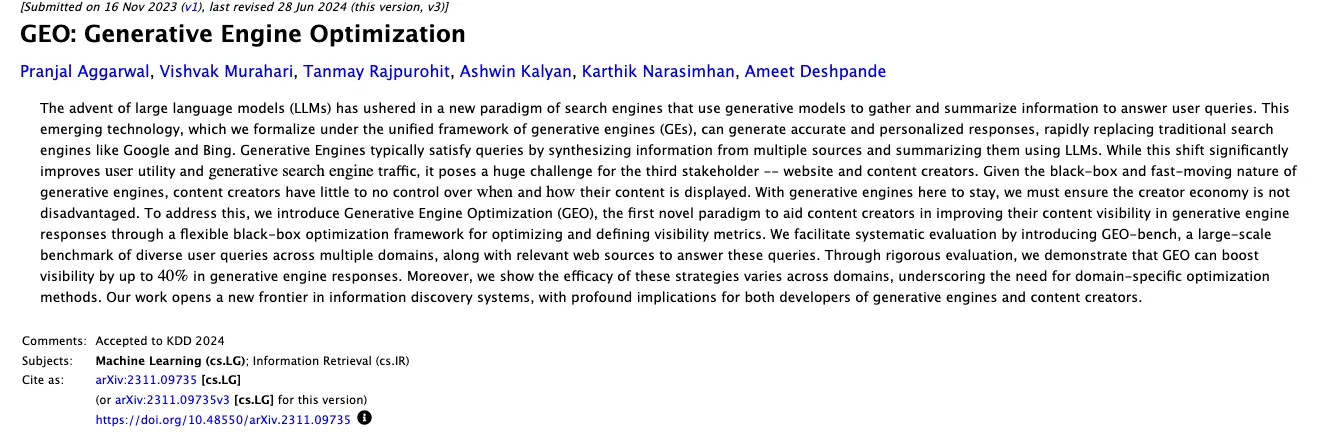
The term comes from a research paper called GEO: Generative Engine Optimization. Its authors included researchers at Princeton University and the Indian Institute of Technology (IIT) Delhi. They wrote it for website owners. Those owners have little say over when an AI answer shows their content, or how. The paper set out to test which edits to a page change that.
What AI Answers Cite In Primal’s Data
Elevate, Primal’s AI Visibility Tracker, logged 16,543 AI answers across 172 buyer questions over the last month. The questions are about 12 brands in 12 industries, such as a university, an airport operator, an online florist and a skincare brand. For each answer, the tracker records which websites it cited.
A brand’s own website was cited in about a quarter of the answers about it. A competitor’s website was cited about as often.
Marketplaces and comparison sites were cited for 11 of the 12 brands. Facebook was the most-cited social site for 8 of them. Google’s own Business Profile and Maps results were cited for 7, and a government register or regulator for 6.
The chart shows how many of the 12 brands had each kind of source in their answers. Every brand’s own site was there, and most brands also had sources they do not control.
General questions follow another pattern. In a smaller set of 3,693 answers across 66 queries about agencies and search, the general search engine optimisation (SEO) questions mentioned no agency at all and cited publishers and Google’s own pages.
My reading is that an assistant cites the places where a buyer compares and checks. So a large part of GEO happens on websites you do not own.
How Generative Engines Pick Their Sources
Most generative engines search first and write second. Google’s guide to its generative AI features calls this retrieval-augmented generation, or grounding. Its AI features find pages in the Google index with the same ranking systems as normal search. Then they write the answer from what those pages say.
The guide also describes query fan-out. The model runs several related searches at once and gathers results from each. So a page Google has not indexed, or cannot show with a snippet, cannot be a source in AI Overviews or AI Mode. The guide adds that the site must also be included in the Search generative AI setting in Search Console.
ChatGPT and Perplexity run their own crawlers. OpenAI’s page on its crawlers says a site that blocks OAI-SearchBot is not shown in ChatGPT’s search answers. GPTBot, its training crawler, is a separate setting. So you can keep your pages out of model training and still appear in ChatGPT search. Perplexity’s crawler page says PerplexityBot is the crawler that links websites in Perplexity’s search results. The same page says the bot does not collect content for training.
An answer written from the model’s memory, with no search, shows no sources. That part comes from being published and cited widely over years. Most GEO work is about the answers that search first, because those are the answers that link to pages.
What The Original GEO Study Found
The study found that pages became more visible in AI answers when they added material the answer could lift. Adding quotations and statistics helped most, and citing sources and smoother wording came next. Keyword stuffing, a habit carried over from old SEO, made pages less visible. The paper puts the best gain at up to 40%.
The researchers made a set of 10,000 questions. For each one they took the first five Google results and had an OpenAI model write an answer that cited them. Then they edited one source in one of nine ways and had the answer written again. They measured how much of the new answer came from the edited page. A more confident tone helped far less than added facts did.
The edits helped pages lower down the results most. When the source in fifth place was edited, its share of the answer roughly doubled. When the first-placed source got the same edits, its share fell. So the gain is largest for a business that ranks on page one but not first. Its page is already among those the AI reads, and better material wins it a bigger part of the answer.
I take the order of the edits from this study and leave the exact percentages aside. In the study a model wrote the added quotes and figures. On your own pages they have to be real, with a source a reader can open.
What Google Says About GEO
Google’s guide mentions answer engine optimisation (AEO) and GEO directly. It says many of the hacks suggested under those labels do nothing in Google Search. Then it lists what site owners can ignore.
- llms.txt files and other files or markup made only for AI, which Google Search does not use.
- Splitting pages into small chunks, since its systems can find the right part of a long page.
- Rewriting pages only for AI, since its systems understand synonyms and meaning.
- Seeking mentions that are not genuine, since its spam systems also cover its AI features.
- Special structured data, which none of its AI features need.
Google asks for content that a summary of other pages cannot give. Its examples are first-hand experience and a clear point of view. It also asks for the basics. Pages must be open to crawling and indexing, and able to show a snippet. For local businesses and shops, it points to Google Business Profile and product data feeds.
The study and Google agree on the main point. Both reward pages that add facts a reader can check, and neither rewards repeated keywords.
How GEO Differs From SEO And AEO
GEO overlaps with SEO and aims at a different result. SEO aims to rank a page in the list of results. GEO aims to have an AI answer cite your page and describe your brand correctly. AEO sits between the two, and aims to make your page the direct answer in featured snippets or the first lines of an AI answer.
| SEO | AEO | GEO | |
|---|---|---|---|
| Goal | Rank pages in search results | Give the direct answer to a question | Be cited in AI answers and described correctly |
| Where it shows | The list of search results | Featured snippets and the first lines of AI answers | The text and source links of answers in ChatGPT, Gemini, Perplexity and Google |
| What you measure | Rankings, clicks and organic traffic | Which questions your page answers | Mentions, citations and share of voice on each platform |
| Main work | Content, links and site health | Question headings and short answers | Checkable facts, crawler access and correct listings on other sites |
For Google’s AI features, the overlap with SEO is large. They run on Google’s core ranking systems. ChatGPT and Perplexity add work beyond SEO, starting with their crawlers. Our posts on answer engine optimisation and on SEO, AEO and GEO side by side go into each one.
In this video from my YouTube channel, I compare GEO with SEO and go through what changes when people search with AI.
How To Start With GEO
Start with the platforms your buyers use. Make sure those platforms can reach your pages, then give them something worth citing.
StatCounter’s figures for Malaysia show that ChatGPT sends about four in five of the visits AI chatbots refer to websites. Gemini comes second. Google AI Overviews sit inside Google Search itself, so ChatGPT and Google are the two places to start.
- Check that each platform can reach your pages. In Search Console, confirm that your main pages are indexed. Then check that the site is included in the Search generative AI setting. In robots.txt, allow OAI-SearchBot and PerplexityBot. Ask your developer whether your firewall blocks them.
- List the 20 questions your buyers ask before they choose, in their own words. Include the questions that compare options, ask about cost and pick a provider. Most of the 172 buyer questions in Primal’s data are of the “best X”, “X vs Y”, “how much does X cost” and “where to buy X” kind.
- Ask each question in ChatGPT and Google. Write down which sites each answer cites and whether your brand appears.
- Give each question a page or a section that answers it in its first sentence. Then add what the study found works. Use real figures with their source, and quotes from people who know the subject, with their name and role. Cite your sources, and add what only your business knows.
- Check your listings on the sites the answers cite. Some marketplaces, comparison sites, directories or publishers will keep appearing. Make sure your entry on each one exists, is correct and matches your own site.
- Use the same name, services and contact details everywhere. That means your site, your Google Business Profile, your Facebook page, LinkedIn, directories and any official register for your industry.
Google’s guide warns that mentions that are not genuine do not help. So step 5 means real reviews and correct listings.
How To Measure GEO
Measure GEO with two kinds of data. One shows where your pages appeared, and the other shows how the answers describe you. Search Console’s Generative AI performance report shows impressions in AI Overviews and AI Mode. You can see them by page, country, device and date.
Prompt tracking covers the rest. You ask the same questions on each platform on a schedule and record each mention and each citation. A mention is your brand in the answer, and a citation is a link to your site. Share of voice is your part of all the brand mentions in those answers. When mentions rise and citations do not, the assistant knows your brand but quotes other pages about it.
The same question can get a different answer from one day to the next. So compare one month with the next and judge the trend, never a single day. Our guide to measuring AI search visibility sets out the monthly report.
What GEO Means For Your Business
GEO asks two things of a business. Your own pages should answer the questions buyers ask before they choose, with facts an AI tool can check and quote. The other sites those tools read should describe you correctly. Primal started in 2015 and has offices in Kuala Lumpur, Bangkok and Singapore. Our generative engine optimisation team records how ChatGPT and Google AI Overviews answer your buyers’ questions. It then works on the pages and listings those answers cite.
Frequently Asked Questions About Generative Engine Optimisation
What does GEO optimised content mean?
It means a page edited so that AI tools are more likely to use it in their answers. In the original GEO study, adding quotations and statistics helped most, and citing sources helped too. For its AI features, Google asks for first-hand experience and a clear point of view.
Do I need an llms.txt file for GEO?
Not for Google. Google’s guide says Google Search does not use llms.txt or any other file made only for AI. OpenAI and Perplexity point site owners to their search crawlers in robots.txt instead.
Does blocking GPTBot remove my site from ChatGPT?
No. OpenAI treats GPTBot and OAI-SearchBot as separate settings. GPTBot collects content that may be used to train OpenAI’s models. OAI-SearchBot decides whether your pages can appear in ChatGPT search answers, so you can block the first and allow the second.
In terms of the different AI tools like Copilot, Claude and Perplexity, is there any differentiation in the optimisation approach?
The work on your pages is mostly the same for each tool. An AI tool that searches the web reads a few pages and cites the ones that answer best. So the same checkable facts help in each one. What differs is how each tool reaches your site.
Google’s AI features use the Google index. ChatGPT needs OAI-SearchBot, and Perplexity needs PerplexityBot. Check each tool’s own crawler page before you change robots.txt.
Where does the term generative engine optimisation come from?
It comes from the research paper GEO: Generative Engine Optimization. Its authors, including researchers at Princeton University and IIT Delhi, posted it on arXiv in November 2023. It was accepted at the Knowledge Discovery and Data Mining (KDD) conference in 2024. It introduced the term along with a set of 10,000 questions for measuring how visible a source is in AI answers.
Founder and Chief Executive Officer
Mark McDowell is the Founder and Chief Executive Officer of Primal, which he started in Bangkok in 2015. He is on the Forbes 30 Under 30 Asia 2020 list and was Campaign Asia’s Southeast Asia Young Achiever of the Year in 2018. He writes about AI search and search engine optimisation.
About The Author


