



By Mark McDowellPosted: 8 min read
Google E-E-A-T And How To Show It On Your Site
Google E-E-A-T stands for experience, expertise, authoritativeness and trust, the qualities Google's quality raters look for in a page, with trust at the centre. It is not a single ranking factor, but Google's systems look for signals that match it, and the same systems pick the sources for AI Overviews. AI answers also lean on what others say about a business, such as its reviews.
Key Takeaways
- Most AI answers about you cite other sites. Across 16,543 AI answers about 12 brands over the last month, a brand's own website was cited in only about a quarter of the answers about it, according to Elevate, Primal's AI Visibility Tracker.
- E-E-A-T is not a single ranking factor. Google says its systems look for signals that match it and give them more weight on health, money and safety topics.
- Poorly rated pages get cited less. Google's AI Overviews and AI Mode pick their sources with the same ranking and quality systems as Search.
- Fix what others say about you first. Start with your listings, Google Business Profile, Facebook page and customer reviews, then the About page, bylines and author pages on your own site.
- Made-up author profiles lower trust. Google's helpful content page says made-up author profiles, such as AI-generated headshots or false credentials, make a page untrustworthy.
What AI Answers Show About Trust
When a buyer asks ChatGPT or Google’s AI Overviews about a business, the answer leans on what other people say about it. Over the last month, Elevate, Primal’s AI Visibility Tracker, logged 16,543 AI answers about 12 brands in 12 industries. A brand’s own website was cited in only about a quarter of the answers about it. A competitor’s site was cited about as often.
That is Google E-E-A-T at work. Google tells the people who rate its results where to look for evidence. They check what a business says about itself, what others say about it, and what is on the page. A client review is evidence a business cannot write about itself.
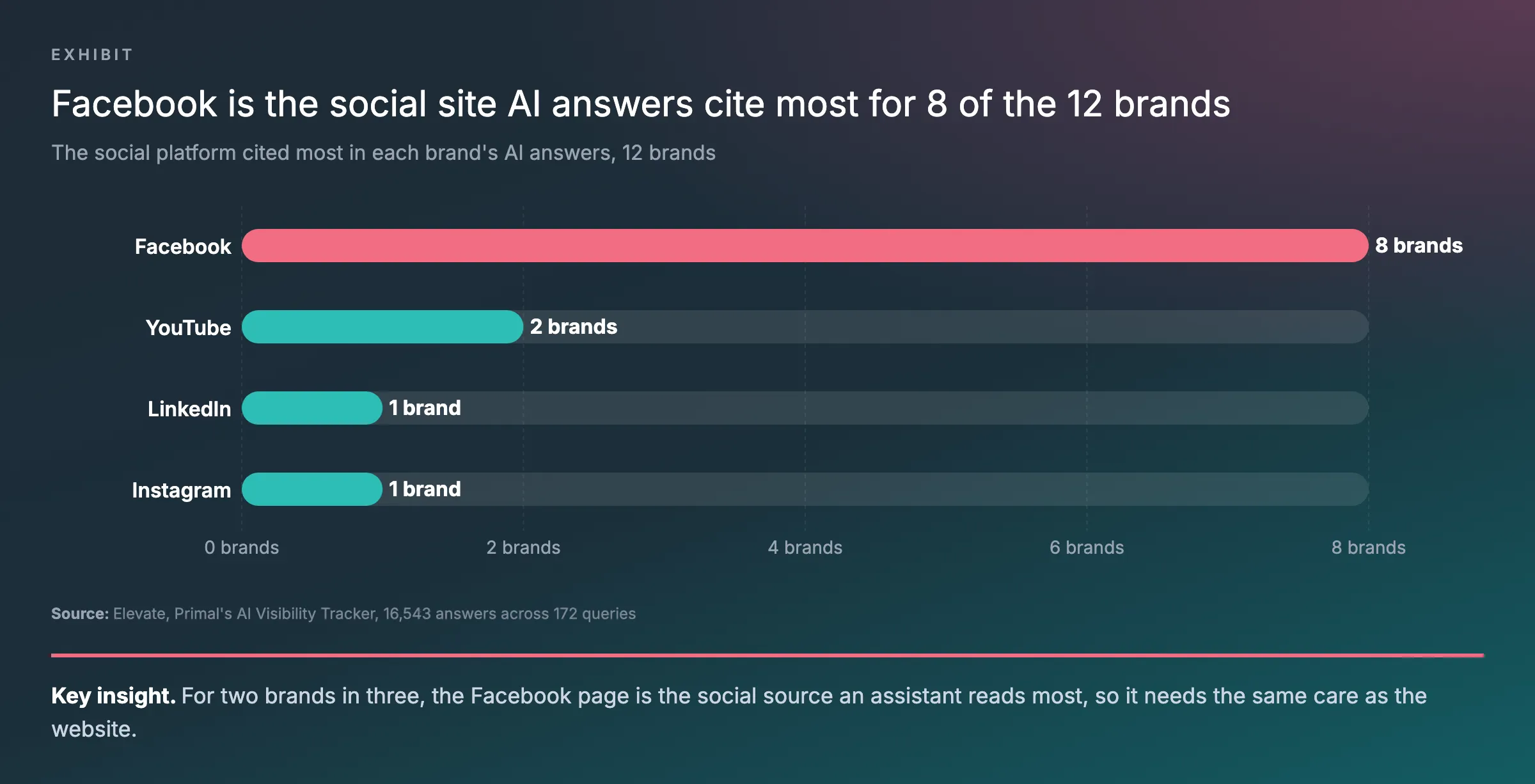
Marketplaces, comparison and listing sites appeared in the answers for 11 of the 12 brands. Facebook was the most-cited social source for 8 of them. Google’s own Business Profile and Maps results were cited for 7. A government register or regulator was cited for 6. The chart shows which social platform the assistants cited most for each of the 12 brands, the clearest sign of where they read what others say about a business.
On technical and health topics, the answers also cited research sites such as ResearchGate and PubMed, and document sites such as Scribd. There, a published spec sheet or paper gives an assistant something to cite that a product page does not.
So trust comes from two places. One is what others say about you. The other is what your own pages show about who you are and what you know. A business needs both, and I would fix the first before writing another blog post.
What Google E-E-A-T Means
E-E-A-T stands for experience, expertise, authoritativeness and trust. It is how Google’s Search Quality Rater Guidelines describe a page worth trusting. Trust sits at the centre, and the other three support it.
| Part | The question it asks | What answers it on a business site |
|---|---|---|
| Experience | Has the writer done the thing? | Your own photos, results and the steps from real jobs |
| Expertise | Does the writer know the subject? | An author name with qualifications that fit the topic, and a professional who holds a licence on health, money or legal pages |
| Authoritativeness | Do others treat the writer or site as a source? | Reviews, press coverage, directory profiles and links from others in your field |
| Trust | Is the page accurate, honest, safe and reliable? | Company details, contact information, secure payment and a source for each fact |
The guidelines draw the four parts as overlapping circles, with trust in the middle. The same section shows that an online store needs a different kind of trust than a social media post.
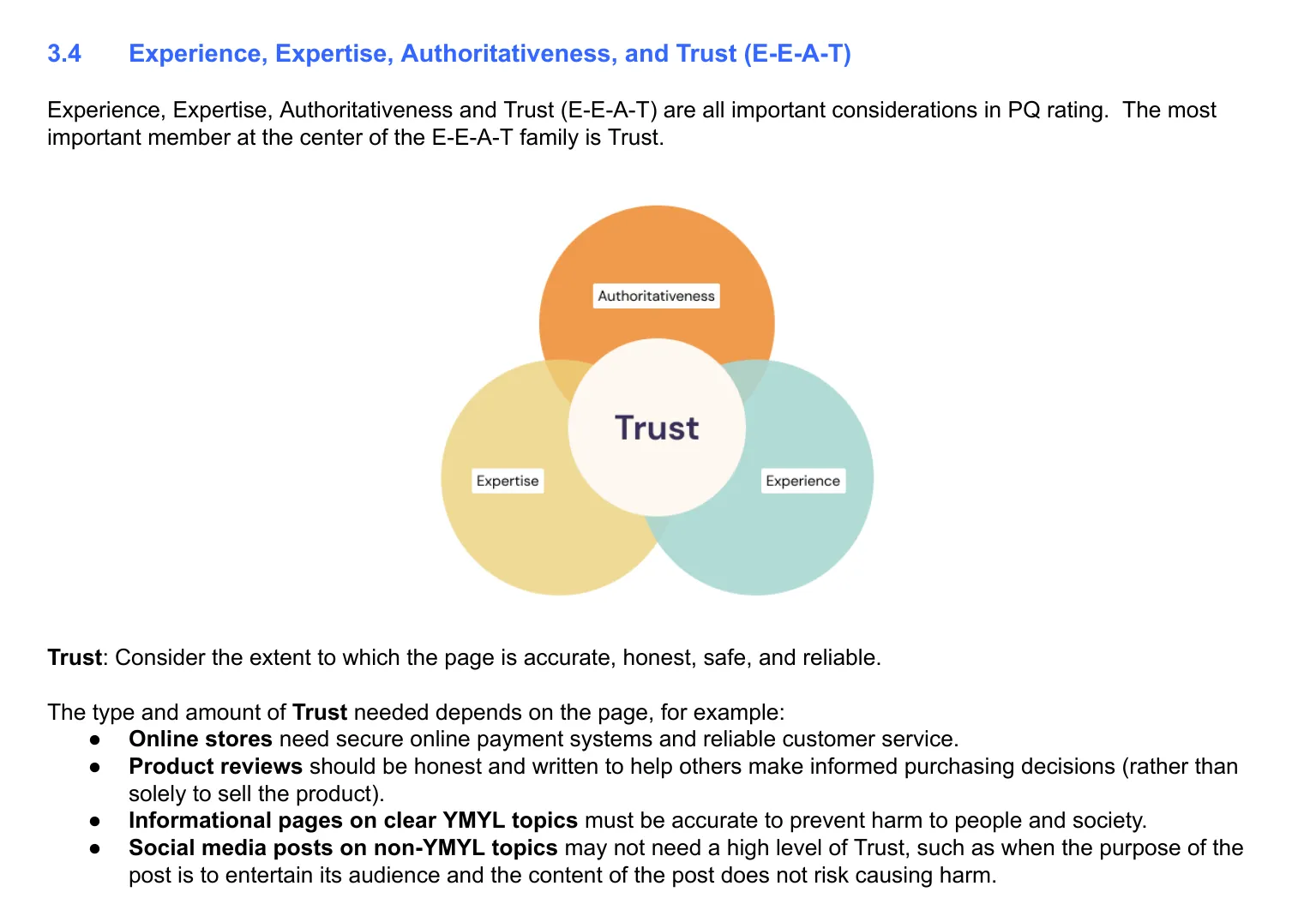
The guidelines say an untrustworthy page has low E-E-A-T however expert it looks. Their example is a scam run by a skilled scammer.
The first E is the newest. In December 2022, Google added experience to the older E-A-T. That is why many people still search for “Google EAT”.
Is E-E-A-T A Ranking Factor
Not on its own. Google’s page on creating helpful, reliable, people-first content says E-E-A-T itself is not a specific ranking factor. Its systems use a mix of signals that point to content with good E-E-A-T instead.
The raters do not set rankings either. The guidelines say no single rating directly changes how a page appears in Search. Google uses the ratings to measure how well its results work.
I read E-E-A-T as Google’s plain description of what its systems try to reward. Nobody outside Google can measure it directly. It still tells you what to put on a page.
What YMYL Pages Need
YMYL pages need the most E-E-A-T. YMYL stands for Your Money or Your Life. It covers topics that could seriously affect people’s health, money or safety, or the welfare of society. Google’s systems give even more weight to strong E-E-A-T on these topics.
The guidelines give two examples. Advice on when to go to the emergency room is clearly YMYL. Advice on how often to replace a toothbrush is not. By that test, the service pages of a clinic, insurer, bank or law firm are YMYL pages. A restaurant menu is not.
Is There An E-E-A-T Score
No. Google has never published an E-E-A-T score or a trust score. The scores in SEO tools are each tool’s own estimate. Google’s guidance on third-party SEO tools says such tools have no access to its internal ranking data.
Customers often ask us how an SEO tool’s trust score works. They want to know how to raise a low one. Find out what that tool measures first. Then fix what a customer would notice, such as missing company details, thin author pages or a lack of real reviews.
How E-E-A-T Carries Into AI Overviews And ChatGPT
For Google’s own AI features, the link is direct. Google’s guide to its generative AI features says AI Overviews and AI Mode are rooted in its core ranking and quality systems. Those systems pick the pages an answer is written from. A page they rate poorly is less likely to be cited.
Our post on AI Overviews explains how those sources are chosen.
The same guide asks for content that is more than a commodity. Its example compares two pages for first-time home buyers. One lists common tips. The other is one buyer’s own account of why they skipped a home inspection. The second page carries experience, the first E. The guide also warns against chasing fake mentions across the web. The AI features rely on Google’s spam systems as well as its quality systems, so those mentions help less than people expect.
OpenAI and Microsoft do not use Google’s term. Microsoft comes closest. A Microsoft Advertising guide says Copilot splits pages into smaller pieces. It checks each piece for authority and relevance before using it in an answer.
Why AI Recommends Other Firms When Your Site Says More
Because your own site is only part of the evidence. In our data, a brand’s own website was cited in only about a quarter of the AI answers about it. In 3,693 answers across 66 queries on agencies, SEO and AI search, Elevate, Primal’s AI Visibility Tracker, found Clutch, a review site, cited in about 4 of 10, more than any agency’s own site. A rival with a full profile on such sites and real client reviews gives the assistant something to cite that your site alone cannot.
Customers often ask us why the AI recommends other firms when their own site holds far more information. More pages on their own site would not change what the directories and reviews say about them. Our guide on how to get cited in AI search covers the steps.
What To Put On Your Site To Show E-E-A-T
Show who you are, who wrote each page, what you have done and where your facts come from. Google’s helpful content page asks three things of every page. Who made it, how, and why.
- Say who runs the business. Put the registered company name, address, phone number and email on an About or Contact page. Add the company registration number to the footer (in Malaysia, the SSM number). The guidelines ask for full contact details on sites that take payments or handle personal data.
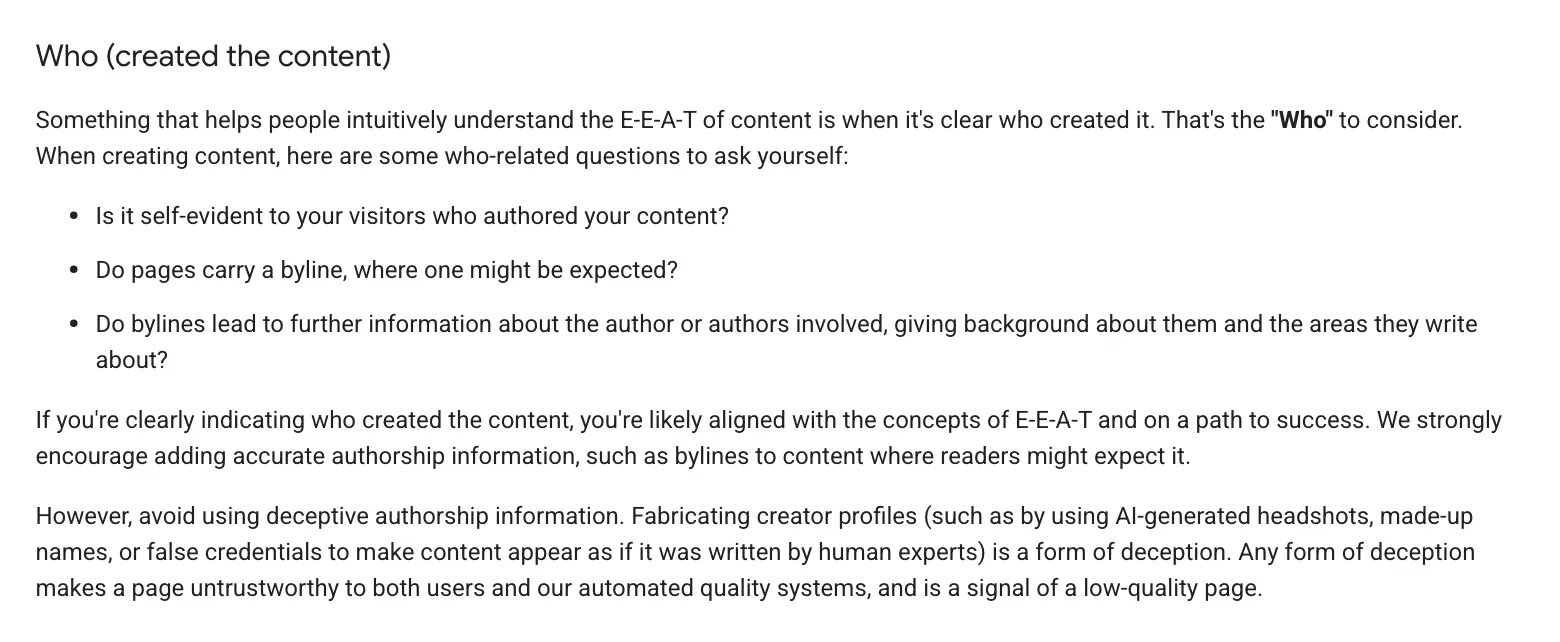
- Put a byline on every article and link it to an author page. Google asks whether bylines lead to more about the author and the subjects they write about.
- Fill each author page with facts a reader can check: role, years in the field, qualifications, licences and links to public profiles. Google warns that made-up profiles, such as AI-generated headshots, invented names or false credentials, make a page untrustworthy.
- Show first-hand work. Use your own photos, your own results and the steps from real jobs.
- Give a source for every figure and link to the original. Change a page’s date only when the content changes, because Google lists date changes made to look fresh as a warning sign.
- Keep your profiles off the site complete and current. Others read your Google Business Profile, your Facebook page and your directory listings. They also read marketplace pages and any register or industry body that lists you. Ask real customers for reviews, and never buy them.
- On YMYL pages, have a qualified person write or check the page, and say who they are on it.
Checks 2 and 3 come from Google’s helpful content page. Below is its part on who created the content.
The author pages on this site follow checks 2 and 3. Each article links to its writer’s page, which has sections for experience, education and awards. Each award links to a public page that lists it. The same facts go into structured data for the person, so search engines can read them too. Our guide to schema markup explains how.
Where To Start
Start outside your site. Search your business name the way a rater would and read what comes up, from reviews to directory profiles to news stories. Fix whatever would make a stranger doubt you. Then work through the seven checks on the pages that bring in enquiries, and on any YMYL pages.
Primal started in 2015 and has offices in Kuala Lumpur, Bangkok and Singapore. Our SEO team in Malaysia works on a site’s technical health, content and links. The same team covers AI search.
Frequently Asked Questions About Google E-E-A-T
Is Google EAT the same as E-E-A-T?
Yes. E-A-T, often written EAT, is the older name for expertise, authoritativeness and trust. Google added experience as a fourth part in December 2022, and the current rater guidelines use E-E-A-T.
Can AI-written content have good E-E-A-T?
It can. The rater guidelines say using generative AI does not decide a page’s rating on its own. Effort, originality and added value do. Google’s guidance on generative AI content asks site owners to check AI-generated text for accuracy before they publish it.
Does a small business need press coverage to show E-E-A-T?
No. The rater guidelines say small businesses may have little or no reputation information. They add that this is not a sign of high or low quality. Raters then look harder at the page itself and at who runs the site.
Do Google reviews help E-E-A-T?
Yes, when they come from real customers. Reviews are part of what others say about a business, one of the three places raters are told to look. Google reviews sit on your Business Profile. In our data, Google’s own Business Profile and Maps results were cited in the AI answers for 7 of the 12 brands.
Founder and Chief Executive Officer
Mark McDowell is the Founder and Chief Executive Officer of Primal, which he started in Bangkok in 2015. He is on the Forbes 30 Under 30 Asia 2020 list and was Campaign Asia’s Southeast Asia Young Achiever of the Year in 2018. He writes about AI search and search engine optimisation.
About The Author


